SMME & Employment Acceleration
Remove friction from SA's best short-term jobs engine
26
Ideas in this package
3.2/5
Average growth impact
Editorial assessment
3.0/5
Average feasibility
Editorial assessment
Decision Summary
The immediate move, the economic upside, and the coalition and delivery constraints that will determine whether this package actually lands.
Roadmap activity
4/14
Actions completed or in progress
Quick wins open
5
5 first-phase actions
High-severity risks
3
SEFA capitalisation constraints
Stakeholders in play
22
7 champions, 13 swing actors
Next Move
SMME Ombud Service operationalisation
In progress · DSBD
Economic Case
+0.8-1.2% GDP by 2030
R90bn private capital for a R45bn public anchor over 5 years.
Delivery Chokepoint
BizPortal 2.0 -> Reduced registration friction
Single-window registration is the prerequisite for all downstream SMME interventions — firms must exist formally before they can access SEFA, procurement set-asides, or Ombud protection.
Coalition Read
Anchor: Presidency / Operation Vulindlela
7 champions, 13 swing actors, 2 hard objections. Highest-leverage persuasion target: COSATU. Hardest resistance to manage: NUMSA.
South Africa's unemployment rate — above 40% on the expanded definition — is structurally unlike that of most middle-income countries. It is not primarily a macroeconomic problem amenable to demand stimulus, nor principally a skills problem that education spending alone can address. It is a market access and regulatory problem: millions of South Africans have skills, energy, and entrepreneurial ambition but face an entry environment designed, in effect, for large incumbents. The SMME & Employment Acceleration package is the growth diagnosticsGrowth Diagnostics: An analytical framework developed by Ricardo Hausmann, Dani Rodrik, and Andrés Velasco to identify the most binding constraint on economic growth in a specific country, allowing policymakers to prioritise high-return interventions. answer to why the private sector's job-creation engine is so persistently stalled.
The core friction is not capital — it is regulatory burden and market exclusion. BizPortal integration, compliance streamlining, and the SMME Ombud Service operationalisation are low-cost reforms achievable by ministerial directive within 12 months. They change the immediate experience of anyone attempting to formalise an enterprise. The second layer — procurement market access and SEFA mandate reform — requires institutional co-ordination but no major spending. The third layer — informal economy integration — addresses the hardest category: the 2–3 million South Africans in survivalist informal employment who are, in many cases, one regulatory accommodation away from productive formal participation.
Unusually among the reform packages, this one generates employment at essentially zero net fiscal cost. The HRV diagnostic suggests that for SMME growth, the binding constraintBinding Constraint: The most critical bottleneck limiting economic growth in a given context, as identified by the Hausmann-Rodrik-Velasco growth diagnostics framework. Addressing binding constraints yields the highest growth dividend relative to other reforms. is not low returns — small businesses in South Africa face high demand from an underserved population — but prohibitively high entry and survival costs. Removing these frictions is a genuine free lunch, which makes its persistence over three decades of democratic government something of a diagnostic puzzle.
Diagnostic Context
Binding Constraints Addressed
The primary binding constraint is market failure in small business entry and survival: regulatory friction, information asymmetries in credit markets, and systematic exclusion from procurement markets. In HRV terms, this is a microeconomic risk and coordination failure — the small business regulatory environment was designed for large formal enterprises and imposes disproportionate compliance costs on new and small firms. Secondary constraints include financial market failure (SEFA's limited risk-capital mandate relative to the scale of the gap) and missing markets for affordable business development services that would reduce the first-three-year failure rate of new enterprises.
Hausmann-Rodrik-Velasco growth diagnostics framework
Sequencing Rationale
Quick regulatory wins — BizPortal integration, the SMME Ombud, red-tape audits — are prioritised because they require no fiscal outlay and deliver visible early results that build political coalition for deeper reform. Procurement reform follows because it requires government-side process changes (payment timelines, set-aside thresholds, compliance requirements) rather than private sector behaviour change. Informal economy integration comes last because it requires both supply-side accommodation (dignified trading infrastructure, simplified tax registration) and demand-side behaviour change, which takes longer to achieve. Skills and access-to-finance reforms run throughout as enablers.
International Precedents
Rwanda's business environment reforms between 2005 and 2015 reduced the time to register a business from 16 days to 4 hours, contributing to a 7-fold increase in formal registrations and sustained 7–8% GDP growth — the key drivers were political commitment and digitalisation, not capital expenditure. Brazil's Simples Nacional system (2006) created a unified tax regime for small enterprises, reducing compliance costs by an estimated 90% for micro-businesses and bringing 7 million firms into the formal economy within 5 years. Colombia's formalisation programme combined simplified registration with tax incentives and business development services. Mexico's experience with procurement set-asides demonstrates that market access reform can shift supplier composition without sacrificing value for money.
Expected Economic Impact
The package targets 400,000–600,000 net new formal jobs over 5 years, primarily in services, retail, construction, and light manufacturing. Procurement market access reform is estimated to redirect R50–80 billion annually toward qualifying small enterprises, generating secondary income multiplier effects. Formalisation of informal economy participants could add R30–50 billion to the national tax base within 5 years. International evidence suggests reducing business entry costs by 50% — achievable through full BizPortal integration — increases registered business numbers by 25–40%, and that simplified tax compliance correlates with 15–25% higher SMME survival rates at the 3-year mark.
Theory of Change
With formal employment growing at under 1% per year and the unemployment rate structurally above 30%, the only credible near-term jobs engine is small and medium enterprise growth. SMMEs account for roughly 60% of employment but face a regulatory environment ranked among the most burdensome in sub-Saharan Africa: multi-step compliance, slow dispute resolution, constrained access to finance, and procurement markets effectively closed to new entrants. Each layer of friction is a lost job.
This package attacks friction directly. Red-tape reduction and BizPortal integration can be achieved by regulatory amendment alone — they are quick wins. SEFA mandate reform and SMME procurement enforcement require institutional alignment but no new spending. The informal economy integration reforms have the longest political economy, but even partial progress — simplified tax registration, dignified trading infrastructure — expands the base. Taken together, the package targets the regulatory and financial bottlenecks identified by the Presidential SMME Summit as the binding constraints on small-business job creation.
Fiscal Impact Estimates
Scenario estimates — not official government projections. See full methodology.
Public investment
R45bn
over 5 years
+ R90bn private capital catalysed
GDP impact
+0.8–1.2%
by 2030
Jobs created
~550k
direct + indirect
Annual revenue uplift
R32bn/yr
break-even ~5 years
Revenue uplift through broadened income-tax and VAT base as informal workers formalise. Employment Tax Incentive (ETI) expansion costs R5bn/yr but is offset by PAYE gains within 3 years of job creation.
Ideas by Time Horizon
Sequencing from quick regulatory wins through institutional reform to structural change.
Productivity SA and Workplace Competitiveness Support
Productivity SA provides turnaround assistance to distressed companies, offering an alternative to retrenchment through workplace restructuring and competitiveness improvement. The entity operates on a modest budget (~R200m) relative to its potential impact. The committee has reviewed Productivity SA quarterly performance alongside CCMA and NEDLAC, noting that early intervention in struggling firms prevents the need for section 189 retrenchment processes. The 2025 BRRR recommended increased allocation to scale turnaround support, particularly for labour-intensive sectors facing structural transition.
Employment Tax Incentive (ETI) Extension and Expansion
The Employment Tax Incentive (ETI), introduced in 2014, provides wage subsidies to employers hiring workers aged 18-29 earning below R6,500/month. Treasury estimates the ETI supports approximately 700,000 jobs annually at a fiscal cost of ~R6bn. Parliamentary review has examined deadweight losses and proposals to expand eligibility beyond the current age and wage thresholds. With youth unemployment above 60%, the committee has debated whether a more generous or broader ETI could meaningfully shift the employment curve.
CCMA Capacity and Case Resolution Reform
The CCMA handles over 200,000 dispute cases annually but faces chronic under-resourcing, with commissioner vacancy rates above 20% in some regions. The committee has tracked rising caseloads, noting that conciliation settlement rates have declined from historic highs. Digitisation of case management and virtual hearings — accelerated during COVID — offer efficiency gains but require sustained investment. The 2025/26 BRRR recommended increased CCMA funding and faster commissioner appointments to reduce average case resolution times from the current 30+ days.
Cannabis and Hemp Industry Licensing Rationalisation
South Africa's cannabis and hemp sector sits at the intersection of agricultural development, industrial policy, public health regulation, and criminal justice reform. The regulatory landscape has been shifting rapidly: hemp was recognised as an agricultural crop in 2022, since when the Department of Agriculture has issued 2,031 cultivation permits. In December 2025, the permissible THC threshold for hemp plants was raised from 0.2% to 2%, significantly expanding the range of commercially viable cultivars. The Hemp and Cannabis Commercialisation Policy is expected to reach Cabinet for approval and public comment by April 2026. An Overarching Cannabis Bill — consolidating the Cannabis for Private Purposes Act (2024), commercial cultivation, manufacturing, and research regulations — is being drafted across DTIC, DAF, DoH, and DoJCD for presentation to Parliament by mid-2027. SAHPRA administers medicinal cannabis licensing. The Department of Trade, Industry and Competition's National Cannabis Master Plan identifies export of medicinal cannabis to the EU, UK, and US as a priority revenue opportunity, with South Africa's climate and soil conditions competitive with established producers in Colombia and Morocco. Provincial recognition frameworks for traditional cannabis growers — particularly in the Eastern Cape and KwaZulu-Natal — address social equity in the sector's formalisation.
SMME Red Tape Reduction: BizPortal and Compliance Integration
Starting and formalising a small business in South Africa requires navigating multiple registration systems — CIPC for company registration, SARS for tax, UIF and COIDA for employment, and multiple municipal licensing bodies. BizPortal, launched by CIPC, offers a single digital entry point but integration with SARS eFiling, municipal systems, and sector-specific licences remains incomplete. The reform agenda involves full interoperability between BizPortal, SARS, the Department of Labour's systems, and provincial licencing databases, enabling a business to complete all regulatory obligations in a single online session. Red tape reduction directly affects SMME formation rates and formalisation of informal businesses. The Presidential Working Group on Small Business has identified compliance fragmentation as a top constraint. As of early 2026, BizPortal handles basic registrations but multi-agency integration milestones are behind schedule.
National Small Enterprise Amendment Act: Ombud Service Operationalisation
The National Small Enterprise Amendment Act (2023) established an Ombud for Small and Medium Enterprises to adjudicate disputes between SMEs and large enterprises or government, particularly around payment delays and contract disputes. Late payment by government and large corporates is a major liquidity constraint for small businesses; the average payment period to SMEs from government entities exceeds 90 days, far beyond the legislated 30-day requirement. The Ombud's operationalisation — appointing staff, developing dispute resolution procedures, and publicising the service — was progressing as of early 2026 but remains incomplete. Effective enforcement could recover significant working capital for the SME sector and deter exploitative contract practices. The office complements SEDA's business support role and the Payment of Suppliers regulations under the PFMA, which have had limited enforcement success to date.
SMME Regulatory Burden Reduction
South Africa's regulatory environment imposes disproportionate compliance costs on small and medium enterprises. Before the World Bank discontinued Doing Business, SA ranked poorly on starting a business, paying taxes (27 annual payments vs. OECD average of 11), and enforcing contracts (average 600 days). The SMME Regulatory Burden Reduction reform — coordinated by the Presidency's Operation Vulindlela unit with the DSBD — targets the highest-friction touchpoints: business registration (CIPC BizPortal digitisation, targeting 1-day company registration), tax compliance (SARS SME relief packages and turnover tax simplification for firms below R1 million turnover), municipal licensing (SPLUMA compliance rationalisation), and labour law compliance costs (CCMA access for small employers). The Presidency's Red Tape Reduction impact assessment (2024) identified an estimated 12 million regulatory-hours per year lost by SMMEs to compliance administration — equivalent to 6,000 full-time workers doing nothing but paperwork. BizPortal, live since 2020, processed fewer than 20% of new business registrations by 2024 due to poor SARS-CIPC system integration. The reform also proposes a single SMME compliance certificate valid across municipalities, reducing the multi-municipal registration burden for mobile businesses.
NEDLAC Social Compact on Employment and Growth
NEDLAC, the tripartite social dialogue institution, brings government, business, labour, and community constituencies together to negotiate structural reform. The committee has monitored NEDLAC performance quarterly, noting both successes (minimum wage negotiations) and failures (stalled labour law amendments). A binding social compact on growth — modelled on the Irish social partnership model — would require wage moderation commitments from labour, investment commitments from business, and reform delivery from government.
Labour Activation Programme for Long-Term Unemployed
South Africa has 8 million unemployed and an additional 4 million discouraged work-seekers — the highest unemployment rate among major economies. Active labour market programmes combining skills training, work experience, and placement services have been debated as an alternative to passive social transfers. The committee held dedicated workshops in 2025 on activation strategies, examining models from Brazil and India. The Presidential Youth Employment Intervention and Social Employment Fund represent existing activation efforts, but scale remains inadequate.
Compensation Fund Turnaround and Claims Backlog
The Compensation Fund, which covers occupational injuries and diseases, has a claims backlog exceeding 100,000 cases and IT systems dating from the 1990s. The Auditor-General has issued consecutive adverse audit opinions. Employer non-compliance with registration and contributions compounds the backlog. Parliamentary oversight has documented systemic processing failures and the impact on injured workers who wait years for compensation. The committee has called for a comprehensive turnaround strategy including migration to modern digital claims management.
Unemployment Insurance Fund (UIF) Governance and Benefit Reform
The Unemployment Insurance Fund holds assets exceeding R200bn but has faced governance failures, investment losses, and processing delays. The committee has scrutinised quarterly performance, including the gap between contribution income and benefit payouts during mass retrenchment events. COVID-era TERS payments exposed systemic weaknesses in claims processing and fraud prevention. The fund is structurally sound financially but operationally dysfunctional — reforms focus on IT modernisation, claims automation, and investment governance aligned with the PIC Act.
National Minimum Wage Review and Adjustment Mechanism
The National Minimum Wage, set at R27.58 per hour in 2024, is reviewed annually by the National Minimum Wage Commission. Parliamentary hearings have examined whether the NMW has reduced in-work poverty or depressed employment in vulnerable sectors — agriculture and domestic work have lower sectoral rates. With strict unemployment at 31.9% (Q4 2024), the tension between adequate wages and employment absorption remains central. The committee has questioned the adequacy of the annual CPI-plus adjustment formula and whether it accounts for productivity differentials across sectors.
Just Energy Transition SMME Finance Facility
South Africa's Just Energy Transition (JET) Investment Plan commits R1.5 trillion over 20 years to transition away from coal, creating significant commercial opportunities in renewable energy installation, energy efficiency retrofitting, battery storage, and green manufacturing. Most of these opportunities require upfront capital that small and medium enterprises cannot easily access through commercial banks, which apply standard credit criteria penalising early-stage energy companies. The DSBD, in coordination with the Small Enterprise Finance Agency (SEFA), is developing a dedicated JET-SMME Finance Facility providing blended first-loss instruments, technical assistance grants, and revenue-based financing. The facility would complement the International Partners Group's $8.5 billion JET-IP commitments, which are directed primarily at large infrastructure.
Enterprise and Supplier Development: Corporate Linkage Programme
The Enterprise and Supplier Development (ESD) element of BBBEE scorecards requires corporations rated above Level 5 to invest 3% of net profit after tax in developing black-owned suppliers and enterprises. Estimated annual ESD investment of R8–12 billion from complying corporations represents a major but poorly managed private sector development finance flow: much ESD spend is directed toward single-year grants, soft-skills training, or preferential procurement clauses that expire with the scorecard cycle, rather than toward multi-year supplier relationship development. The Corporate Linkage Programme reform proposes: restructuring ESD codes to require multi-year supplier development contracts (minimum 3 years), integration of ESD suppliers with the SEDA Supplier Development Hubs and IDC's SME Finance programme, mandatory ESD supplier registration on the Central Supplier Database to create a bankable track record, and a DTI-administered ESD impact measurement framework (currently ESD is self-reported with minimal verification). The PC on Trade BRRRs identify ESD as the BBBEE element with the largest gap between scorecard compliance and developmental impact.
Informal Economy Integration: Simplified Tax and Municipal Trading Infrastructure
South Africa's informal economy employs an estimated 2.8-3.2 million workers predominantly in retail, food vending, and household services, but operates largely outside the formal regulatory and tax system. SARS's Turnover Tax regime for businesses below R1 million annual turnover has seen slow uptake due to administrative complexity, while municipal trading infrastructure — market stalls, ablution facilities, electricity connections — is chronically inadequate in most townships and CBDs. The DSBD's Informal Economy Policy Framework (2019) and Operation Vulindlela's work on the spatial economy identify informal economy formalisation as an untapped labour market and fiscal resource. This reform combines SARS simplification with COGTA/SALGA-driven municipal infrastructure investment to lower the cost of formalisation.
SEDA Digital Transformation and Specialist Sector Hubs
The Small Enterprise Development Agency (SEDA) operates a network of over 50 enterprise development centres providing business advisory, training, and incubation services across South Africa, but a 2024 DSBD performance review found that services are perceived as generic, insufficiently linked to market demand, and inaccessible in deep rural areas and townships. Reform proposals include transitioning from generic advisory to sector-specialist hubs covering agri-processing, ICT, tourism, and the creative economy; deploying digital service delivery for basic advisory functions to extend geographic reach; and establishing outcome-based performance contracts for SEDA tied to measurable enterprise growth and job creation metrics. The PC on Small Business Development's BRRRs repeatedly flagged SEDA's high administration spend (over 40% of budget) versus actual enterprise impact.
SEFA Mandate Refocus: Growth-Oriented SMME Finance
The Small Enterprise Finance Agency (SEFA), a subsidiary of the IDC, provides development finance to SMMEs and cooperatives through direct loans and wholesale lending via microfinance intermediaries. Its R2.5 billion annual deployment has been criticised by the PC on Small Business Development for: over-concentration in working capital (short-term) loans rather than growth capital (equipment, premises, expansion), excessive concentration in Gauteng (55% of portfolio) relative to provincial SMME distributions, high non-performing loan rates (above 30% in several years), and insufficient linkage with the SEDA business support ecosystem. The mandate refocus reform proposes: a 40% minimum allocation to manufacturing and agro-processing (sectors with multiplier effects), dedicated provincial deployment targets aligned with the SMME policy, a non-performing loan recovery strategy that preserves lending capacity, and a blended finance partnership with the Jobs Fund to de-risk equity investments in high-growth SMMEs. The SMME Equity Fund (proposed in the 2024 Budget) would complement SEFA's debt offering.
Government SMME Procurement: Enforcing the 30% Set-Aside
National Treasury Instruction 3 of 2021/22 mandated that all national and provincial departments reserve 30% of all procurement contracts for Small, Medium, and Micro Enterprises (SMMEs), township enterprises, and cooperatives—an estimated R120 billion per year in procurement that should flow to small businesses. However, compliance monitoring reveals that most departments meet the target on paper by disaggregating existing contracts and awarding sub-components to SMME subcontractors, without genuinely transferring the supply chain relationship or management capacity. The reform proposes: a reclassification of SMME procurement compliance to require direct prime contracts (not subcontracts) for the 30%, mandatory Supplier Development Plans where large contractors are awarded above-threshold contracts, BizPortal integration with CSD to make SMME registration and procurement participation seamless, and monthly compliance reporting to the PC on Small Business Development. The DSBD's SMME Barometer (2024) estimates that only 18% of the 30% target is achieved through genuine prime SMME contracts. The Jobs Fund impact evaluation (2023) found that supply chain SMME development has the highest employment multiplier of any DSBD programme.
Expanded Public Works Programme Reform: Towards Skills Pathways
The Expanded Public Works Programme (EPWP) has created over 14 million work opportunities since 2004, primarily in labour-intensive construction, environmental care, and social sector activities, but has been criticised for offering short-term, low-wage employment with minimal skills transfer and for susceptibility to political patronage at municipal level. Reform proposals include linking EPWP participation to formal artisan training under TVET college or SETA frameworks, establishing minimum training hours and certification requirements per project, and shifting the programme toward infrastructure maintenance where community-based workers can develop durable skills. The PC on Public Works' BRRRs flag inconsistent reporting and absence of post-EPWP employment outcome data as persistent governance gaps.
Minibus Taxi Formalisation and Digital Integration
South Africa's minibus taxi industry transports approximately 15 million passengers daily—two-thirds of all public transport users—through 250,000 vehicles operated by 16,000 taxi associations, generating an estimated R90 billion in annual revenue largely outside the formal financial and regulatory system. Taxi formalisation has been attempted through the Taxi Recapitalisation Programme (TRP, 2006), which paid scrapping allowances for old vehicles, and subsequent digitisation proposals, without achieving meaningful formalisation. The current reform agenda focuses on: mandatory electronic payment integration (the Golden Arrow/Dial-A-Ride model for taxi routes), GPS tracking and route permit digital verification through the National Public Transport Regulator, taxi industry association incorporation as Cooperatives or SOC structures (enabling access to SEFA and SITA procurement), and fare regulation within integrated transport frameworks. The R1.8 billion Taxi Relief Fund (COVID-era) demonstrated that direct financial engagement with the industry is possible. The PC on Transport BRRRs flag ongoing taxi violence (linked to route competition) and the absence of meaningful labour protection for taxi drivers as governance failures. Minibus taxi formalisation is a precondition for effective IPTN integration.
Cooperative Banks Development and Township Financial Inclusion
South Africa's Cooperative Banks Development Agency (CBDA), established under the Cooperative Banks Act (2007), oversees approximately 40 registered cooperative financial institutions (CFIs) with combined assets under R500 million — tiny relative to the formal banking sector. The reform agenda seeks to grow CFIs in township and rural areas to provide affordable savings, credit, and payment services to the unbanked. Proposals include: an amended Cooperative Banks Act to create a tiered licensing framework with lower capital thresholds for community-level savings groups; SARB supervisory ring-fencing for CFIs below R50 million in assets; blended finance first-loss facilities through the IDC; and integration with the Post Bank's township payments infrastructure. The FSD Africa and UNCDF have co-funded pilot CFI capacity programmes in KZN and Gauteng townships.
Land Bank Recapitalisation and Agricultural Finance Refocus
The Land and Agricultural Development Bank (Land Bank) entered a debt standstill in 2020 after a R5 billion guarantee call triggered a liquidity crisis. Government provided R10 billion in recapitalisation between 2021 and 2024, restructured the loan book, and replaced board and management. The strategic refocus targets a shift from commercial farmer financing (previously 85% of the book) toward emerging Black farmers, smallholders, and agri-processing enterprises under the DALRRD's land reform programme. The Land Bank Amendment Act (2023) clarified its development mandate and SARB exemption status. Key challenges: non-performing loan legacy, procurement of agricultural insurance, and integration with Blended Finance instruments (USAID, DFI co-funding). Parliament's PC on Agriculture has monitored the turnaround, noting improved liquidity but ongoing NPL concerns.
Informal Economy Integration and Worker Protection
South Africa has approximately 3 million informal economy workers — street traders, waste pickers, domestic workers, and platform gig workers — most of whom lack basic labour protections, UIF coverage, or occupational health insurance. The committee has examined the gap between formal labour law and the reality of informally employed South Africans, including hearings on elder care, farm worker conditions, and CEDAW compliance. Platform work (e-hailing, delivery) has grown rapidly without clear regulatory coverage. Extending basic social security and dispute resolution to these workers is a recognised gap.
Section 189 Retrenchment Process Reform
Sections 189 and 189A of the Labour Relations Act govern large-scale retrenchments, requiring 60-day consultation periods and social plans for employers with 50+ employees. The committee held workshops in November 2025 examining whether current protections are adequate following major job losses in manufacturing and mining. Organised labour argues consultation periods are performative; business argues the process is too rigid for firms in genuine financial distress. Proposed amendments would strengthen mandatory social plan requirements while streamlining timelines for companies in business rescue.
Cooperative Development: Outcome-Based Redesign
South Africa's cooperative development programme, administered by the DSBD through the Cooperatives Incentive Scheme (CIS) and SEDA incubation, has disbursed hundreds of millions in grants since the Cooperatives Act (2005) yet produced few sustainable, scaled cooperative enterprises — a DSBD evaluation found an 80-90% failure rate within five years. The proposed outcome-based redesign replaces upfront capital grants with patient development capital linked to revenue milestones, restricts support to cooperatives in sectors with demonstrated market demand (particularly construction, waste, and community services), and mandates technical skills development alongside financial support. The IDC's cooperative financing window provides a model for scaling to smaller entities under DSBD's remit.
Urban Land Release for Affordable Housing and Infrastructure
DPWI and other national departments own significant well-located urban land — including former military bases, unused state hospitals, and surplus government offices — that is not being used productively. Releasing these parcels for affordable housing, mixed-use development, or social infrastructure could dramatically reduce the cost of urban land for low-income housing programmes without requiring expropriation. Operation Vulindlela identified public land release as a Phase I priority but progress has been slow due to inter-departmental coordination failures, disputes over land valuations, and competing departmental claims. A centralised Land Release Coordinating Committee with National Treasury, DPWI, DHS, and DTIC representation, backed by a Cabinet directive with implementation deadlines, is the proposed governance mechanism.
Reform Dependencies
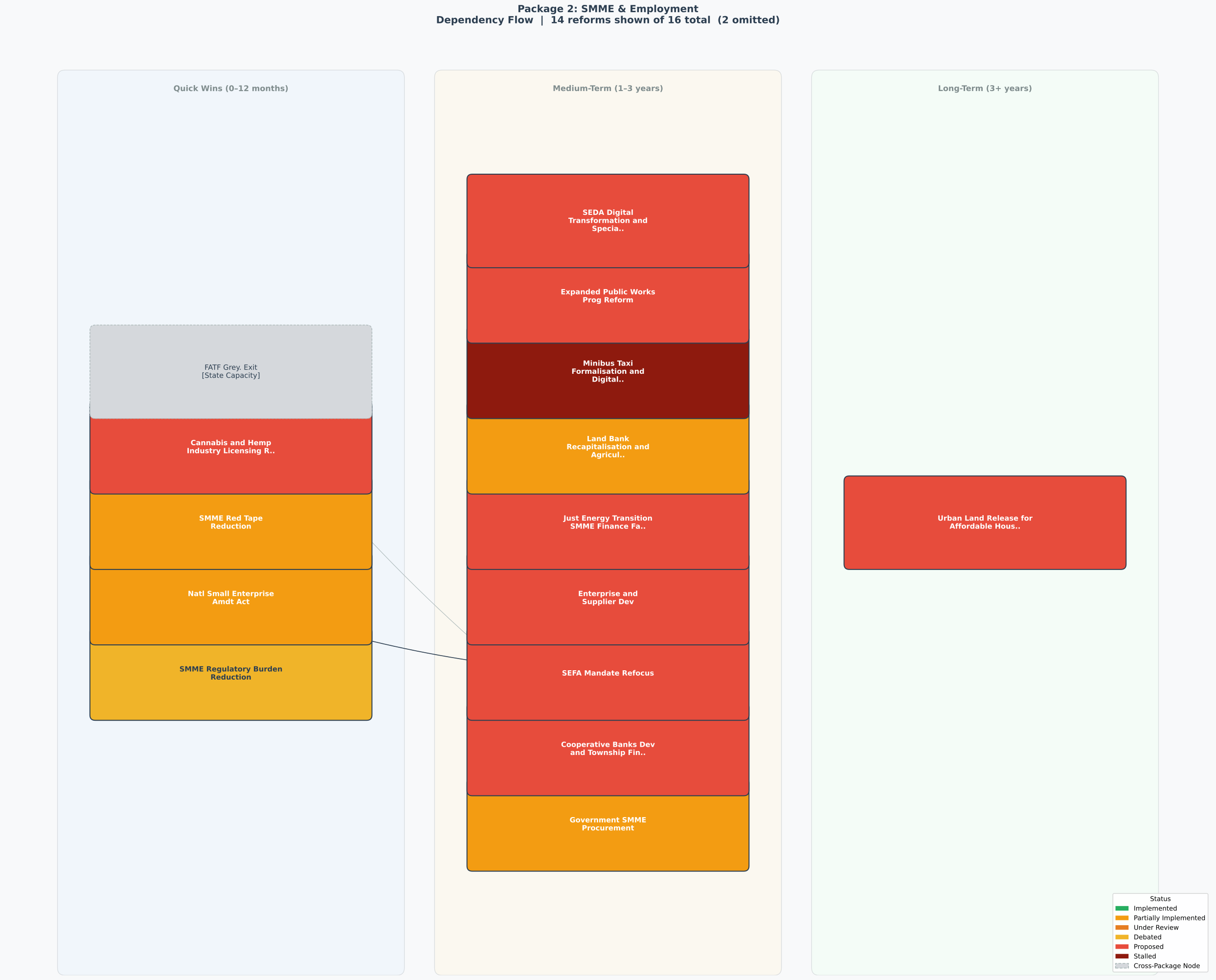
Which reforms in this package enable or unlock others.
SMME Ombud builds confidence underpinning SEFA financing
SMME 30% procurement set-aside creates enterprise market linkages
SEFA mandate refocus enables just energy transition SMME finance
BizPortal red-tape platform delivers SMME regulatory burden relief
BizPortal platform infrastructure supports SEDA digital transformation
BizPortal enables streamlined informal economy business registration
SMME Ombud enforcement builds credibility of 30% procurement set-aside
Ombud service provides dispute resolution protecting enterprise development participants
Government procurement set-aside creates loan demand enabling SEFA mandate refocus
SEDA specialist hubs connect SMMEs to corporate supply chains
Cooperative development programme expands cooperative banking clientele
Informal economy formalisation creates new cooperative banking members
Land Bank agricultural finance model informs SEFA rural SMME finance approach
SMME regulatory burden reduction creates political mandate for BizPortal integration
Minimum wage review requires NEDLAC social compact
UIF reform enables Compensation Fund turnaround
Dependency Flow Diagram
See all packages →Visual map of how reforms in this package sequence and unlock each other.
Implementation Roadmap
Sequenced action plan from quick regulatory wins to structural reform, with key dependencies, success metrics, and risk factors.
Activate the Small Enterprise Ombud Service under the National Small Enterprise Amendment Act 2023. The Ombud resolves B2B payment disputes between SMMEs and large firms without court action — a critical cash flow protection mechanism.
Integrate CIPC, SARS tax registration, UIF, Workmen's Compensation, and business bank account opening into a single digital registration journey. Reduce business registration from 5 days and 6 agencies to 1 day.
Issue a binding directive under the PFMA requiring all national departments and public entities to pay SMME invoices within 30 days. Direct instruction from the Presidency under Operation Vulindlela.
Publish a model municipal by-law permitting home offices, tutoring, repair workshops, and small-scale food production in residential zones. Reduces regulatory barrier for the most accessible entry point to self-employment.
Issue regulations exempting enterprises below R10m turnover from BBBEE verification fees and simplifying annual compliance reporting. Reduces regulatory burden on the smallest firms.
Increase SEFA's capitalisation and annual lending envelope from ~R2.5bn to R8bn. Requires National Treasury allocation and a revised SEFA mandate prioritising direct lending over wholesale (blended finance vehicles).
Mandate that 30% of all government tenders above R500,000 be awarded to qualifying SMMEs and cooperatives. Implement monitoring through NT procurement portal and publish quarterly compliance reports.
Introduce a simplified presumptive tax for informal traders below R500k turnover, and develop dignified urban trading infrastructure (covered markets, ablution facilities, storage) in at least 20 municipalities.
Designate 50 township enterprise zones with simplified zoning, infrastructure grants, and reduced municipal levies. Builds on Gauteng and Western Cape pilot programmes.
Increase CCMA commissioner capacity and implement a 30-day maximum for conciliation and arbitration of unfair dismissal and labour disputes. Reduces employment uncertainty for small firms.
Design and implement a replacement for the Section 12J venture capital incentive (expired 2021) focused on early-stage SMME equity. Target R5bn in private co-investment over 3 years.
Enable credit bureaux and banks to use alternative data (utility payments, mobile money, SARS tax history) for SMME credit assessment. Unlock formal finance for the estimated 700,000 creditworthy but unscored small firms.
Establish a dedicated development finance institution for SMMEs, consolidating SEFA, NEF small-business functions, and SEDA financial services. Modelled on Germany's KfW or Brazil's BNDES SME division.
Achieve 500,000 new formal business registrations from the informal sector by 2030 through combined incentives: tax simplification, social protection eligibility, access to public procurement.
Key Dependencies
Single-window registration is the prerequisite for all downstream SMME interventions — firms must exist formally before they can access SEFA, procurement set-asides, or Ombud protection.
Government late payment is the most commonly cited cash flow killer for small suppliers. Rule enforcement is a no-cost intervention with immediate impact on SMME viability.
Without adequate capitalisation, SEFA cannot serve as a meaningful alternative to commercial banks for SMME lending. NT budget allocation is the binding constraint.
Success Metrics
| Metric | Current | Target | By |
|---|---|---|---|
| New business registrations (annual) | ~430,000 per year (CIPC 2023) | 520,000 per year (+20%) | 2026 |
| Business registration time | 5 days (multiple agencies) | 1 day (BizPortal) | 2025 |
| Government 30-day payment compliance | ~50% (National Treasury estimate) | 90% | 2026 |
| SEFA annual disbursements | R2.5bn | R8bn | 2027 |
| SMME share of government procurement | ~18% | 30% | 2028 |
Risk Factors
Municipalities jealously guard zoning and trading by-laws as revenue sources. Home-based business and informal trading reforms face pushback from local government officials and established business associations.
National Treasury's fiscal consolidation programme limits new allocations to SEFA. Without additional capital, the lending envelope expansion cannot materialise.
Existing procurement relationships and compliance complexity favour large incumbents even under set-aside rules. Enforcement of the 30% SMME set-aside requires active monitoring and consequences for non-compliance.
SMME owners consistently cite Labour Relations Act and BCEA dismissal procedures as a reason to avoid formal employment. Without LRA amendment, formal job creation remains constrained.
Informal traders and taxi operators represent organized constituencies. Formalisation and trading infrastructure reforms can trigger political backlash if poorly sequenced.
Key Stakeholders
Major actors with a stake in this reform package, ranked by influence. Full stakeholder map →
Presidency / Operation Vulindlela
Influence
10/10
Cross-cutting structural reform coordination across energy, logistics, water, digital infrastructure, and visa reform. Operation Vulindlela,…
National Treasury
Influence
9/10
Fiscal consolidation with public debt stabilising below 75% of GDP; structural reforms that improve revenue without expanding contingent lia…
COSATU
Influence
9/10
Worker protections under the Labour Relations Act and Basic Conditions of Employment Act; collective bargaining rights; equitable wage growt…
South African Reserve Bank
Influence
8/10
Price stability under the 3–6% inflation targeting framework; financial system stability under the Twin Peaks prudential model; integrity of…
Business Unity South Africa (BUSA)
Influence
8/10
Cross-sector structural reform across energy security, logistics efficiency, regulatory certainty, labour market flexibility, and digital in…
DTIC (Dept. of Trade, Industry & Competition)
Influence
7/10
Industrial policy objectives — local content requirements, beneficiation, BBBEE transformation, SEZ development, and protection of manufactu…
Transnet
Influence
7/10
Recovering operational and financial capacity after state capture-era looting that cost over R100bn; maintaining port and rail network as th…
Business Leadership South Africa (BLSA)
Influence
7/10
CEO-level advocacy for structural reform across energy, logistics, digital infrastructure, and investment climate. Runs the CEO Initiative o…
Minerals Council South Africa
Influence
7/10
Investment certainty and mineral rights security under the MPRDA; energy cost and reliability for deep mining operations (SA mines are among…
Competition Commission
Influence
7/10
Reducing market concentration and promoting effective competition across freight, telecoms, financial services, food retail, and healthcare.…
NUMSA
Influence
7/10
Metalworker and Eskom employee livelihoods; opposition to the IPP model and Eskom unbundling; preserving state ownership of the electricity…
ICASA
Influence
6/10
Spectrum licensing and management; competition regulation in electronic communications; consumer protection; broadband connectivity targets…
SAFTU
Influence
6/10
Anti-austerity fiscal policy; nationalisation of strategic sectors; worker and community ownership of public enterprises; opposing structura…
World Bank Group
Influence
6/10
Structural reform technical assistance and Development Policy Loan financing conditional on reform milestones; energy transition support thr…
Dept. of Public Enterprises (DPE)
Influence
5/10
SOE restructuring and shareholder oversight under the PFMA; balancing Eskom and Transnet restructuring with employment protection; implement…
PRASA
Influence
5/10
Commuter rail rehabilitation and rolling stock procurement; urban mobility for low-income commuters; PRASA Modernisation Programme recovery;…
OUTA
Influence
5/10
Fiscal accountability and value for money in public spending; SOE governance and transparency; infrastructure pricing fairness; opposing was…
IMF
Influence
5/10
Fiscal sustainability with public debt stabilising below 80% of GDP; current account stability; SOE contingent liability management; labour…
AgriSA / Commercial Agriculture
Influence
5/10
Water allocation security for irrigation agriculture; water user association governance and infrastructure investment; logistics access for…
African Development Bank
Influence
4/10
Infrastructure financing for energy, transport, and water with a regional integration lens; REIPPP co-financing; logistics corridor investme…
Portfolio Committee on Transport (Parliament)
Influence
4/10
Legislative oversight of Transnet, PRASA, and SANRAL; transport policy bills and amendments; concessioning legislation for ports and rail; p…
Public Affairs Research Institute (PARI)
Influence
3/10
Evidence-based institutional reform; state capacity building across national and subnational government; governance quality analysis; docume…
How to cite
Wilse-Samson, L. (n.d.). SMME & Employment Acceleration. SA Policy Space. https://sa-policy-space.vercel.app/packages/2 Live page. Data version: 2026-10-12.218dea82; data as of: 2026-10-12.
Data as of 2026-10-12 · latest PMG meeting 2026-10-09