Human Capital Pipeline
Invest now because the lags are a decade long
30
Ideas in this package
3.5/5
Average growth impact
Editorial assessment
3.1/5
Average feasibility
Editorial assessment
Decision Summary
The immediate move, the economic upside, and the coalition and delivery constraints that will determine whether this package actually lands.
Roadmap activity
6/15
Actions completed or in progress
Quick wins open
5
5 first-phase actions
High-severity risks
3
Teacher union resistance to curriculum reform
Stakeholders in play
17
6 champions, 10 swing actors
Next Move
National Reading Programme — 1,000 priority schools
In progress · DBE / Provinces
Economic Case
+1.2-2% GDP by 2035
R35bn private capital for a R180bn public anchor over 7 years.
Delivery Chokepoint
Foundation literacy (Grades 1–3) -> Secondary school completion
Children who cannot read for meaning by Grade 4 rarely recover academically. Foundation literacy is the single highest-leverage intervention in the human capital pipeline.
Coalition Read
Anchor: Presidency / Operation Vulindlela
6 champions, 10 swing actors, 1 hard objection. Highest-leverage persuasion target: National Treasury. Hardest resistance to manage: SERI (Socio-Economic Rights Institute).
No middle-income country has sustained 5% growth with 30% youth unemployment and a literacy crisis affecting the majority of its primary school children. South Africa's human capital deficit is simultaneously its deepest structural problem and its most expensive to fix — deep because it compounds across generations, expensive because the lags between investment and outcome stretch 8–15 years. The Human Capital Pipeline package begins from this uncomfortable arithmetic: South Africa cannot grow its way out of inequality without fixing its schools, but fixing schools takes a decade. The time to start is therefore not tomorrow.
The package's anchor is the literacy crisis. PIRLS 2021 placed only 19% of South African Grade 4 children at the reading-for-meaning benchmark — the worst outcome of any middle-income country tested. A child who cannot read by Grade 4 has a dramatically reduced probability of completing secondary school, accessing TVET, or participating in the formal labour market as an adult. Foundation Phase literacy is therefore not merely an education metric but a labour market policy intervention with a 10-year lag. ECD expansion, mother-tongue instruction fidelity, and structured literacy programmes in Grades 1–3 are the highest-return human capital investments South Africa can make.
TVET reform and health system strengthening run in parallel because the current skill composition of the labour market is misaligned with demand, and because health outcomes — TB prevalence, untreated mental illness, primary care access — directly reduce workforce capacity. South Africa spends comparably to higher-performing peers as a share of GDPGDP — Gross Domestic Product: The total monetary value of all goods and services produced within a country's borders in a given period. The primary measure of an economy's size and overall output. on education; the problem is not resources but institutional delivery quality.
Diagnostic Context
Binding Constraints Addressed
The binding constraint is low human capital quality — a case of low social returns arising not from inadequate public spending but from institutional failure in delivery. In the HRV diagnostic, low-quality human capital keeps South Africa's economy locked in less sophisticated production activities where skill intensity is low, limiting both productivity growth and wages for the majority. Secondary constraints include skills mismatch (the TVET system producing artisans in the wrong trades at insufficient volume) and health system failure (TB prevalence, untreated mental health, primary care gaps reducing effective workforce participation and life expectancy).
Hausmann-Rodrik-Velasco growth diagnostics framework
Sequencing Rationale
Foundation Phase literacy reform is sequenced first because it is the prerequisite for all other human capital outcomes and can be initiated through curriculum reform and teacher coaching with minimal capital investment — no new schools need to be built to fix how reading is taught. ECD expansion requires more fiscal commitment but can begin incrementally with community-based models. TVET quality reform is sequenced for the medium term because it requires industry partnerships, infrastructure investment, and curriculum redesign that cannot be rushed. Health system reforms — TB control, mental health scale-up, primary care platform strengthening — benefit from some early governance quick wins but are largely medium-to-long-term investments.
International Precedents
Poland's education reforms between 1999 and 2009 transformed its PISA scores from below OECD average to consistently above average through curriculum reform, teacher professionalisation, and structural school system changes — demonstrating that systemic coherence outperforms isolated interventions. Vietnam's exceptional PISA performance despite low per-capita spending shows that institutional quality matters more than expenditure levels. Brazil's Bolsa FamÃlia demonstrated that conditional transfers tied to school attendance can dramatically reduce dropout and improve learning outcomes for children from poor households. Chile's SIMCE assessment created school-level accountability and drove continuous improvement over two decades. Ethiopia's health extension worker programme showed that community-based primary care can improve health outcomes at scale and low cost.
Expected Economic Impact
Full implementation is projected to raise South Africa's potential labour productivity by 0.5–1.5% per year over a 15-year horizon, as better-educated cohorts enter the workforce. The return on the reading crisis intervention alone is estimated at 8–12% annually by economists applying standard human capital pricing models. TVET reform targeting artisan supply could reduce the engineering skills premium by 30–40%, making manufacturing investment more internationally competitive. Health system strengthening — particularly TB control — is estimated to recover 0.3–0.5% of GDP annually in lost workforce productivity. The alternative — locking in the human capital deficit for another generation — has a compound cost that dwarfs the investment.
Theory of Change
South Africa's medium-term growth potential is capped by human capital failure. Only 19% of Grade 4 learners can read for meaning (PIRLS 2021) — the worst outcome among middle-income comparators. The TVET system produces artisans at roughly 20% of the economy's estimated need. Healthcare worker unemployment coexists with healthcare worker shortages in public facilities. These are not primarily fiscal problems; they are institutional, pedagogical, and governance failures that can be addressed now, but whose full returns arrive in 8–15 years. Starting late means locking in the human capital deficit for a generation.
The package is anchored in the reading crisis: foundation literacy is the prerequisite for every other human capital outcome. ECD reform feeds into primary literacy; primary literacy feeds TVET take-up and university readiness; TVET quality feeds the manufacturing and energy transition skills pipelines. Health system strengthening runs in parallel as a labour productivity intervention — TB, mental health, and the primary healthcare platform directly affect workforce capacity. NHI implementation is included because a credible roadmap is necessary to prevent further talent flight from the public health system.
Fiscal Impact Estimates
Scenario estimates — not official government projections. See full methodology.
Public investment
R180bn
over 7 years
+ R35bn private capital catalysed
GDP impact
+1.2–2%
by 2035
Jobs created
~225k
direct + indirect
Annual revenue uplift
R70bn/yr
break-even ~14 years
Revenue uplift is primarily structural: a higher-skilled workforce raises average earnings and therefore PAYE receipts, and reduces expenditure on social grants and remedial programmes. Returns are back-loaded — most impact accrues post-2032.
Ideas by Time Horizon
Sequencing from quick regulatory wins through institutional reform to structural change.
Critical Skills List Update and Visa Fast-Track
South Africa's Critical Skills Visa allows holders of qualifications in designated scarce-skills occupations to enter and reside in SA without a prior job offer. The revised Critical Skills List gazetted in 2022 expanded qualifying occupation categories. Operation Vulindlela Phase II committed to reducing the Critical Skills Visa turnaround to 4-8 weeks and implementing a dedicated fast-track lane for priority skills categories. As of early 2026, DHA has implemented processing improvements and piloted a trusted-employer programme allowing pre-certified companies to recruit foreign professionals with expedited approvals. In-demand categories include engineering, ICT, medical specialists, and energy transition skills.
African Medicines Agency Treaty Ratification and SAHPRA Strengthening
The African Medicines Agency (AMA) was established under the African Union framework and opened its headquarters in Yaoundé, Cameroon in 2021 after South Africa ratified the AMA Treaty. SAHPRA (South African Health Products Regulatory Authority) — one of Africa's most technically sophisticated medicines regulators — is positioned as a reference regulatory authority for the AMA framework, able to provide registration reliance mechanisms that allow other African countries to benefit from SAHPRA's rigorous reviews. SAHPRA's 2025-2030 Strategic Plan and 2025/26 Annual Performance Plan outline priorities including: implementing a fully risk-based assessment approach, reducing registration backlogs (critical for NHI benefit package design), strengthening post-market surveillance, and combating the proliferation of counterfeit pharmaceuticals and medical devices. On 30 September 2025, South Africa launched a National Action Plan on Substandard and Falsified Medical Products in partnership with WHO. SAHPRA is also refining its eCTD dossier submission standards and labelling requirements to align with international ICH guidelines, critical for attracting pharmaceutical manufacturers to register in South Africa as a gateway to African markets. The AMA-SAHPRA relationship represents South Africa's most concrete contribution to African health system integration under the AU Agenda 2063 framework.
National School Nutrition Programme Procurement Reform
The National School Nutrition Programme (NSNP) feeds approximately 9 million learners at nearly 20,000 primary and secondary schools daily, representing a R9.8 billion annual budget that is one of South Africa's most effective social protection programmes: attendance research shows NSNP participation increases school attendance by 8–12% and measurably improves learning outcomes, particularly in the Foundation Phase. However, NSNP procurement—controlled by Provincial Education Departments (PEDs) through conditional grants—is among the most fraud-prone in government: the Auditor-General's 2023 report found irregular expenditure exceeding R1.5 billion across three provinces, including ghost schools, inflated food prices, and payments to non-compliant service providers. The procurement reform proposes: centralised NSNP food category price benchmarking by National Treasury, mandatory use of the CSD (Central Supplier Database) with a nutrition-focused supplier filter, co-location of NSNP procurement with DAFF's agri-processing supplier development programme to source from small-scale farmers, and SASSA cross-verification to exclude schools with inflated learner numbers. The BRRR synthesis identifies NSNP fraud as fiscally recoverable (savings of R600 million–R1 billion annually).
University Certification Backlog Elimination
South Africa's universities and TVET colleges accumulated a qualification certification backlog estimated at 140,000 outstanding certificates as of 2024, with some institutions reporting backlogs extending over five years. Graduates unable to obtain their certificates cannot register with professional bodies (HPCSA, SACAP, ECSA), access formal employment in regulated professions, or demonstrate their qualifications to employers. The backlog arises from: inadequate student records management systems, manual processing of supplementary examination results, incomplete fee payment records blocking certification release, and SAQA registration delays where institutional accreditation is contested. The DBE/DHET digital student records initiative (part of the HEMIS/TVETMIS modernisation programme) is the systemic fix; the immediate relief measure is a one-time backlog clearance programme with dedicated administrative teams, funded through the university administration budget rather than requiring new appropriation. The PC on Higher Education's BRRR 2023 flagged this as a rights issue: denying graduates their certificates is an infringement of the right to access educational records under PAIA.
Health Market Inquiry: Private Sector Reforms Implementation
The Competition Commission's Health Market Inquiry (HMI), which reported in September 2019 after five years of investigation, found that South Africa's private healthcare market is characterised by systemically high prices driven by concentrated hospital group power, inadequate price transparency, and a medical scheme system that fails to effectively represent patient interests against providers. The HMI's 140+ recommendations include: mandatory multi-funder contracting (hospital groups cannot negotiate individually with each medical scheme), a National Reference Price List (NRPL) setting benchmark tariffs for all procedures, compulsory quality reporting by all private hospitals and specialists, and a new market conduct regulator for the healthcare sector. Implementation has been slow: the NRPL has been delayed by legal challenges from private hospital groups and specialist associations (HASA, SAMA), and the Council for Medical Schemes (CMS) lacks enforcement capacity. The MTBPS 2025 notes that private healthcare costs constitute 45% of total health spending despite serving only 16% of the population—a resource allocation that NHI implementation must address structurally. The PC on Health BRRRs 2021–2024 consistently flag HMI implementation delays as a governance failure.
Tobacco Products and Electronic Delivery Systems Control Act: Passage and Implementation
South Africa's tobacco control framework has not been substantively updated since the Tobacco Products Control Act (1993), despite the global proliferation of electronic nicotine delivery systems (ENDS), heated tobacco products, and waterpipes. The Tobacco Products and Electronic Delivery Systems Control Bill — providing for plain packaging, comprehensive advertising bans, and regulation of ENDS products — was tabled in 2018 and approved by Cabinet in 2022 but has been delayed by industry lobbying, jurisdictional disputes between the Departments of Health and Trade, Industry and Competition, and concerns about tax revenue implications. South Africa is a signatory to the WHO Framework Convention on Tobacco Control (FCTC), creating an international obligation to enact these measures. The PC on Health's BRRRs consistently flagged the Bill's stalled progress as a public health governance failure.
Mental Health Services Expansion and Care Act Reform
South Africa's mental health system is severely under-resourced: fewer than 20 psychiatrists per million people (WHO recommends 1 per 10,000), 95% of mental health funding allocated to acute psychiatric hospitals rather than community-based care, and an estimated 75% of people with diagnosable mental health conditions receiving no treatment. The Life Esidimeni tragedy (2017), in which 144 mentally ill patients died after the Gauteng DOH terminated psychiatric care contracts and transferred patients to unregistered NGOs, exposed the catastrophic consequences of mental health service failures. The Mental Health Care Act Amendment (under preparation since 2020) proposes: community care mandates for provincial health departments, a minimum psychiatric bed ratio per district, recognition of community-based mental health workers as a formal health cadre, and a dedicated Mental Health Conditional Grant (currently mental health is unfunded within the PHC grant). The 2025 MTBPS does not include a dedicated mental health appropriation, making the structural reform dependent on the NHI implementation framework. The PC on Health BRRRs identify Life Esidimeni docket follow-up and provincial psychiatric bed capacity as the two most repeated mental health recommendations.
Primary Healthcare Platform Strengthening and CHW Integration
South Africa's primary healthcare (PHC) platform—comprising 3,500 public health facilities plus approximately 72,000 community health workers (CHWs) deployed through the Ward-Based PHC Outreach Teams (WBPHCOT) model—is the structural foundation for NHI. This reform consolidates the CHW programme as a formal, paid tier of the health system, implements the integrated patient registration system (IPRS) across all PHC facilities, and deploys the digital health record system (HPRS) to enable continuity of care. The PEPFAR funding transition makes CHW formalisation urgent: an estimated 15,000 CHWs employed through PEPFAR-funded NGOs face retrenchment as US funding winds down, creating a cliff in community-level HIV/TB service delivery. The PC on Health BRRRs 2022–2024 repeatedly flagged CHW contractualisation and the absence of a national employment framework as the central gap. Cost estimates: R8–12 billion annually for full CHW formalisation, partially offset by reduced hospital admissions.
TB Elimination National Acceleration Programme
South Africa has the world's highest absolute burden of tuberculosis, with approximately 300,000 new cases and 55,000 deaths annually, disproportionately affecting HIV-positive individuals and mineworkers. The TB Elimination Acceleration Programme targets a 90% reduction in TB incidence and mortality by 2030, aligned with the End TB Strategy. Key interventions include universal drug susceptibility testing, expanded access to bedaquiline-based regimens for drug-resistant TB, community-based active case finding, and workplace TB screening in mining. The Department of Health's TB Directorate coordinates with the National Health Laboratory Service (NHLS) and NGO partners. TB imposes a direct labour productivity cost — an estimated 0.5% of GDP annually in lost working days and treatment costs. As of early 2026, TB incidence is declining but remains far above elimination thresholds; funding gaps at provincial health departments constrain programme scale-up.
Healthcare Worker Employment: Absorbing the Qualified but Unemployed
South Africa produces approximately 5,000 medical graduates, 14,000 nursing graduates, and 3,000 allied health graduates annually from public universities, yet an estimated 20,000–30,000 qualified health professionals are unemployed or underemployed due to frozen posts in provincial health departments. The contradiction—a country with catastrophic health worker shortages (doctor-to-population ratio of 0.9 per 1,000 vs. WHO recommended 2.5) that simultaneously has qualified but unemployed health workers—is a consequence of provincial health budget constraints and headcount freezes imposed under fiscal consolidation. The reform proposes: a national healthcare worker employment guarantee (funded through the NHI conditional grant and an emergency health workforce allocation of R5 billion per year), priority placement in rural and under-served districts, and a community service extension for doctors and nurses from 1 year to 2 years to expand rural coverage. The PC on Health BRRRs 2022–2024 document that Eastern Cape alone has 8,000 funded but vacant health posts, suggesting the problem is partly administrative (salary budget available but HR processes failing). PEPFAR transition makes healthcare worker absorption more urgent by 2026.
PEPFAR Funding Transition: Domestic HIV/AIDS Programme Financing
The US President's Emergency Plan for AIDS Relief (PEPFAR) has invested approximately USD 6.5 billion in South Africa's HIV/AIDS response since 2004, currently providing around USD 650 million annually (roughly R12 billion) to support antiretroviral treatment for 5.5 million people, community health worker programmes, laboratory networks, and civil society organisations. The Trump administration's 2025 executive order initiating a review of all PEPFAR programming created an acute fiscal risk for South Africa's health system: approximately 2 million patients on PEPFAR-supported ART programmes, 15,000 community health workers employed through PEPFAR-funded NGOs, and 47 PEPFAR-supported laboratory facilities face potential disruption. The DOH's PEPFAR Transition Plan (2024–2027) proposes phased domestic absorption of the HIV programme into the NHI conditional grant framework, using HIV/AIDS conditional grant increase of R8 billion over three years to absorb the highest-priority programmes. International Development Finance from GFATM (Global Fund) and EU development partners provides potential bridge financing. This reform intersects directly with CHW formalisation and NHI implementation.
BELA Act Implementation: Admissions, Language Policy, and Grade R Compulsion
The Basic Education Laws Amendment (BELA) Act, signed by President Ramaphosa in September 2024 after a decade of parliamentary contestation, introduces three significant changes to the Schools Act (1996): it transfers admissions and language policy decision-making from school governing bodies (SGBs) to provincial education departments (PEDs), making Grade R (pre-Grade 1) compulsory, and expands home education regulations. The admissions and language provisions are the most contested: DA-governed Western Cape and Afrikaans community organisations challenged the Act in the Constitutional Court, arguing that SGB autonomy on language of instruction is constitutionally protected under the right to education in one's language of choice. Implementation involves: provincial regulatory frameworks for admissions under the new Sections 5A and 6A, a national Grade R expansion plan (additional classrooms and teachers required), and a revised home education regulatory framework. The DBE estimates compulsory Grade R requires an additional 12,000 classrooms and 18,000 teachers nationally. The PC on Basic Education BRRRs 2022–2024 track BELA's Parliamentary progress and flag the Grade R infrastructure deficit as the binding constraint on compulsory Grade R roll-out.
NHI Phased Implementation: Credible Roadmap and Costed Financing Plan
The National Health Insurance Act (signed June 2023) establishes the legal framework for a single-payer health financing system that will pool public and private healthcare funding, contract accredited health service providers, and guarantee universal access to a defined package of services. The NHI Fund is to be operationalised in phases: Phase 1 (2023–2026) focuses on registering health users and providers, establishing governance structures, and piloting primary care contracting in selected districts. Full implementation, including mandatory enrolment and the transfer of private medical scheme members, is envisioned post-2030. Costing remains deeply contested: National Treasury estimates put the full NHI at R200–300 billion annually (current combined public and private health spending is R650 billion), but critics argue the model requires R450+ billion given expanded benefits and population. The World Bank, IMF, and rating agencies have flagged NHI fiscal risk as a sovereign concern. The PC on Health BRRRs 2023–2024 note that Phase 1 implementation is behind schedule on provider accreditation and ICT system procurement. This idea's reform requirement is essentially: develop a credible, costed, phased implementation plan that can survive actuarial scrutiny before Phase 2 commitments are locked in.
Inclusive Education: Special Needs Schools and Full-Service Schools Expansion
South Africa's Education White Paper 6 (2001) committed to a full-service inclusive education system, but implementation has lagged severely. There are approximately 460 special schools nationally serving children with moderate-to-severe barriers to learning, but these schools are overcrowded and under-resourced. The DBE's plan to convert 30% of ordinary schools to 'full-service schools' — equipped to accommodate learners with mild-to-moderate barriers to learning — has stalled at under 10% national conversion. Key gaps include shortage of specialised educators, lack of assistive devices and accessible infrastructure, and inadequate inter-departmental coordination with the Department of Social Development. Amendments to the South African Schools Act to mandate reasonable accommodation are under consideration.
Mother-Tongue Based Multilingual Education Scale-up
South Africa's constitution recognises 11 official languages, yet most public schools transition to English or Afrikaans as the language of instruction by Grade 4, despite robust international evidence that children learn to read and comprehend most effectively in their mother tongue. The DBE's Language in Education Policy (LiEP, 1997) mandates mother-tongue-based multilingual education (MTBMLE) in the Foundation Phase but implementation has been inconsistent, particularly in Nguni and Sotho language groups. Scaling up MTBMLE requires qualified teachers in all official languages at Foundation Phase level, graded reader materials in all 11 languages, and provincial language policy enforcement mechanisms. South Africa's PIRLS 2021 last-place ranking among 57 countries is directly linked to inadequate mother-tongue literacy instruction.
School Infrastructure Acceleration: Eliminating Inappropriate Structures
The Accelerated Schools Infrastructure Delivery Initiative (ASIDI), launched in 2011 under the Artisan Development Programme and managed by the DBE through the Education Infrastructure Grant (EIG), was designed to replace all schools built from inappropriate materials (mud, asbestos, wood) and to address the most critical backlogs in sanitation, water, and electricity provision. As of 2024, approximately 800 inappropriate structures remain across Eastern Cape, KwaZulu-Natal, and Limpopo—down from an original list of 3,116—despite R5.6 billion in EIG allocations since 2011. The slow progress (averaging 150–200 schools replaced per year) reflects: procurement failures within provincial education departments, disputes over school sites (particularly in rural areas with traditional authority land), the community disruption of school relocation during construction, and contractor performance failures. The reform proposes: direct DBE management of remaining ASIDI schools (bypassing under-performing provincial implementing agents), a dedicated contractor performance management unit, and an accelerated 3-year completion target. The PC on Basic Education's BRRRs 2020–2024 document annual slippage on ASIDI targets despite available budget.
STEM Teacher Development and Retention Programme
South Africa produced only 9,000 mathematics pass rates above 60% at Grade 12 level in 2023—an inadequate pipeline for a technology and engineering-dependent economy. The STEM teacher crisis has two dimensions: a quantity deficit (an estimated 15,000 unfilled posts in mathematics and science across public schools) and a quality deficit (many acting mathematics teachers lack subject-matter competency, particularly in rural and township schools). The STEM Teacher Development and Retention Programme proposes: bursary-for-service agreements that fund mathematics and science teacher training in exchange for 5-year deployments to high-need schools, a STEM teacher salary premium (above the ELRC collective agreement baseline) for certified specialists, revitalised subject adviser networks in districts, and partnerships with universities offering secondary mathematics teacher qualifications. The National Education Collaboration Trust (NECT) and teacher training institutions (WITSEd, STADIO) provide existing delivery platforms. Cost estimate: R2.5 billion over 5 years for 5,000 additional qualified STEM teachers.
ECD Function Shift: Early Childhood Development Migration to DBE
The Constitutional Court-ordered function shift of Early Childhood Development (ECD) from the Department of Social Development (DSD) to the Department of Basic Education (DBE) was completed in 2022, transferring responsibility for approximately 50,000 registered ECD centres serving 1.2 million children under age 6. The function shift transferred R2.5 billion in conditional grants (the ECD Conditional Grant) and the national ECD registration and standards framework. However, the shift has exposed major implementation challenges: an estimated 30,000 of SA's ECD centres operate below norms and standards (inadequate facilities, unqualified practitioners), the DBE lacks the provincial infrastructure to inspect and support community-based ECD centres that previously fell under DSD social welfare frameworks, and the ECD practitioner qualification and salary question remains unresolved (ECD practitioners earn R2,000–3,500 per month, below any comparable education employee). The National Early Childhood Development Policy (2015) and the ECD Action Plan (2022–2025) provide the strategic framework. The BRRR synthesis from the PC on Basic Education flags ECD centre compliance as the top implementation risk.
NRF Postgraduate Bursary Reform: Value and Industry Co-funding
The NRF funds approximately 30,000 postgraduate students annually but bursary values of R80,000–R120,000 for doctoral students in 2024 are insufficient for urban cost of living and uncompetitive with international programmes, contributing to brain drain. Reform proposals include doubling doctoral bursary values to R180,000–R250,000, introducing industry co-funding requirements for applied research areas (mining, fintech, agri-tech), and linking bursary allocations to DSI Decadal Plan priorities. The NRF Amendment Act (2019) created the framework for industry partnerships; implementation has been partial. Parliamentary Committee on Science BRRRs noted South Africa's PhD production rate of 45 per million population is below the AU target of 100 per million by 2025, with bursary inadequacy as a cited cause of slow growth.
STI Decadal Plan 2022–2032: From Aspiration to Funded Mandate
South Africa's STI Decadal Plan, gazetted in 2022, sets 10-year targets across eight priority areas: space, the ocean economy, advanced manufacturing, agriculture, human health, energy, ICT, and mining. The Plan is the most ambitious STI policy framework since the 1996 White Paper. However, it remains largely unfunded: the MTBPS 2025 did not allocate the estimated R50 billion required for full implementation, and DSI's budget has declined in real terms. Parliamentary Committee on Science and Innovation BRRRs noted the disconnect between the Decadal Plan's ambition and DSI's appropriation trajectory. The reform converts the Decadal Plan into a funded mandate through multi-year appropriations, EU Horizon association co-funding, AfDB grants, and revised CSIR/NRF mandates explicitly aligned to Decadal Plan priorities.
Advanced Manufacturing Skills for the Energy Transition (EV, Solar, Green Hydrogen)
South Africa's energy transition — expanding renewable energy, electric vehicles, and green hydrogen production — creates demand for new technical skills categories currently absent from the TVET and HET pipeline: EV technicians, solar PV installation and maintenance artisans, electrolyser engineers, and battery systems specialists. DHET's Green Skills programme, developed with the GreenCape cluster and SAPVIA, is developing occupational qualifications through QCTO and piloting short-course upskilling programmes in TVET colleges in the Western Cape and Northern Cape. SETAs — particularly MERSETA and ESETA — are critical funding conduits for workplace-based learning in these trades. Germany's GIZ and the EU's Just Energy Transition Partnership are co-funding curriculum development. Without proactive skills pipeline investment, South Africa risks importing the human capital needed for its own energy transition, undermining local job creation commitments.
Post-School Education Pathways — CET and Second-Chance Programme
South Africa's Community Education and Training (CET) colleges provide second-chance education for an estimated 3.5 million adults without matric, but enrolments remain under 300,000—far below potential demand. The Second Chance Matric Programme (2017) offers supplementary exams and distance learning for those who failed. The PSET White Paper (2013) envisioned CET as the foundation of a mass adult education system; implementation has been partial. Both programmes are severely underfunded: CET colleges lack infrastructure, qualified educators, and curriculum links to TVET progression pathways. Parliamentary BRRRs noted the absence of articulation between CET, TVET, and university programmes means second-chance learners face dead-end qualifications. Reform requires CET Act amendment, funding model revision, and SAQA articulation framework updates.
R&D Investment Escalation — Reaching 1.5% of GDP
South Africa's gross expenditure on research and development (GERD) stands at approximately 0.6% of GDP (2023/24)—well below the National Development Plan's 1.5% target and the OECD average of 2.7%. Business expenditure on R&D (BERD) is particularly low at 0.3% of GDP, compared to 2.0% in South Korea and 1.2% in Brazil, reflecting limited domestic innovation investment by the private sector and structural dependence on technology licensing from multinationals. The R&D Tax Incentive (Section 11D of the Income Tax Act), which provides a 150% deduction for qualifying R&D expenditure, has not achieved the uplift anticipated at its 2012 introduction: fewer than 200 companies claim the incentive annually, constrained by the narrow definition of qualifying R&D and the complex approval process administered by DSIT. The STI Decadal Plan sets a credible path to 1% of GDP by 2027 and 1.5% by 2032. Reforms proposed: broadening the Section 11D definition to include market validation and design activities, creating an R&D voucher scheme for SMMEs (complementing the Innovation Fund, id=68), and establishing a government R&D procurement programme that counts as public GERD. The PC on Science BRRRs note DSIT's own budget declining in real terms, the opposite of what the Decadal Plan requires.
SETA Reform and Skills Development Levy Efficiency
South Africa's 21 Sector Education and Training Authorities (SETAs) collect the Skills Development Levy (1% of payroll) — generating approximately R16 billion annually — but disbursement efficiency is chronically low, with large cash reserves accumulating and training output disconnected from labour market demand. The reform involves rationalising the SETA landscape (reducing from 21 to a smaller number aligned with economic clusters), strengthening DHET's oversight of SETA boards, improving mandatory grant disbursement timelines to employers, and redirecting discretionary grants toward occupation-in-demand qualifications. QCTO integration is central to ensuring SETA-funded training leads to recognised qualifications. As of early 2026, DHET has published a SETA rationalisation framework and several mergers are proposed; implementation is contested by SETA incumbents and sector stakeholders with vested interests in existing levy-funded structures.
TVET College Quality and Industry Relevance — Artisan Pipeline
South Africa faces a critical artisan shortage estimated at over 40,000 across electrical, mechanical, and construction trades, constraining infrastructure delivery and private investment. TVET colleges, which enrol approximately 700,000 students, suffer from low throughput rates (under 50% in many programmes), misaligned curricula, and inadequate workshop equipment. The reform programme focuses on work-integrated learning partnerships with industry, accreditation of employer-based training, and updating the National Qualifications Framework (NQF) occupational qualifications through the Quality Council for Trades and Occupations (QCTO). DHET's TVET recapitalisation plan includes lecturer upskilling and equipment grants. Artisan output is directly linked to Eskom maintenance capacity, construction sector growth, and the energy transition pipeline. Sustained political commitment and SETAs' cooperation in funding placements are the binding implementation constraints.
NSFAS Sustainable Funding Model — Comprehensive Post-School Student Finance
NSFAS funds approximately 500,000 students at universities and 440,000 at TVET colleges, with total expenditure exceeding R50 billion annually. The scheme faces a structural funding gap: income from student loan repayments is negligible (collection rate below 5%), making NSFAS effectively a grant system funded from the fiscus. The Sustainable Funding Model review, overseen by a Ministerial Task Team, is developing an income-contingent loan component for students above the R350,000 household income threshold, while retaining full grants for the poorest quintiles. NSFAS's administration has been plagued by financial irregularities, payment delays, and failed IT systems. Fixing the funding model without addressing NSFAS's operational governance would not achieve sustainability. As of early 2026, the task team's recommendations have been published; the policy shift to an income-contingent model faces significant student organisation opposition.
4IR and Digital Skills Pipeline
South Africa's Fourth Industrial Revolution (4IR) strategy, launched by President Ramaphosa's Presidential Commission on 4IR in 2019 and operationalised through DSIT's 4IR Strategy (2022), aims to position SA as a competitive digital economy through targeted investment in artificial intelligence, big data, cloud computing, robotics, and IoT capabilities. The skills dimension—the 4IR Digital Skills Pipeline—is coordinated by DHET and the SETAs (particularly MICT SETA and EWSETA), targeting 1 million digital skills graduates by 2030 across three tiers: digital literacy for workers, applied digital skills for technicians, and advanced digital skills for engineers and data scientists. Specific programmes include the Coding and Robotics curriculum (rolled out to Grades 3–7 from 2023), the National Digital and Future Skills Strategy, and partnerships with TECH4SA, WeThinkCode, and uMsinitihi for developer pipeline programmes. The PC on Science and Technology BRRRs identify the absence of a dedicated 4IR skills budget line and the coordination failure between DSIT, DHET, and MICT SETA as the primary implementation gaps. The textbook (Chapter 5) identifies digital skills as the binding human capital constraint for South Africa's participation in global value chains.
Rural School Consolidation Policy
South Africa has approximately 2,700 micro-schools with fewer than 100 learners each, predominantly in rural areas with declining populations. These schools often cannot offer Grades 10-12 subjects, lack functioning laboratories or libraries, and struggle to attract qualified teachers. The DBE's rationalisation policy — providing financial incentives and transport subsidies for consolidating learners into better-resourced nearby schools — has been politically contentious as communities resist closures. National Treasury's MTEF baseline reviews have repeatedly identified micro-school rationalisation as a fiscal efficiency opportunity, and evidence on learning outcomes in micro-schools versus consolidated institutions has renewed interest in voluntary consolidation paired with guaranteed learner transport.
Learner Transport Policy: Funded National Programme
Approximately 5-7 million South African learners travel more than 5 km to their nearest school, yet the country lacks a nationally funded, consistently implemented learner transport programme. The DBE's Learner Transport Policy (2015) provides a framework but funding is a provincial competence, resulting in wide inter-provincial variation: some provinces provide subsidies while others provide none. Irregular or absent transport contributes to absenteeism, dropout, and gender-based safety risks for girls. The PC on Basic Education's BRRRs consistently flagged learner transport as a critical equity gap, particularly in rural Eastern Cape, Limpopo, and KwaZulu-Natal. A national conditional grant with standardised norms and minimum service standards is the proposed reform.
National Reading and Literacy Crisis Response Programme
South Africa's PIRLS 2021 results revealed that 81% of Grade 4 learners cannot read for meaning — among the worst outcomes globally. The National Reading and Literacy Crisis Response Programme consolidates DBE initiatives including the Early Grade Reading Assessment (EGRA), Fundza Lushaka bursary reforms, and structured literacy programmes into a coordinated national response. It prioritises mother-tongue instruction in Foundation Phase, teacher coaching in phonics-based methods, and school library provisioning. The economic stakes are severe: low literacy is a binding constraint on the skills pipeline and labour productivity. As of early 2026, the DBE's Reading Panel recommendations await full Cabinet endorsement and budget appropriation. Effective implementation requires district-level monitoring capacity and SETA-aligned teacher development at scale.
Reform Dependencies
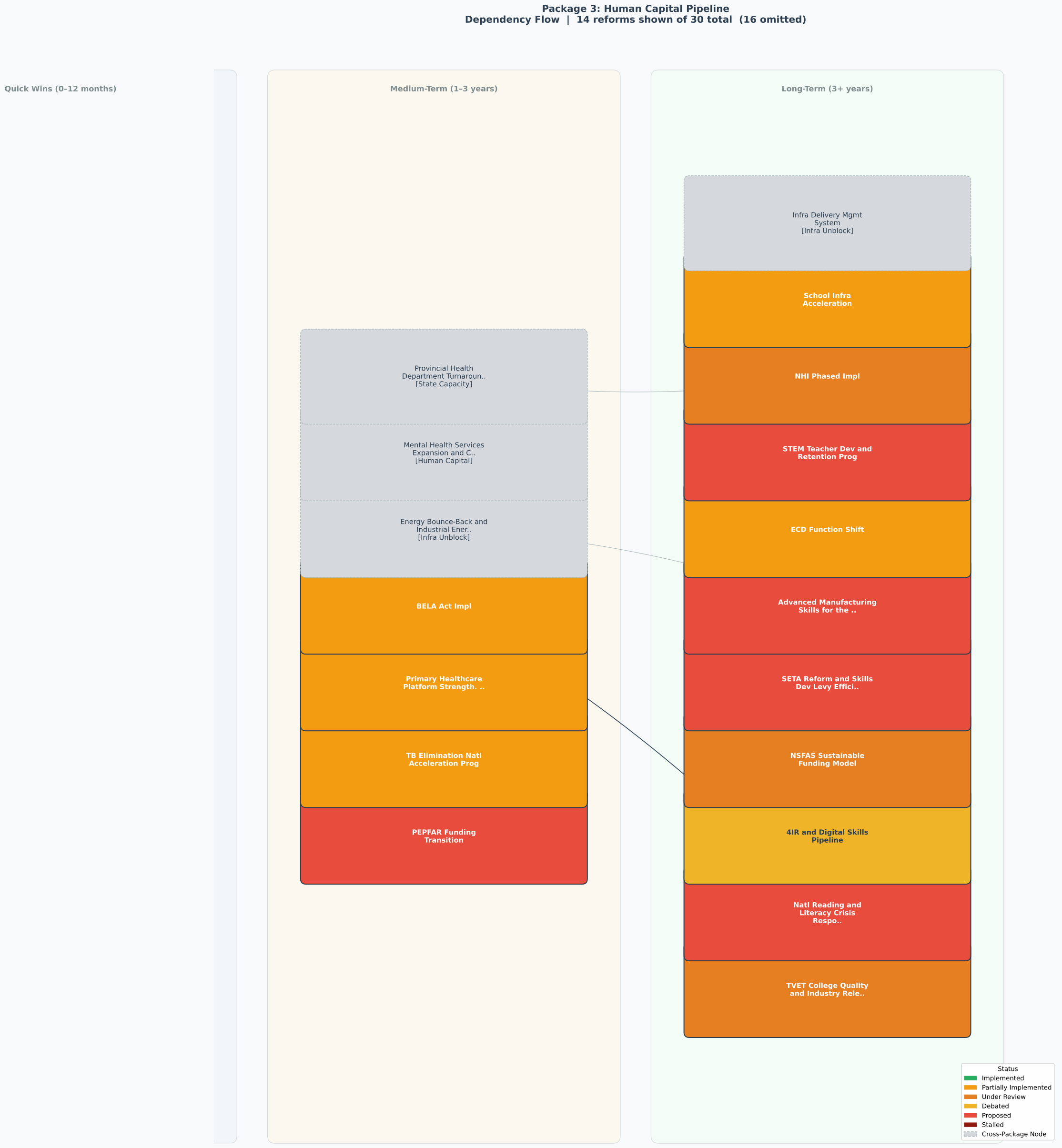
Which reforms in this package enable or unlock others.
4IR digital skills pipeline feeds advanced manufacturing
TVET artisan pipeline feeds advanced manufacturing skills
SETA reform improves TVET funding quality and relevance
ECD migration to DBE creates platform for reading literacy programme
Foundation literacy enables effective STEM teacher programmes
Reading outcomes improve BELA Act admissions/language policy
Foundation literacy feeds NSFAS-eligible student pipeline
STEM teachers feed advanced manufacturing/energy transition skills
PEPFAR transition restructures primary healthcare funding
PHC platform strengthens TB elimination programme
PHC integration enables mental health services expansion
Mother-tongue instruction improves cognitive foundation for national literacy programme
Foundation literacy is prerequisite for effective TVET participation
Foundation literacy enables effective adult second-chance education outcomes
NSFAS sustainable funding enables TVET college enrollment at scale
NSFAS funding enables CET second-chance programme participation
SETA reform redirects skills levy funds to energy transition skills training
SETA reform funds 4IR digital skills development pipeline
STI Decadal Plan operationalises and targets R&D investment escalation to 1.5% GDP
STI plan provides mandate and framework for NRF bursary reform
NRF bursary reform expands research workforce contributing to R&D investment targets
ECD function shift to DBE enables coherent multilingual early childhood education
Healthcare worker employment strengthens NHI delivery capacity on the ground
NHI roadmap creates formal mandate for healthcare worker absorption programme
SAHPRA medicines regulation strengthens NHI pharmaceutical procurement credibility
Health market inquiry reforms are precondition for NHI insurance market functioning
School infrastructure provides physical space for literacy programme delivery
School nutrition improves cognitive capacity and attendance for literacy
Learner transport ensures school attendance enabling literacy programme delivery
Rural school consolidation triggers school infrastructure acceleration in rural areas
TB programme workers qualify for healthcare worker absorption programme
NRF bursary reform produces research talent for STI Decadal Plan implementation
Dependency Flow Diagram
See all packages →Visual map of how reforms in this package sequence and unlock each other.
Implementation Roadmap
Sequenced action plan from quick regulatory wins to structural reform, with key dependencies, success metrics, and risk factors.
Launch targeted structured literacy deployment in the 1,000 lowest-performing primary schools (Quintile 1–2). Based on DBE's Early Grade Reading Study, phonics-based structured literacy can raise Grade 3 reading scores by 0.3–0.5 SD in 18 months.
Mandate phonics sequencing and decodable texts in the CAPS curriculum for Home Language in Grades 1–3. Requires teacher guides, workbooks, and assessor training — all within the current DBE expenditure envelope.
Clear the QCTO backlog of TVET college programme accreditations, qualification part-qualifications, and assessment centre approvals. Estimated 2,000+ applications stalled. Blocking artisan certification.
Publish the qualifications pathway and registration framework for ECD practitioners under the Social Service Professions Act. Required to professionalise the 100,000+ person ECD workforce and unlock subsidy eligibility.
Publish a National Digital Skills Framework mapping ICT qualifications across TVET, community colleges, and higher education to labour market demand. Coordinates SETAs, MICT SETA, and DHET programming.
Scale the structured literacy programme from 1,000 pilot schools to all 25,000+ primary schools through a national reading coach deployment programme. Estimated 5,000 coaches at R400m annual cost.
Increase artisan apprenticeship targets specifically for electricians, solar PV technicians, wind turbine technicians, and green hydrogen plant operators. Align MERSETA and EWSETA funding with REIPPP sector needs.
Establish District Health Management Offices and pilot the purchasing function under the NHI Act in 3 pilot districts. Tests the contracting model before national rollout. NHI Act signed May 2024.
Implement means-testing improvements, bursary cap administration, and direct payments to institutions to stabilise NSFAS after the administrative collapse of 2023–2024. Critical to TVET and university throughput.
Extend Grade R (preschool year) to all learners through a combination of public schools, ECD centres, and subsidy expansion. Foundation for reading readiness intervention.
Implement a national teacher coaching and professional development programme focused on literacy instruction. Built on lesson observation and feedback — distinct from traditional workshop-based CPD.
Achieve a doubling of Grade 4 reading proficiency in the PIRLS assessment from the 2021 baseline of 19% (worst among middle-income countries). Requires sustained structured literacy and teacher development from 2025.
Triple annual artisan certification output by transforming TVET colleges from compliance-driven to industry-integrated institutions. Requires SETA reform, industry partnerships, and facility investment.
Achieve broad universal health coverage for primary and secondary care through the NHI Fund by 2030. Requires successful Phase 1 pilots, private sector contracting model, and sustained fiscal commitment.
Credential 1 million young South Africans with marketable ICT qualifications by 2030 through TVET, community colleges, and digital skills partnerships with industry (Microsoft, Google, AWS cloud programmes).
Key Dependencies
Children who cannot read for meaning by Grade 4 rarely recover academically. Foundation literacy is the single highest-leverage intervention in the human capital pipeline.
ECD quality determines the cognitive and language baseline children bring to Grade 1. Without ECD investment, the reading programme starts from a lower baseline.
Industrial strategy and green transition reforms (Package 4) depend on a supply of qualified artisans. TVET transformation is the upstream requirement.
NSFAS collapse in 2023–2024 disrupted hundreds of thousands of students. Sustainable NSFAS funding is required before throughput targets are meaningful.
Success Metrics
| Metric | Current | Target | By |
|---|---|---|---|
| PIRLS Grade 4 reading proficiency | 19% (PIRLS 2021) | 40% | 2030 |
| TVET artisan certifications per year | ~20,000 | 50,000 | 2028 |
| ECD enrollment (ages 3–5) | 65% | 85% | 2027 |
| Grade 12 pass rate (quality-adjusted) | 80.1% (2023) | 85% with improved bachelor pass share | 2027 |
| Public healthcare worker vacancy rate | ~32% unfilled posts | Below 20% | 2028 |
Risk Factors
SADTU has historically opposed structured literacy mandates as undermining teacher professional autonomy. Implementation requires DBE to navigate union relations carefully while maintaining curriculum accountability.
Recurring administrative failures and underfunding of NSFAS create student and institution instability. A second major NSFAS crisis would undermine both TVET and university throughput targets.
ECD practitioners earn below minimum wage in most non-profit centres. Without pay equity with Grade R teachers, the ECD workforce cannot be professionalised or retained.
Medical associations, private hospital groups, and some provinces are litigating the NHI Act. Court decisions could delay or fundamentally alter implementation.
Structural corruption in textbook, stationery, and school infrastructure procurement in some provinces has historically wasted education resources and delayed curriculum implementation.
Key Stakeholders
Major actors with a stake in this reform package, ranked by influence. Full stakeholder map →
Presidency / Operation Vulindlela
Influence
10/10
Cross-cutting structural reform coordination across energy, logistics, water, digital infrastructure, and visa reform. Operation Vulindlela,…
National Treasury
Influence
9/10
Fiscal consolidation with public debt stabilising below 75% of GDP; structural reforms that improve revenue without expanding contingent lia…
Business Unity South Africa (BUSA)
Influence
8/10
Cross-sector structural reform across energy security, logistics efficiency, regulatory certainty, labour market flexibility, and digital in…
DTIC (Dept. of Trade, Industry & Competition)
Influence
7/10
Industrial policy objectives — local content requirements, beneficiation, BBBEE transformation, SEZ development, and protection of manufactu…
Minerals Council South Africa
Influence
7/10
Investment certainty and mineral rights security under the MPRDA; energy cost and reliability for deep mining operations (SA mines are among…
National Union of Mineworkers (NUM)
Influence
7/10
Mining employment security and worker safety; just transition pace that protects coal-dependent community livelihoods; collective bargaining…
DMRE (Dept. of Mineral Resources & Energy)
Influence
6/10
Regulatory oversight of energy generation licensing and mineral rights under the ERA and MPRDA; managing the REIPPP procurement programme; c…
ICASA
Influence
6/10
Spectrum licensing and management; competition regulation in electronic communications; consumer protection; broadband connectivity targets…
World Bank Group
Influence
6/10
Structural reform technical assistance and Development Policy Loan financing conditional on reform milestones; energy transition support thr…
PRASA
Influence
5/10
Commuter rail rehabilitation and rolling stock procurement; urban mobility for low-income commuters; PRASA Modernisation Programme recovery;…
European Union / JETP Partners
Influence
5/10
Just Energy Transition Partnership — €8.5bn committed for SA's coal transition; renewable energy scale-up and coal community support; Carbon…
AgriSA / Commercial Agriculture
Influence
5/10
Water allocation security for irrigation agriculture; water user association governance and infrastructure investment; logistics access for…
Section27
Influence
4/10
Constitutional rights to health, education, food, water, and social security under sections 26–29 of the Constitution. Litigates against sta…
Equal Education
Influence
4/10
School infrastructure quality and safety; electrification of schools in underserved areas; broadband connectivity in education; equitable re…
African Development Bank
Influence
4/10
Infrastructure financing for energy, transport, and water with a regional integration lens; REIPPP co-financing; logistics corridor investme…
Public Affairs Research Institute (PARI)
Influence
3/10
Evidence-based institutional reform; state capacity building across national and subnational government; governance quality analysis; docume…
SERI (Socio-Economic Rights Institute)
Influence
3/10
Socio-economic rights for poor and marginalised communities under the Constitution; land rights and housing security; informal settlement se…
How to cite
Wilse-Samson, L. (n.d.). Human Capital Pipeline. SA Policy Space. https://sa-policy-space.vercel.app/packages/3 Live page. Data version: 2026-10-13.a85db628; data as of: 2026-10-13.
Data as of 2026-10-13 · latest PMG meeting 2026-10-09