State Capacity & Governance
None of the above works without a capable state
40
Ideas in this package
3.0/5
Average growth impact
Editorial assessment
3.0/5
Average feasibility
Editorial assessment
Decision Summary
The immediate move, the economic upside, and the coalition and delivery constraints that will determine whether this package actually lands.
Roadmap activity
9/16
Actions completed or in progress
Quick wins open
5
6 first-phase actions
High-severity risks
4
Political will for SOE restructuring against union opposition
Stakeholders in play
21
9 champions, 9 swing actors
Next Move
SARS capacity expansion — high-wealth and transfer pricing
In progress · SARS
Economic Case
+0.5-1% GDP by 2030
R185bn annual revenue uplift with break-even in about 3 years.
Delivery Chokepoint
FATF exit -> Lower borrowing costs and correspondent banking
Greylisting raised SA's risk premium by an estimated 25–50bps and impaired correspondent banking relationships. Exit (achieved October 2024) reduces fiscal pressure and improves banking access.
Coalition Read
Anchor: Presidency / Operation Vulindlela
9 champions, 9 swing actors, 3 hard objections. Highest-leverage persuasion target: COSATU. Hardest resistance to manage: NUMSA.
South Africa's governance crisis is not an abstract concern about political culture — it carries a precise and measurable fiscal cost. Load-shedding was partly a governance failure: the decisions that left EskomEskom: South Africa's national electricity utility and dominant power producer, transmitter, and distributor. Eskom's debt crisis and maintenance failures have been a primary cause of load shedding and a binding constraint on economic growth. technically and financially insolvent were not acts of God but of procurement fraud, political interference in appointments, and systematic underinvestment in maintenance. The FATF greylisting, lifted in 2023 but leaving institutional scar tissue, emerged from legislative and enforcement gaps that sophisticated jurisdictions had addressed years earlier. Debt service now absorbs over 22 cents of every rand of government revenue — crowding out spending on nurses, teachers, and infrastructure — because fiscal consolidation was deferred across three successive administrations.
The State Capacity & Governance package is therefore not aspirational good-government reform: it is the enabling condition for every other package in this database. A state that cannot maintain its electricity infrastructure cannot implement an energy transition. A state that cannot manage procurement without systematic leakage cannot deliver affordable housing at scale. A state that cannot collect the taxes legally due cannot fund its human capital investment commitments. The binding constraintBinding Constraint: The most critical bottleneck limiting economic growth in a given context, as identified by the Hausmann-Rodrik-Velasco growth diagnostics framework. Addressing binding constraints yields the highest growth dividend relative to other reforms. on South Africa's reform capacity is not ideas — this database contains 139 of them — but institutional execution.
The package is organised around three interdependent pillars: fiscal sustainability (debt stabilisation, SARS capacity restoration, expenditure quality), SOESOE — State-Owned Enterprise: A company owned wholly or partially by the South African government. Key SOEs include Eskom (electricity), Transnet (rail and ports), SAA (aviation), and SABC (broadcasting). SOE reform is a central plank of South Africa's structural reform agenda. rationalisation (Eskom completion and the broader portfolio), and anti-corruption and consequence management. These pillars are mutually reinforcing: fiscal space requires ending SOE bailouts; SOE performance requires anti-corruption enforcement; anti-corruption requires independent institutions with tenure and resources.
Diagnostic Context
Binding Constraints Addressed
The binding constraint in HRV terms is microeconomic risk — specifically, the risk that investment returns will be appropriated through corruption, regulatory capture, or contract renegotiation. This raises the cost of capital across the economy and reduces the probability of long-horizon investment that requires a credible state counterparty (infrastructure PPPs, mining rights, export processing zones). Secondary constraints include fiscal crowding out (high debt service reduces the state's capacity to invest in public goods), SOE contingent liabilities that create fiscal instability and suppress sovereign credit ratings, and insufficient administrative capacity that prevents regulatory and delivery agencies from functioning competently even when legislation is sound.
Hausmann-Rodrik-Velasco growth diagnostics framework
Sequencing Rationale
FATF compliance has the highest near-term urgency because its absence raises borrowing costs and impairs financial system functioning — and it is a tractable governance reform with immediate, measurable external validation. SARS capacity expansion is sequenced early because it generates its own fiscal return (every rand invested in SARS recovers an estimated R10–12 in additional revenue) and changes the fiscal arithmetic for everything else. Fiscal consolidation is medium-term because it requires both revenue measures and expenditure reprioritisation that need political consensus across coalition partners. SOE rationalisation beyond Eskom is medium-to-long term given workforce implications and sector-specific regulatory redesign. Anti-corruption institutional reforms — NPA capacity, SIU resourcing, asset forfeiture, consequence management — are longest-horizon because they require institutional culture change, not just legislative amendment.
International Precedents
Estonia's public sector digitalisation between 1997 and 2010 demonstrates that a country with weak legacy institutions can leapfrog to governance excellence through technology-enabled transparency — e-government reduced corruption opportunities by minimising discretionary human interaction in public services. Botswana's Directorate on Corruption and Economic Crime, established at independence, has maintained the country as one of Africa's least corrupt despite natural resource wealth, demonstrating that governance institutions can be built alongside resource booms. Rwanda's dramatic governance improvement post-1994 — from near-failed state to one of Africa's better-governed countries — was enabled by clear political commitment, merit-based civil service recruitment, and robust accountability mechanisms. Colombia's constitutional fiscal rules (2011 Fiscal Sustainability Act) demonstrate that legislative constraints on expenditure growth can be durable when political will to enforce them exists.
Expected Economic Impact
Governance and state capacity reforms have diffuse but large economic effects. Elimination of the governance risk premium on South African sovereign debt is estimated to reduce borrowing costs by 100–150 basis points over 5 years, saving R15–25 billion annually in debt service. Full SARS capacity restoration is estimated to recover R50–80 billion in annual tax gap. SOE rationalisation — ending Eskom bailout requirements and reducing contingent liabilities — could free R40–60 billion annually for productive investment. Improved public procurement integrity, bringing South Africa to OECD average procurement efficiency, could recover 10–15% of procurement spend (R40–60 billion per year). The compound effect — improved fiscal space, lower cost of capital, higher investment confidence — is estimated at 0.8–1.5 additional percentage points of annual GDP growth.
Theory of Change
Every other reform package is mediated by state institutions: regulators, procurement systems, tax authorities, SOE boards, provincial departments. Where those institutions are captured, underfunded, or dysfunctional, reform legislation sits unimplemented and fiscal resources leak. South Africa's structural fiscal deficit — debt service now absorbs over 20 cents of every revenue rand — is itself a governance failure compounded by Eskom bailouts, SOE losses, and revenue shortfalls that a fully capacitated SARS could partially recover.
This package addresses the enabling conditions for all other packages. FATF greylisting exit is the most urgent: it raises borrowing costs, impairs correspondent banking, and signals institutional fragility to investors. Fiscal consolidation and SARS capacity expansion create the headroom for infrastructure investment. SOE reform — not just Eskom but the full portfolio — reduces contingent liabilities. Anti-corruption and consequence management reforms close the governance loop. Without meaningful progress here, the other four packages will be partially implemented, poorly resourced, and chronically stalled.
Fiscal Impact Estimates
Scenario estimates — not official government projections. See full methodology.
Public investment
R28bn
over 5 years
GDP impact
+0.5–1%
by 2030
Jobs created
~107k
direct + indirect
Annual revenue uplift
R185bn/yr
break-even ~3 years
Highest return package by fiscal ROI. The SIU and GIZ estimate R100–200bn/yr in procurement irregularities alone. SARS modernisation is projected to close a R50bn/yr compliance gap. Indirect employment gains accrue as investor confidence improves and the regulatory environment becomes predictable.
Ideas by Time Horizon
Sequencing from quick regulatory wins through institutional reform to structural change.
SIU Special Tribunal and Asset Recovery Acceleration
The SIU Special Tribunal, established in 2019, enables civil recovery of state losses from corruption without criminal prosecution requirements. The committee has monitored recovery outcomes — the SIU has referred matters worth over R50bn but actual recoveries remain a fraction of this. The June 2025 session reviewed the SIU Annual Performance Plan alongside Legal Aid SA. Strengthening the Tribunal pipeline from investigation to recovery order to execution is the critical bottleneck, particularly for Digital Vibes and PPE-era corruption matters.
SANDF Deployment in Support of SAPS Border Security
The SANDF has been deployed in support of SAPS for internal security operations and border protection under successive Presidential authorisations. The March 2026 committee session examined the deployment alongside the Mkhwanazi Committee report on police-military coordination. Cost-effectiveness concerns persist — military deployments are expensive relative to equivalent police capacity. The committee has questioned whether permanent SANDF border deployment should be replaced with a dedicated border policing unit within SAPS.
Anti-Extortion and Construction Mafia Task Force
Construction site extortion and business protection rackets have become a major barrier to infrastructure delivery, with the construction mafia disrupting projects worth billions of rands. The committee heard that over 80% of major construction sites in KwaZulu-Natal and Gauteng face extortion demands. Dedicated anti-extortion units, established in some provinces, have had mixed results due to the intersection of organised crime with local political structures. The committee has called for inter-departmental coordination between SAPS, NPA, and DTIC to protect infrastructure investment.
NSFAS Fraud Prevention and Administration System Overhaul
The National Student Financial Aid Scheme's administration collapse became a national crisis between 2021 and 2024: delayed allowance payments left students unable to pay rent or buy food; a R2.1 billion irregular expenditure finding by the Auditor-General revealed procurement failures in the student accommodation and allowance payment systems; and a Special Investigating Unit (SIU) probe uncovered fraudulent registrations by students, ghost students, and institutions claiming NSFAS funding for enrolled students who had dropped out or never attended. The administration overhaul reform covers: replacing the current bursary management system with an integrated student information system linked to HEMIS and institutional student records, implementing biometric verification for allowance collection, establishing an NSFAS fraud investigative unit within the SIU, and restructuring the NSFAS board and executive management. The MTBPS 2025 notes NSFAS as a fiscal risk entity with qualified audit opinions in three consecutive years. The PC on Higher Education BRRRs 2022–2024 contain over 40 specific recommendations on NSFAS governance that remain partially implemented.
AML/CFT Implementation Monitoring — NCOP and Provincial Layer
South Africa was placed on the FATF Grey List in February 2023 following deficiencies in anti-money laundering, counter-terrorist financing, and proliferation financing frameworks. An inter-agency Action Plan (National Treasury, FIC, SAPS, NPA, SARB) addresses 22 action items across six priority areas. The NCOP's Select Committee on Security and Justice plays a monitoring role, particularly for the provincial implementation of AML/CFT obligations on Designated Non-Financial Businesses and Professions (DNFBPs: attorneys, accountants, estate agents, car dealers). Key legislative reforms include the General Laws Amendment Act (2022) and the Protected Disclosures Amendment Act. FATF on-site assessment in late 2024 determined progress sufficient for grey list exit, expected in mid-2025. Asset forfeiture, beneficial ownership registers (CIPC), and suspicious transaction reporting volumes are the key performance indicators.
SARS Capacity Expansion and Revenue Recovery
SARS's institutional capacity was severely eroded during state capture (2014–2018), with revenue shortfalls estimated at R300+ billion over that period. The rebuilding programme under Commissioner Edward Kieswetter has restored staffing levels, re-established the High Wealth Individual unit and Large Business Centre, upgraded the SARS digital platform (eFiling, customs modernisation), and improved VAT refund processing. Revenue performance has recovered significantly, with tax-to-GDP ratio rising from under 24% to approximately 25.5% by 2024/25. Further reforms include expanding the third-party data ecosystem for automatic assessments, improving customs compliance through scanner investment at ports of entry, and deepening transfer pricing enforcement. SARS's effectiveness is a foundational fiscal institution reform — each percentage point improvement in the tax-to-GDP ratio generates approximately R70 billion in additional annual revenue at current GDP levels.
FATF Greylisting Exit — AML/CFT Legislative Package
South Africa was greylisted by the Financial Action Task Force (FATF) in February 2023 following assessments of deficiencies in anti-money laundering (AML) and counter-financing of terrorism (CFT) frameworks. The legislative response included the General Laws Amendment Act (2022), Financial Sector Laws Amendment Act (2022), and subsequent amendments to the Companies Act and Trust Property Control Act. The FATF Action Plan required 22 priority actions across beneficial ownership registers, prosecutorial capacity, and financial intelligence. South Africa exited the greylist in October 2025 after addressing most action items. The reform's significance extends beyond the list: greylisting raised correspondent banking costs, deterred foreign portfolio investment, and increased compliance burdens on SA financial institutions. Sustained AML/CFT capacity at the FIC, NPA, and Hawks is needed to maintain the exit and prevent re-listing.
Road Accident Fund Structural Reform
The Road Accident Fund (RAF), a statutory insurer that compensates people injured in road accidents, and the dependants of people killed in them, where another driver's negligence caused the crash, carries an actuarial liability of R600 billion (2024)—equivalent to 10% of GDP—making it the largest contingent liability on South Africa's books after Eskom. The RAF is structurally insolvent: fuel levy revenue of R45 billion annually (2025/26) covers only current claims, while the unfunded liability grows by R50–80 billion per year as courts award increasingly large general damages. The Road Accident Benefit Scheme (RABS) Bill, first proposed in 2014, would replace this fault-based system with a no-fault social insurance model (fixed benefit schedules, income replacement for injured workers, functional rehabilitation rather than lump-sum damages). The National Assembly rejected the RABS Bill in 2020; the Department of Transport briefed the Portfolio Committee on Transport on reintroducing it in June 2025. The reform eliminates the R20 billion in legal fees and disbursements that currently absorb 40% of the RAF's total payments, redirecting them to claimant benefits. The PC on Transport BRRRs 2021–2024 have unanimously recommended RAF structural reform for a decade, noting that the legal profession's opposition (protecting a R20 billion annual fee income) is the primary political obstacle. National Treasury's fiscal risk register classifies RAF as the highest-risk contingent liability.
Cybercrime and Digital Evidence Legislation
The Cybercrimes Act (2020) established a framework for criminalising cyber offences, preserving electronic evidence, and enabling international cooperation. Implementation has been slow — designated cybercrime courts are not yet operational, and SAPS digital forensic capacity remains limited. South Africa loses an estimated R2.2bn annually to cybercrime. The committee has examined readiness for Act enforcement, including capacity within the SAPS Hawks and coordination with the Information Regulator under POPIA.
Legal Aid South Africa Capacity and Access to Justice
Legal Aid South Africa provides legal representation to approximately 400,000 indigent clients annually but faces persistent funding constraints that limit coverage, particularly in rural areas and civil matters. The committee has examined the tension between Legal Aid mandate expansion and budget adequacy. Access to justice in family law, eviction, and administrative matters remains severely limited for poor South Africans, with implications for property rights, social grant access, and protection order enforcement.
Court Case Backlog and Judicial Efficiency
Court case backlogs exceed 200,000 matters in the lower courts, with some criminal cases taking 3-5 years to reach trial. The committee has examined the causes: insufficient judicial officers, courtroom infrastructure in disrepair, and the impact of the COVID backlog that was never fully cleared. The Chief Justice has proposed case flow management reforms and expanded small claims jurisdiction. The November 2025 annual report review documented the gap between the Office of the Chief Justice modernisation plans and the Department of Justice budget allocation.
NPA Prosecution Capacity and Independence
The NPA, under NDPP Shamila Batohi (appointed 2019), has made progress rebuilding prosecution capacity following the state capture era. The Investigating Directorate Against Corruption (IDAC), established as a permanent unit, has secured several high-profile convictions. However, the committee has tracked persistent vacancy rates in complex commercial crime units and the slow pace of Zondo Commission referral prosecutions. The June 2025 Annual Performance Plan review noted that NPA conviction rates have improved but remain below the 92% target in priority crime categories.
Community Policing Forum Revitalisation
Community Policing Forums (CPFs), mandated by the South African Police Service Act, are intended to enable civilian oversight and community safety partnerships at station level. In practice, most CPFs are underfunded and dysfunctional. The committee workshop in September 2025 examined revitalisation strategies, including sustainable funding models, integration with municipal Integrated Development Plans, and formal accountability mechanisms. The Civilian Secretariat for Police Service (CSPS) oversees CPF coordination but lacks enforcement capacity.
Illegal Mining and Resource Crime Combatting
Illegal mining (zama-zama operations) in abandoned mines poses severe safety, environmental, and security risks. The Stilfontein tragedy in late 2024, where hundreds of illegal miners were trapped underground, brought national attention to the issue. The committee received an illegal mining petition in September 2025 and has examined inter-departmental coordination failures between SAPS, DMRE, and the Department of Home Affairs. Combatting illegal mining requires addressing both the criminal syndicates that control operations and the desperate economic conditions that drive participation.
Private Security Industry Regulation (PSIRA) Reform
South Africa has over 2.7 million registered private security officers — significantly more than the 180,000 SAPS members. PSIRA, the regulatory authority, oversees an industry worth ~R70bn annually. The committee has examined PSIRA regulatory effectiveness, including foreign ownership rules, training standards, and incidents involving security companies in community conflicts. Reform proposals include better coordination between private security and public policing, minimum qualification standards, and addressing the growing use of private security for essential public safety functions.
IPID Independence and Police Accountability
IPID, the police oversight body, has faced institutional instability including leadership disputes documented in the February 2025 committee session. The directorate investigates deaths in custody, discharge of firearms, and corruption but has fewer than 500 investigators for 180,000+ SAPS members. Strengthening IPID operational independence is essential for police accountability, particularly given ongoing concerns about police brutality and extra-judicial killings. The committee has examined IPID caseloads relative to resources in quarterly performance reviews.
Gender-Based Violence Prevention and Response Strategy
South Africa has one of the highest rates of gender-based violence globally, with femicide rates five times the global average. The National Strategic Plan on GBVF (2020-2030) established targets including expanded Thuthuzela Care Centres, dedicated FCS units, and the National Register for Sex Offenders. The committee has examined implementation progress, noting police station-level compliance gaps with the Domestic Violence Act. The June 2025 hearings focused on systemic failures in victim support and the low conviction rates for sexual offences.
SAPS Detective Service Capacity and Case Clearance
South Africa recorded over 27,000 murders in 2023/24, a rate of approximately 45 per 100,000 — among the highest globally. SAPS detective-to-case ratios in some provinces exceed 1:100, far above the recommended 1:25. The committee has documented critical shortages in forensic capacity, with DNA backlogs and ballistic analysis delays undermining prosecution success rates. The 2025/26 BRRR recommended ring-fenced funding for detective recruitment and forensic services modernisation as a prerequisite for improving the 20% serious crime conviction rate.
Provincial Health Department Turnaround Programme
Seven of South Africa's nine provincial health departments received qualified audit opinions from the Auditor-General in 2023/24, reflecting persistent failures in financial management, supply chain governance, and infrastructure maintenance. The cumulative effect—medicine stockouts, equipment breakdowns, staff non-payment, and facility collapse—falls disproportionately on the 84% of South Africans dependent on public health. The Provincial Health Department Turnaround Programme (modelled on National Treasury's Municipal Finance Improvement Programme for local government) deploys specialist financial management, supply chain, and HR teams to the three worst-performing provinces (Eastern Cape, Limpopo, North West) with a 2-year intensive support mandate. The PC on Health BRRRs 2022–2024 document the cyclical nature of provincial health crises: the same departments that were placed under Section 100 interventions in 2011–2013 are again in distress. NHI implementation requires a stable provincial health infrastructure as its foundation—without turnaround, NHI will formalise dysfunction rather than reform it.
PPP Regulatory Reform for Social Infrastructure
National Treasury's PPP Unit administers South Africa's public-private partnership framework under Treasury Regulation 16, which requires extensive feasibility studies, value-for-money assessments, and multi-stage National Treasury approval. While this oversight protects public finances, the process has been criticised as too slow and costly — particularly for smaller social infrastructure PPPs covering schools, health centres, and correctional facilities — with fewer than 40 PPP agreements reaching financial close since 2000. DPWI and National Treasury are reviewing streamlined approval pathways for social infrastructure PPPs below a defined threshold, an off-balance-sheet framework for municipal-level PPPs, and better alignment with the Infrastructure Fund's blended finance model established in 2020.
Government Building Maintenance Budget Ring-fencing
South Africa's public infrastructure — schools, hospitals, courts, police stations, and government offices — suffers chronic underfunding of maintenance estimated by DPWI at R1 billion annually in deferred costs. When capital budgets are under pressure, departments routinely cut maintenance first, accelerating deterioration of state assets. National Treasury and DPWI are developing a Maintenance Delivery Improvement Programme that would ring-fence a minimum maintenance allocation (proposed at 1-1.5% of asset replacement value per year) in departmental budgets, enforce it through conditional grant conditions, and track compliance through infrastructure condition indices. The Government Immovable Asset Management Act (GIAMA) provides the statutory basis for asset condition reporting but enforcement has been weak.
DPWI Enterprise Renewal: Financial Systems and Consequence Management
The Department of Public Works and Infrastructure (DPWI) has received qualified or adverse audit opinions from the AGSA for multiple consecutive years, reflecting systemic failures in financial management, procurement, and consequence management. The department manages over R100 billion in infrastructure programmes — including EPWP, capital works, and government leases — yet has struggled to maintain accurate asset registers, resolve irregular expenditure findings, and take disciplinary action against officials implicated in procurement irregularities. DPWI's enterprise renewal programme — covering BAS and LOGIS financial system implementation and supply chain management overhaul — is under review by SCOPA. Active referrals to the SIU where criminality is suspected are central to the consequence management component.
PMTE Property Portfolio Rationalisation and Revenue Optimisation
The Property Management Trading Entity (PMTE) within DPWI manages approximately 83,000 immovable state assets valued at over R100 billion, including offices, warehouses, police stations, courts, and vacant land, yet operates at a chronic deficit because large portions of the portfolio are underutilised, poorly maintained, or yield below-market rentals from user departments. National Treasury spending reviews have identified the PMTE portfolio as a significant unrealised fiscal asset. Key reforms under review include disposing of non-strategic assets, commercialising well-located land parcels for affordable housing, enforcing accurate user department lease payments, and implementing a government-wide facilities management system. The AGSA has persistently flagged irregular expenditure, incomplete asset registers, and audit backlogs in the PMTE as governance concerns.
SAA Successor Entity — Commercial Viability Without Ongoing State Support
South African Airways, placed into business rescue in December 2019 after accumulating R49 billion in government guarantees and requiring R32 billion in direct bailouts since 2014, resumed operations in September 2021 through a business rescue plan that gave Takatso Consortium a 51% stake. However, the Takatso deal collapsed in 2023 after disagreements over government guarantees, leaving the successor SAA as a wholly state-owned entity again, operating with a R3.5 billion government equity injection and a narrow profitable route network (primarily regional African routes and the Johannesburg–London corridor). The reform agenda requires: concluding an alternative strategic equity partner process (international airline or private equity), reducing the route network to commercially viable core routes, severing all remaining government guarantee obligations so that SAA does not become a contingent liability in future, and developing a clear endpoint for the state's equity position. The MTBPS 2025 does not allocate further SAA capital, effectively requiring commercial viability or wind-down. The PC on Public Enterprises BRRRs consistently recommend zero further transfers to SAA absent a credible commercial plan.
Alexkor and Safcol Land Claims — Long-Delayed Resolution
Alexkor, the state diamond mining company at Alexander Bay, has been entangled in the Richtersveld land restitution claim since 1999. A 2003 Constitutional Court ruling granted the Richtersveld community surface and mineral rights, but the 49% equity settlement has been improperly implemented as Alexkor's diamond operations collapsed and community trust benefits remain minimal. Safcol (South African Forestry Company) faces restitution claims over commercial forests in Limpopo, Mpumalanga, and KwaZulu-Natal. Both cases represent failure to implement legally settled land claims through workable business models. The reform requires restructuring the Alexkor joint venture, resolving governance between the community trust and mining entity, and processing Safcol community equity models. Parliamentary Committee on Public Enterprises BRRRs flagged both as fiscal risks with governance vacuums.
Denel Strategic Equity Partner and Defence Industrial Viability
Denel, South Africa's state-owned defence and aerospace company, entered a severe financial crisis between 2016 and 2022, driven by state capture-era contract irregularities, mismanagement, and the collapse of orders from state clients and export markets. At peak distress (2021), Denel could not pay salaries for 4,000 employees, defaulted on government-guaranteed bonds, and saw its engineering talent exodus to private sector and foreign defence contractors. The Strategic Equity Partner (SEP) process, initiated in 2023, seeks private investment in Denel's viable business units (Dynamics: missiles and drones; Optronics: electro-optical systems; LMT: ammunition) while potentially closing or merging unviable units (Aeronautics: no domestic aircraft programme). The MTBPS 2025 allocates R3.4 billion to Denel over the medium term, conditional on the SEP process completion. National security considerations (ITAR restrictions on technology transfer, SA defence industrial sovereignty) complicate any foreign investor acquisition. The PC on Public Enterprises BRRRs 2020–2024 document Denel's complete institutional collapse and the risk to SANDF procurement capacity if Denel's strategic capabilities are lost.
Eskom Debt Relief Conditions and Restructuring Framework
As part of the 2023 Eskom debt relief package, National Treasury assumed R254 billion of Eskom's approximately R400 billion debt burden over a multi-year period extending to 2028/29, subject to strict conditions including restructuring milestones, cost reduction targets, and renewable energy procurement progress. The restructuring framework requires Eskom to separate its balance sheets for generation, transmission, and distribution. As of early 2026, tranches have been transferred on schedule and the programme runs to 2028/29 per the revised Treasury framework. Eskom's Energy Availability Factor improvement from approximately 58% in 2023 to approximately 69% by 2025 demonstrates progress against restructuring milestones.
SOE Policy Impediments Reform — PFMA, BBBEE, and Procurement Flexibility
South Africa's State-Owned Enterprises operate under a regulatory environment—the Public Finance Management Act (PFMA), BBBEE procurement requirements, the National Treasury Regulations, and Ministerial directives—that creates structural impediments to operational efficiency and private participation. Specific reform targets include: revising Section 54 of the PFMA to reduce ministerial pre-approval requirements for commercial transactions (which delays Eskom, Transnet, and other SOE deals by months), clarifying BBBEE scorecard treatment for SOE-private joint ventures (a barrier to private sector participation in Transnet and PRASA concessions), and harmonising the Public Procurement Act (2023) with SOE-specific procurement needs. The Presidential SOE Council, chaired by the President, coordinates governance reform across the 10 major commercial SOEs. The MTBPS 2025 notes that SOE transfer payments have declined from R40 billion to R28 billion annually as restructuring conditions tighten. The textbook (Chapter 3) identifies the statutory board model (Singapore's statutory authorities) as the structural reform that could fundamentally change SOE governance dynamics.
Derelict and Ownerless Mines Rehabilitation Fund
South Africa has approximately 6,000 derelict and ownerless mines (DOMs) from the gold and coal eras, posing acid mine drainage, sinkhole, and water pollution risks. The DMRE's DOM Unit faces a rehabilitation backlog requiring an estimated R50 billion. A dedicated fund—capitalised through mining royalty levies, the Mines and Minerals Development Bill, and potential green bond issuance—would address this fiscal liability systematically. Rand Water's AMD pumping operation costs R2 billion annually, a preventable outlay if upstream rehabilitation proceeds. Parliamentary BRRRs flagged the Western Basin AMD threat to Johannesburg's water security repeatedly from 2021 to 2024. International models (US Superfund, Canada's Abandoned Mines programme) inform the fund design.
Intergovernmental Fiscal Framework Review — Equitable Share Formula
South Africa's system of intergovernmental fiscal transfers—governed by the Division of Revenue Act (DoRA), the Intergovernmental Fiscal Relations Act (1997), and the equitable share formula—distributes approximately R900 billion annually between national, provincial, and local government. The equitable share formula for provinces (the largest transfer, R850 billion in 2025/26) has not been fundamentally revised since 2002, and its components—education (weighted by learner numbers), health (weighted by population and poverty), and basic services—no longer align with provincial fiscal needs or service delivery capacity. Key reform proposals from the FFC (Financial and Fiscal Commission): revising the health component to align with actual provincial disease burden (KZN and EC are undercompensated relative to their TB/HIV burden), introducing a conditional infrastructure maintenance grant (ring-fenced from the provincial equitable share to prevent maintenance budget raiding), and strengthening the local government equitable share to reflect the growing service delivery obligations of municipalities. The MTBPS 2025 commits to a comprehensive equitable share formula review to be completed by the 2026 Budget.
Financial Matters Amendment — Insurance Sector and Microinsurance
The Financial Matters Amendment Act and the Insurance Act (18 of 2017) created a dedicated microinsurance licence category to serve low-income households with simple, affordable products (funeral cover, crop insurance, household contents). The FSCA oversees approximately 12 licensed microinsurers and hundreds of cell captive arrangements. The reform agenda addresses: persistently high expense ratios (>60%) in the microinsurance market; exclusionary fine print in funeral policies; integration with SASSA grant payment infrastructure for premium deduction; and the extension of microinsurance to parametric agricultural products for smallholders. The PC on Finance has raised concerns about the Policyholder Protection Rules (PPR) enforcement and debit order abuse targeting grant recipients. Twin Peaks regulation gives both the Prudential Authority (SARB) and FSCA oversight roles.
Municipal Fiscal Powers and Functions Amendment Bill
The Municipal Fiscal Powers and Functions Amendment Bill (MFPFA), tabled in Parliament in 2024 and endorsed by both the National Treasury and the PC on Finance BRRRs, proposes to standardise the regulation of development charges—fees levied by municipalities on new property developments to recover the cost of bulk infrastructure connections (water, sewer, roads, electricity). Currently, development charge methodology varies enormously across municipalities: some municipalities charge developers nothing and cross-subsidise from rates; others levy charges that bear no relationship to actual infrastructure cost. The Bill introduces a national framework for development charge calculation (based on actual bulk infrastructure cost per connection), removes discretionary waiver powers that have been captured by politically connected developers, and requires municipalities to maintain a development charge reserve fund for bulk infrastructure investment. The PC on Finance BRRRs 2020–2023 repeatedly flag under-charging of development charges as a major cause of municipal infrastructure deficits—well-located urban land development subsidised by the rates base undermines municipal financial sustainability.
Carbon Tax Phase 2 Implementation and Revenue Use
South Africa's Carbon Tax Act (2019) introduced a carbon price starting at R127 per tonne CO₂ equivalent (2019), escalating under a schedule to reach R600–800 per tonne by 2035 (Phase 2, beginning 2026). The current effective price—after multiple allowances (process emissions, trade exposure, carbon budget compliance allowances)—is significantly below headline rates, averaging approximately R160–200 per tonne for most large emitters in 2024/25. Phase 2 implementation, which begins in January 2026, reduces allowances and raises the effective carbon price substantially, with revenue implications estimated at R28–35 billion annually by 2030 for SARS. The critical policy design question is revenue use: the 2019 Act hypothecated carbon tax revenue through the electricity levy reduction (offsetting consumer electricity costs), but this offset mechanism expires and Phase 2 revenue must be directed toward the Just Energy Transition Investment Plan, Eskom coal plant closure fund, and SMME energy transition support. The PC on Finance BRRRs 2023–2024 flag the disconnect between carbon tax ambition and the absence of a clear revenue recycling framework for Phase 2. Industrial sectors (steel, cement, chemicals) have submitted exemption requests that will be adjudicated by SARS and DMRE.
Inclusive Growth Spending Review — Reprioritising Social Grants vs. Employment
South Africa spends approximately R280 billion annually on social grants (2025/26), including the Social Relief of Distress (SRD) grant (R110 per day for 9 million recipients), child support grants (R530 per month for 13 million children), old age pensions, and disability grants. The fiscal cost of the SRD grant alone—introduced as a COVID-19 measure in 2020 and retained due to mass unemployment—is R35 billion per year. The Inclusive Growth Spending Review, proposed in the 2024 Budget and commissioned within the Medium-Term Expenditure Framework process, evaluates whether the social protection budget is optimally structured to simultaneously reduce poverty (short-term) and unemployment (long-term). Specifically: could a portion of the SRD grant budget be redirected to employment programmes (EPWP, Jobs Fund) without leaving vulnerable people worse off? The evidence from international social protection research suggests that conditionality (linking grants to training or job search) works in countries with functioning labour markets but has negligible effects in high-unemployment contexts. The textbook (Chapter 8) notes that South Africa's grant system is fiscally large, well-targeted, and poverty-reducing but has no direct channel to labour market activation. The MTBPS 2025 commits to resolving the SRD grant's legal status by 2026/27.
National Treasury PPP Unit and Infrastructure Financing Reform
South Africa's PPP pipeline has been largely stalled since the 2010s, with National Treasury's PPP Unit under-resourced and regulatory approval timelines averaging 4–7 years. The reform agenda includes recapitalising the PPP Unit with specialist transaction advisors, streamlining the Treasury Approval process (TA I–III), and developing standardised concession contracts for transport, water, and social infrastructure. The Infrastructure Fund, established in 2020 and housed at the DBSA, is intended to blend concessional and private capital but has deployed limited capital to date. Unlocking private infrastructure financing is critical given constrained public balance sheets. The government's Infrastructure South Africa (ISA) pipeline lists over R1 trillion in projects; the bottleneck is transaction preparation capacity, not project identification. Reform here would directly accelerate bulk infrastructure delivery.
Two-Pot Pension System — Retirement Savings Architecture Reform
The Two-Pot Retirement System, implemented on 1 September 2024, fundamentally restructured South Africa's retirement savings architecture by dividing all new pension contributions into two components: one-third into an accessible "savings pot" (from which a single withdrawal is permitted per tax year, minimum R2,000) and two-thirds into a "retirement pot" (accessible only at retirement or emigration). The reform addressed the longstanding tension between South Africa's low household savings rate and the economic hardship that historically drove members to preserve fund withdrawals on retrenchment (the primary cause of inadequate retirement outcomes). In the first four months of implementation, SARS and the National Treasury received R10.6 billion in withdrawal tax revenue from 2.1 million fund member withdrawals—indicating the scale of latent demand and the fiscal windfall from the transition. The reform was developed under the Pension Funds Act (amended by the Revenue Laws Amendment Act 2023) and required extraordinary coordination between FSCA, SARS, National Treasury, and all registered pension and provident funds. The PC on Finance BRRRs 2022–2024 document the legislative journey and note the retirement pot's long-term adequacy challenge: low income workers contributing only to the savings pot across short working lives will face severe retirement income shortfalls.
Localisation and Designation Policy for Public Procurement
South Africa's localisation policy, formalised through the Preferential Procurement Regulations (2022) and the Public Procurement Act (2023), designates specific product categories for mandatory local procurement in government contracts. Designated products—including buses, rolling stock, set-top boxes, clothing, canned vegetables, and construction materials—must be sourced domestically when government institutions procure above threshold values. The programme is one of the most powerful industrial policy instruments available to government: state procurement at R1.3 trillion annually (including SOEs) represents approximately 20% of GDP. The reform agenda focuses on: expanding the designation list to include medium-voltage switchgear, solar panels, steel structures, and pharmaceutical active ingredients; strengthening ITAC's local supplier assessment capacity to issue designations faster; closing compliance gaps where institutions report local procurement but subcontract to importers; and linking designations to SEDA and IDC supplier development programmes to build supplier capacity ahead of designation. The PC on Trade BRRRs 2021–2024 document widespread non-compliance, particularly in SOE procurement, and recommend mandatory reporting with consequence management for non-compliant institutions.
National Lotteries Commission Governance Overhaul
The National Lotteries Commission (NLC), which distributes approximately R3 billion annually from lottery proceeds to charitable, sports, and arts organisations, has been subject to sustained parliamentary and media scrutiny since 2019 for systemic governance failures. The Special Investigating Unit (SIU) investigation completed in 2023 identified R3.1 billion in irregular, fruitless, and wasteful expenditure across the NLC distribution portfolio — including grants to non-existent NGOs, politically connected beneficiaries, and construction projects with no charitable purpose. The NLC Amendment Act (under parliamentary development since 2022) proposes: mandatory public disclosure of all grants above R1 million, an independent NLC board with publicly nominated trustees replacing Ministerial appointments, a ring-fenced arts and culture fund with sector-governed distribution, and criminal referrals for implicated officials through the NPA. The PC on Trade BRRRs 2022–2024 consistently rank NLC among the worst-governed entities in its oversight portfolio. The reform is simultaneously a governance imperative and an arts sector recovery issue: legitimate arts and cultural organisations were excluded from NLC grants by politically connected intermediaries during the critical COVID-19 recovery period.
Fiscal Consolidation and Debt Stabilisation
South Africa's gross government debt reached 78.9% of GDP in 2025/26, with debt service costs consuming over 20% of consolidated expenditure — crowding out infrastructure and social spending. National Treasury's fiscal consolidation framework targets stabilising the debt-to-GDP ratio by 2025/26 through expenditure restraint, public sector wage bill management, and improved SOE fiscal transfers. The 2024 MTBPS revised the primary balance target, signalling continued commitment to consolidation despite growth pressures. Fiscal credibility is a prerequisite for sovereign credit rating improvement: a ratings upgrade to investment grade would reduce borrowing costs and unlock institutional capital flows. The key risk is that consolidation without growth reforms simply compresses the denominator. Coordination with the GNU's structural reform agenda is essential.
TRC Recommendations Implementation
Implementation of outstanding TRC recommendations — including individual reparations, community rehabilitation, and prosecution of apartheid-era crimes — remains incomplete nearly three decades after the Commission reported. The committee held dedicated stakeholder engagements in May 2025, including with Deputy Ministers. Individual reparations of R30,000 per victim were paid in 2003 but have not been adjusted for inflation. Community reparations and symbolic measures have been sporadically implemented. The political economy of transitional justice has shifted as the original victim cohort ages.
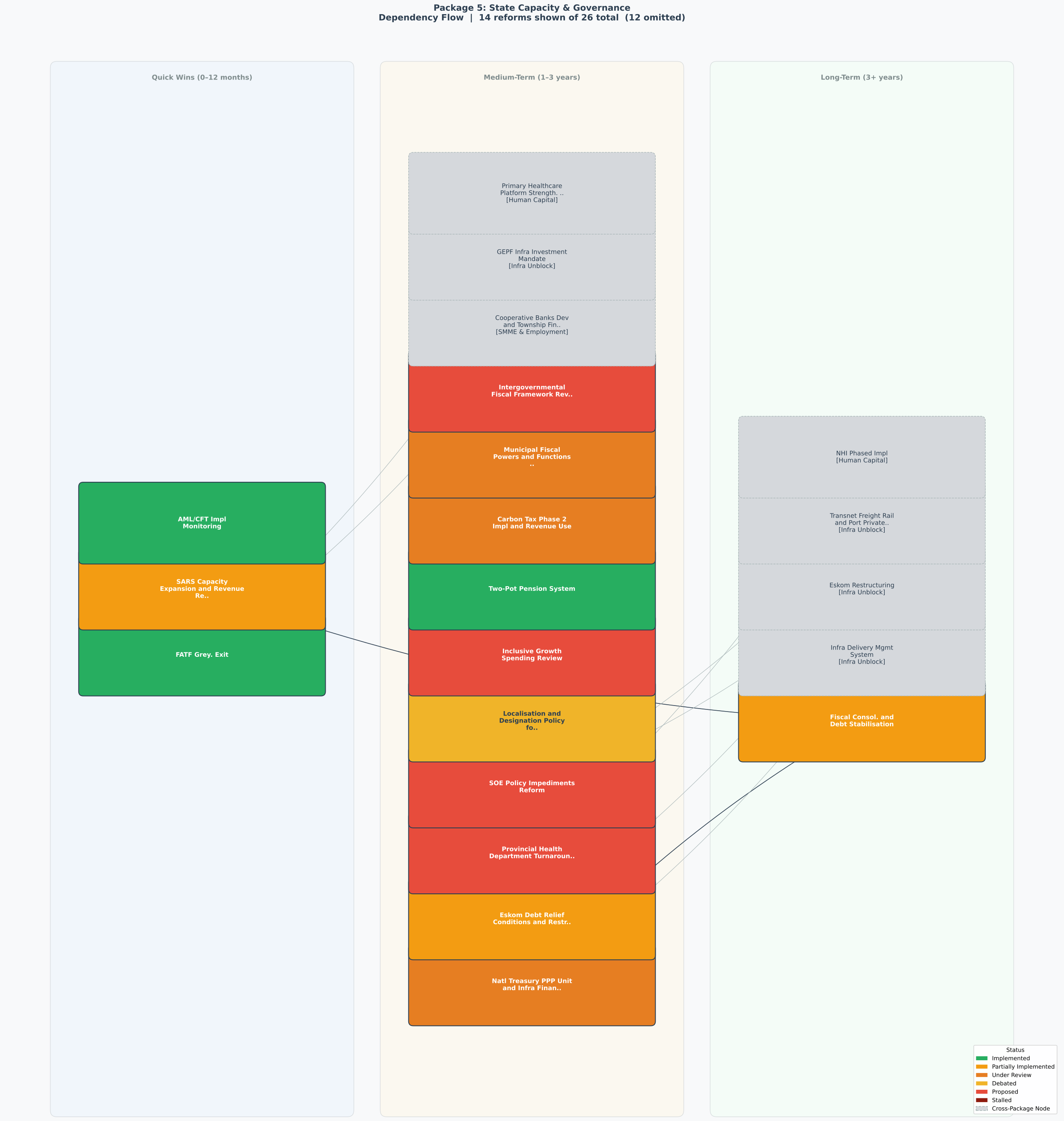
Reform Dependencies
Which reforms in this package enable or unlock others.
Fiscal headroom enables credible PPP/infrastructure financing reform
SARS revenue recovery enables fiscal consolidation path
NCOP AML monitoring strengthens sustainability of FATF exit conditions
SARS capacity data provides accurate revenue baseline for spending review
Inclusive growth spending review delivers expenditure reform enabling fiscal consolidation
Fiscal consolidation framework drives Eskom debt relief conditionality
PPP financing reform enables social infrastructure PPP regulatory framework
Municipal fiscal powers amendment connects to intergovernmental equitable share reform
SOE policy reform enables SAA successor entity viability through PFMA flexibility
SOE policy reform provides framework for Denel strategic equity partnership
Two-pot pension reform reduces pension fund contingent claims on fiscal resources
Carbon tax revenue contributes additional resources for fiscal consolidation
NSFAS fraud prevention reduces contingent fiscal liabilities improving consolidation
FATF exit reduces sovereign risk premium improving fiscal consolidation conditions
Fiscal consolidation review triggers equitable share formula reform
SARS capacity expansion strengthens carbon tax compliance and collection
Provincial health turnaround enables systemic accountability for NSFAS-equivalent fraud prevention
Fiscal consolidation creates tension with inclusive growth spending priorities
NPA prosecution capacity enables SIU asset recovery
Detective capacity feeds NPA prosecution pipeline
Dependency Flow Diagram
See all packages →Visual map of how reforms in this package sequence and unlock each other.
Implementation Roadmap
Sequenced action plan from quick regulatory wins to structural reform, with key dependencies, success metrics, and risk factors.
South Africa was removed from the FATF grey list in October 2024 following passage of the General Laws (Anti-Money Laundering and Combating Terrorism Financing) Amendment Act and the Financial Sector and Deposit Insurance Laws Amendment Act. Maintain compliance to prevent re-listing.
Deploy 2,000 additional auditors targeting high-wealth individuals, transfer pricing, and VAT fraud. Operation Vulindlela and Zondo Commission identified SARS undercapacity as a major revenue leakage. Reversing the 2015–2018 capacity destruction.
Publish and secure Cabinet approval for a plan to reduce the national government SOE portfolio from 700+ entities to below 200, through mergers, liquidations, and privatisations. Addresses the contingent liability overhang.
Implement the PRASA Recovery Plan Phase 2: security force deployment on Metrorail corridors, track rehabilitation on Johannesburg and Cape Town lines. PRASA ridership has collapsed from 2m to 200,000 daily trips since 2015.
Deploy MISA technical support teams to 50 distressed municipalities covering engineering, finance, and supply chain management. Operation Vulindlela priority to restore basic service delivery.
Issue the secondary regulations required to operationalise the Public Procurement Act signed in 2023. Act consolidates Preferential Procurement Policy Framework and establishes the Office of the Chief Procurement Officer.
Implement binding performance contracts for all SOE board members and executives, with public disclosure of targets and outcomes. Apply fit-and-proper standards using the Companies Act and King IV framework.
Operationalise SIU civil recovery orders and NPA prosecutions identified in the Zondo Commission findings. Targets: R500bn in identified losses, estimated 1,000+ prosecutable matters. Requires NPA and SIU capacity investment.
Restore Metrorail operations on Cape Town (all lines), Johannesburg (main corridors), and Tshwane lines by 2027. Requires R40bn capital programme for rolling stock, signalling, and station infrastructure.
Increase NPA prosecutor complement by 500 and establish dedicated commercial crime prosecution units in all provinces. The NPA currently has a 40% vacancy rate in commercial crime units.
Standardise and accelerate COGTA's Section 139 interventions in financially distressed municipalities. Develop a graduated support framework from advisory to full administration.
Migrate national government services to a shared cloud infrastructure, reducing IT fragmentation and enabling cross-departmental data integration. Precondition for e-government at scale.
Stabilise gross national debt below 75% of GDP by FY2025/26 and put it on a declining trajectory. Requires sustained primary balance improvement, SOE bailout containment, and revenue growth from SARS compliance.
Complete sale or winding up of non-strategic SOEs (SA Forestry, SAA minority stake, Alexkor, Safcol) and partial privatisation of commercial SOEs. Reduces contingent liabilities by an estimated R200bn.
Amend legislation to entrench the NPA's operational and budgetary independence and the DPCI (Hawks)'s independence from political interference. Implements Zondo Commission Recommendation 4.7.
Revise the provincial and local government equitable share formula to better reflect service delivery costs, demographic change, and own-revenue capacity. Last major revision was 2009.
Key Dependencies
Greylisting raised SA's risk premium by an estimated 25–50bps and impaired correspondent banking relationships. Exit (achieved October 2024) reduces fiscal pressure and improves banking access.
Every other reform package requires fiscal expenditure. SARS revenue performance is the single most important input to fiscal space — each 1% improvement in compliance yields ~R20bn.
Eskom's R254bn bailout and Transnet's distress absorb fiscal headroom that could fund infrastructure and human capital. SOE reform is a prerequisite for fiscal consolidation.
Without visible prosecutions and asset recovery from state capture, procurement reform norms lack credibility and rent-seeking continues. SIU recovery and NPA prosecutions are the enforcement mechanism.
Collapsed public rail forces workers into expensive and unreliable minibus taxi transport, limiting labour market access in township communities. Rail restoration is a spatial equity intervention.
Success Metrics
| Metric | Current | Target | By |
|---|---|---|---|
| Gross national debt as % of GDP | 74.7% (FY2024/25 Budget) | Stabilise below 75% by FY2025/26 | 2026 |
| SARS revenue above baseline (compliance gains) | R40bn above baseline (FY2023) | R90bn above baseline | 2028 |
| PRASA daily rail ridership | ~200,000 | 600,000 | 2027 |
| Metropolitan municipality clean audit outcomes | ~30% | 50% | 2027 |
| SOE contingent liabilities (excl. Eskom) | ~R600bn | Below R400bn | 2029 |
| Government tenders on Open Tender portal | ~60% | 95% | 2026 |
Risk Factors
NUM, NUMSA, and COSATU have consistently opposed SOE privatisation and restructuring. Coalition government dynamics in the GNU could produce ministerial resistance to any SOE reform that threatens jobs.
SAA, SABC, Denel, Transnet, and the Land Bank have recurring balance sheet crises. Each new bailout request erodes the fiscal consolidation pathway. NT's ability to say no depends on political cover from the Presidency.
The NPA faces a 40% vacancy rate and persistent political interference allegations. Even with Zondo prosecutions prioritised, the judicial backlog means state capture consequences may take 8–10 years to materialise.
The Government of National Unity coalition requires consensus across parties with divergent economic philosophies. Structural reforms (privatisation, NHI renegotiation, LRA amendment) face coalition veto risk.
PRASA has had repeated CEO and board changes that disrupted implementation. Recovery plan continuity requires stable governance for 5+ years — a historically difficult ask for SA parastatals.
Key Stakeholders
Major actors with a stake in this reform package, ranked by influence. Full stakeholder map →
Presidency / Operation Vulindlela
Influence
10/10
Cross-cutting structural reform coordination across energy, logistics, water, digital infrastructure, and visa reform. Operation Vulindlela,…
National Treasury
Influence
9/10
Fiscal consolidation with public debt stabilising below 75% of GDP; structural reforms that improve revenue without expanding contingent lia…
COSATU
Influence
9/10
Worker protections under the Labour Relations Act and Basic Conditions of Employment Act; collective bargaining rights; equitable wage growt…
South African Reserve Bank
Influence
8/10
Price stability under the 3–6% inflation targeting framework; financial system stability under the Twin Peaks prudential model; integrity of…
Business Unity South Africa (BUSA)
Influence
8/10
Cross-sector structural reform across energy security, logistics efficiency, regulatory certainty, labour market flexibility, and digital in…
Eskom
Influence
8/10
Managing R400bn+ debt restructuring with government support; maintaining grid stability during the unbundling transition; preserving technic…
Business Leadership South Africa (BLSA)
Influence
7/10
CEO-level advocacy for structural reform across energy, logistics, digital infrastructure, and investment climate. Runs the CEO Initiative o…
Competition Commission
Influence
7/10
Reducing market concentration and promoting effective competition across freight, telecoms, financial services, food retail, and healthcare.…
NUMSA
Influence
7/10
Metalworker and Eskom employee livelihoods; opposition to the IPP model and Eskom unbundling; preserving state ownership of the electricity…
SAFTU
Influence
6/10
Anti-austerity fiscal policy; nationalisation of strategic sectors; worker and community ownership of public enterprises; opposing structura…
US / AGOA Trade Relations
Influence
6/10
Preferential market access under the African Growth and Opportunity Act (AGOA) for SA textile, automotive, and agricultural exports; investm…
World Bank Group
Influence
6/10
Structural reform technical assistance and Development Policy Loan financing conditional on reform milestones; energy transition support thr…
Dept. of Public Enterprises (DPE)
Influence
5/10
SOE restructuring and shareholder oversight under the PFMA; balancing Eskom and Transnet restructuring with employment protection; implement…
DCDT (Dept. of Communications & Digital Tech)
Influence
5/10
Broadband infrastructure roll-out under SA Connect Phase 2 targeting 100% connectivity by 2030; spectrum allocation coordination; digital ec…
OUTA
Influence
5/10
Fiscal accountability and value for money in public spending; SOE governance and transparency; infrastructure pricing fairness; opposing was…
IMF
Influence
5/10
Fiscal sustainability with public debt stabilising below 80% of GDP; current account stability; SOE contingent liability management; labour…
Financial Sector Conduct Authority (FSCA)
Influence
5/10
Consumer protection in financial markets; retirement fund reform under the Conduct of Financial Institutions (COFI) Act; financial inclusion…
Fintech & Payments Sector
Influence
5/10
Open banking framework enabling third-party data access; Payment Systems Act reform enabling non-bank payment operators in the National Paym…
Section27
Influence
4/10
Constitutional rights to health, education, food, water, and social security under sections 26–29 of the Constitution. Litigates against sta…
Public Affairs Research Institute (PARI)
Influence
3/10
Evidence-based institutional reform; state capacity building across national and subnational government; governance quality analysis; docume…
SERI (Socio-Economic Rights Institute)
Influence
3/10
Socio-economic rights for poor and marginalised communities under the Constitution; land rights and housing security; informal settlement se…
How to cite
Wilse-Samson, L. (n.d.). State Capacity & Governance. SA Policy Space. https://sa-policy-space.vercel.app/packages/5 Live page. Data version: 2026-10-12.218dea82; data as of: 2026-10-12.
Data as of 2026-10-12 · latest PMG meeting 2026-10-09