Trade & Industrial Competitiveness
Align incentives with comparative advantage and compete globally
24
Ideas in this package
3.3/5
Average growth impact
Editorial assessment
3.0/5
Average feasibility
Editorial assessment
Decision Summary
The immediate move, the economic upside, and the coalition and delivery constraints that will determine whether this package actually lands.
Roadmap activity
6/15
Actions completed or in progress
Quick wins open
5
5 first-phase actions
High-severity risks
4
AGOA renewal uncertainty
Stakeholders in play
16
7 champions, 9 swing actors
Next Move
Critical Minerals Beneficiation Strategy — gazette
In progress · DMRE
Economic Case
+1-1.8% GDP by 2030
R210bn private capital for a R95bn public anchor over 5 years.
Delivery Chokepoint
Energy transition (Package 1) -> Green hydrogen production cost
Green hydrogen competitiveness depends entirely on the price of renewable electricity. SA's green hydrogen exports are only viable if REIPPP delivers electricity below R0.50/kWh — requiring Package 1 success.
Coalition Read
Anchor: Presidency / Operation Vulindlela
7 champions, 9 swing actors, 0 hard objections. Highest-leverage persuasion target: National Treasury.
South Africa's productive structure is simultaneously a story of extraordinary natural endowment and relative industrial underperformance. It holds the world's largest reserves of platinum group metals, significant chrome, manganese, titanium, and vanadium deposits, a globally competitive automotive assembly base, and agricultural exports that punch above the country's weight in global specialty markets. Yet its export basket has barely diversified over three decades, its integration into global value chains remains limited, and its share of continental manufacturing has declined relative to faster-moving peers. The Trade & Industrial Competitiveness package addresses the gap between potential and performance.
The theory of change draws on Ricardo Hausmann's product space analysis: South Africa's challenge is not simply to produce more of what it already makes, but to develop productive capabilities that allow movement into adjacent, higher-value activities. Minerals beneficiation is the paradigmatic case — South Africa already has the input endowment, technical base, and global market relationships; what it lacks is a policy environment making value-addition attractive relative to raw-concentrate export. Similarly, the automotive sector's EV transition is not a threat but an opportunity if industrial policy provides the right transition support.
This package requires more institutional sophistication than the others because effective industrial policy is genuinely difficult: it requires the state to identify and support activities where market failures are real, while resisting capture by incumbents seeking protection from competition. The international evidence is clear that the critical success factor is not the choice of sector but the choice of instrument — R&D tax incentives, export-linked performance conditions, and contestable procurement work better than discretionary subsidies.
Diagnostic Context
Binding Constraints Addressed
The primary binding constraint is market failure in productive diversification — the 'self-discovery' problem identified by Hausmann and Rodrik (2003): private returns to discovering that a new product is viable are lower than social returns because competitors can immediately imitate a successful innovator. This problem is most acute in minerals beneficiation, green hydrogen, and advanced manufacturing. Secondary constraints include coordination failures in export market development (individual firms cannot afford the market intelligence and relationship-building that collective action could achieve), missing markets in long-term trade finance, and concentrated domestic markets that reduce competitive pressure on incumbents.
Hausmann-Rodrik-Velasco growth diagnostics framework
Sequencing Rationale
Trade facilitation reforms — AfCFTA implementation, AGOA utilisation maximisation, customs modernisation — are quick wins because they expand the market immediately addressable by existing SA producers without requiring industrial investment. Sector master plans (automotive, steel, agri-processing, minerals beneficiation) are medium-term because they require co-development with industry and investment commitments that take time to materialise. Science, technology, and innovation reforms — increasing GERD, improving IP frameworks, developing the university-to-industry commercialisation pipeline — are long-term because their returns compound over decades. Competition policy reforms run throughout, since concentrated domestic markets are a structural drag on competitiveness across all sectors.
International Precedents
Botswana's renegotiated diamond beneficiation agreement with De Beers (2011) required domestic polishing; within a decade Botswana became the world's second-largest diamond cutting and polishing centre — demonstrating that resource nationalism and private partnership can co-exist when terms are reasonable. Mauritius transformed from a single-crop economy to a diversified financial services and light manufacturing hub between 1970 and 2000, using export processing zones, preferential trade agreements, and active investment promotion. Morocco's automotive ecosystem development — from near-zero to 700,000 vehicles per year in 15 years — shows what African industrial policy can achieve with sustained sectoral focus and strategic investment promotion. South Korea's conditional support for strategic sectors with performance-linked incentives demonstrates that structural transformation is possible within a generation when state capacity is adequate.
Expected Economic Impact
Trade and industrial competitiveness reforms are estimated to add 0.5–1.0 percentage points to annual growth through improved export performance and higher value-added manufacturing. AfCFTA full implementation could increase South Africa's intra-African exports by $50–70 billion over 10 years, given its role as the continent's most diversified industrial producer. Minerals beneficiation at scale could generate R80–120 billion in additional annual GDP by 2035. The green hydrogen economy represents a potential $20–50 billion export opportunity by 2040 if South Africa captures a 5–10% share of projected global demand — a plausible scenario given its solar and wind endowments, existing platinum catalyst production, and deep-water port infrastructure.
Theory of Change
South Africa's economy is too small to grow on domestic demand alone. With a GDPGDP — Gross Domestic Product: The total monetary value of all goods and services produced within a country's borders in a given period. The primary measure of an economy's size and overall output. of roughly $380 billion and structural unemployment above 30%, sustainable growth requires deeper participation in global value chains. AfCFTA creates a $3 trillion continental market; AGOA provides preferential US access; the energy transition creates demand for South African critical minerals and green hydrogen. But capturing these opportunities requires competitive logistics, credible industrial policy, and a regulatory environment that rewards investment.
The package combines trade facilitation (AfCFTA, AGOA, BRICS+ payment systems) with sector-specific master plans (auto, textiles, steel, minerals beneficiation) and the horizontal enablers that make them credible: competition policy, IP reform, and digital markets. Science, technology, and innovation reforms connect commercial R&D to industrial strategy. The theory of change is comparative advantage: South Africa has structural strengths in minerals, automotive assembly, agri-processing, and potentially green hydrogen — industrial policy should reinforce these positions rather than try to create winners from scratch.
Fiscal Impact Estimates
Scenario estimates — not official government projections. See full methodology.
Public investment
R95bn
over 5 years
+ R210bn private capital catalysed
GDP impact
+1–1.8%
by 2030
Jobs created
~230k
direct + indirect
Annual revenue uplift
R52bn/yr
break-even ~8 years
Revenue gains through higher customs receipts (AfCFTA and AGOA export growth), corporate income tax from expanded manufacturing base, and SEZ company tax receipts. The EV transition creates a new R60bn annual export opportunity by 2032 if managed correctly.
Ideas by Time Horizon
Sequencing from quick regulatory wins through institutional reform to structural change.
e-Visa System Rollout for Tourism and Business
South Africa's e-visa system — enabling online visa applications without requiring in-person biometric capture at a DHA mission for initial applications — is intended to substantially reduce the friction that has suppressed tourism and business visitor arrivals. The National Tourism Sector Strategy targets restoring visitor numbers toward the 2019 pre-COVID baseline of 15 million arrivals annually; tourism contributes approximately 2.9% of GDP directly and supports over 700,000 jobs. As of early 2026, the e-visa system has been launched for a limited set of nationalities and visa categories. Expanding e-visa eligibility to the 10 highest-volume source markets would generate an estimated 1-2 million additional annual arrivals.
Merchant Shipping and Maritime Industry Development
South Africa's 3,900 km coastline, two major ocean trade routes, and five commercial ports give it strategic maritime importance, yet the merchant shipping and maritime industry remains underdeveloped. South Africa has no meaningful cabotage policy, limited maritime training capacity through SAMSA's SA Maritime Training Academy, and few SA-flagged vessels. Operation Phakisa's Oceans Economy roadmap and the 2050 Maritime Industry Master Plan identified merchant shipping development as a priority. Reform includes a cabotage policy for coastal trade (reserving coastal cargo for SA-flagged vessels), SAMSA Act amendment to strengthen port state control, and expansion of the Simon's Town and Durban maritime clusters. Parliamentary Committee on Transport BRRRs noted SAMSA's budget is insufficient to enforce port state control effectively, undermining safety and competitive standards at SA ports.
IPR-PFRD Act Reform for Faster R&D Commercialisation
The IPR-PFRD Act (2008), modelled on the US Bayh-Dole Act, governs how IP developed from public R&D funding is commercialised. The National Intellectual Property Management Office (NIPMO) within DSI implements the Act but has been underfunded and understaffed. Key obstacles are mandatory government march-in rights provisions deterring private co-investors, complex disclosure timelines (36 months), and NIPMO's limited capacity for international patent applications. Reform proposals include streamlining the commercialisation timeline to 12 months, removing automatic government retention for non-national-security IP, and co-funding international patent filing through the NRF's IP Fund. A NIPMO Amendment Bill was introduced in Parliament in 2023 but not passed. Industry support for reform is strong; government march-in rights are the political sticking point.
Anti-Dumping and Import Surveillance Modernisation
The International Trade Administration Commission (ITAC) administers South Africa's trade remedy system — anti-dumping, countervailing, and safeguard measures — under the International Trade Administration Act (2002). The system is under-resourced relative to its mandate: investigations average 18–24 months (against the WTO-compliant target of 12), the import surveillance unit has fewer than 15 analysts for a R1.7 trillion import base, and the SARS customs data interface is poorly integrated, causing delays in price comparison and injury determination. The modernisation reform proposes: an ITAC Capacity Enhancement Programme funded through a small levy on trade remedies collected; a real-time import surveillance system using HS code monitoring with automated price threshold alerts; integration of SARS trade microdata into ITAC's price comparison database; and a 6-month fast-track procedure for critical industry investigations (steel, poultry, cement, chemicals). The PC on Trade BRRRs 2023–2024 note that ITAC is the enforcement backbone of every sector master plan but lacks the resources to sustain enforcement. BRICS+ trade expansion complicates the system: tariff remedy actions against BRICS partner imports require diplomatic calibration alongside technical trade law application.
AGOA Retention and Post-AGOA Trade Diversification
The African Growth and Opportunity Act (AGOA) provides duty-free access to the US market for approximately 1,800 South African product categories. SA's AGOA exports—concentrated in vehicles, citrus, wine, and minerals—were valued at USD 2.8 billion in 2023. AGOA's current authorisation expires in September 2025, and renewal on favourable terms requires SA to demonstrate compliance with eligibility criteria including market openness, worker rights, and IP protection. The AGOA Retention Strategy, led by DIRCO and DTIC, involves diplomatic engagement with the USTR, addressing US concerns about SA's IP regulatory approach (Copyright Amendment Bill) and its non-alignment stance on Russia. Simultaneously, the Post-AGOA Diversification Strategy develops contingency plans for EU (TDCA/SADC EPA), UK (SACUM-UK EPA), and AfCFTA alternatives. The PC on Trade's BRRR 2024 flagged both the urgency of AGOA retention and the structural dependence on preferential access as a long-term vulnerability for SA exporters.
SA Satellite Space Programme Commercialisation
South Africa's space programme through SANSA has a legacy in Earth observation and space weather monitoring but limited commercial satellite manufacturing or launch services. The DSI Space Economy Roadmap (2017) and STI Decadal Plan target R21 billion in space economy value and 10,000 jobs by 2030. Geographic positioning near optimal orbital inclinations and the residual capability of Denel Spaceteq offer a foundation for a commercial satellite manufacturing hub. Reform involves establishing a commercial space agency framework, amending the Space Affairs Act (1993), and attracting anchor tenants for a proposed satellite manufacturing cluster at the Cape Peninsula. ESA, NASA, and commercial launch provider partnerships (including Starlink ground operations) are identified leverage points. Parliamentary Committee on Science BRRRs noted SANSA's budget is insufficient for commercial programme development.
Advanced Agri-Tech and Food Systems Cluster
South Africa's agricultural sector contributes 2.5% of GDP while employing 5.5% of the workforce, yet underperforms its potential in technology adoption. Precision agriculture, digital market linkage platforms, cold chain logistics, and agro-processing value addition are underdeveloped relative to Brazil, Kenya, and the Netherlands. The Agri-Tech cluster reform proposes concentrating agri-tech incubation, R&D, and production in SEZs in the Western Cape (wine and horticulture), Limpopo (tropical fruits), and KwaZulu-Natal (sugar and macadamia). DAFF's Agri-Parks programme provides partial infrastructure. Parliamentary Committee on Agriculture BRRRs noted the R14 billion agriculture budget is heavily weighted toward land reform rather than productivity enhancement. DTIC's SEZ framework provides the legal and incentive structure for cluster development.
CSIR 10-Year Foundational Digital Capabilities Research Programme
The CSIR, South Africa's primary applied research institution with 3,000+ researchers and R3.5 billion in annual revenue, is proposed as the anchor institution for a 10-year foundational digital capabilities programme covering AI model development, cybersecurity, quantum computing, and advanced semiconductor design. The programme mirrors Singapore's A*STAR and Germany's Fraunhofer Society, where public research institutes provide industry-connective tissue for digital transformation. The Presidential Commission on the Fourth Industrial Revolution (2019) and DSI's 4IR Initiative both identified CSIR as the natural lead. Parliamentary Committee on Science and Innovation BRRRs noted CSIR's external industry revenue has increased but foundational R&D is crowded out by short-term commercialisation pressure, eroding the long-term research pipeline.
Innovation Fund Scale-up Beyond Pilot Phase
The South African Innovation Fund (IF), established by the DSIT in 2019 as a blended finance vehicle to commercialise university and CSIR research, completed its pilot phase (R1.4 billion committed to 42 portfolio companies) in 2023. Scale-up to R5 billion by 2027—as recommended by the PC on Science and Technology BRRR 2024—requires: a permanent legislative mandate (the IF currently operates under a company structure rather than a statutory framework), co-investment from the PIC and IDC, stronger deal pipeline from universities (through the Technology Transfer Office network), and a dedicated growth-stage fund for companies that have outgrown the IF's early-stage focus but are too small for IDC commercial finance. The DSIT's STI Decadal Plan 2022–2032 sets a 1.5% of GDP R&D target, and the Innovation Fund is the vehicle for translating public R&D expenditure into commercial outcomes. South Africa currently commercialises less than 4% of university patents—the OECD average is 18%.
Technology Innovation Agency 2.0 Reform
The Technology Innovation Agency (TIA), established under the DSI in 2008, provides bridge funding between academic research and commercial scale-up with an annual budget of approximately R900 million. TIA has supported over 200 companies, but its commercialisation success rate—measured by IP licences, spinouts reaching revenue, and jobs created—is below international benchmarks. Reform involves restructuring TIA's mandate to focus on fewer, larger bets aligned with DSI's priority sectors (green hydrogen, mining automation, health biotech), introducing co-investment requirements from industry and VC co-investors, and improving portfolio monitoring. Parliamentary Committee on Science and Innovation BRRRs noted TIA's administrative overhead absorbs 25–30% of budget and that portfolio attrition rates are high relative to comparators like Israel's BIRD Foundation.
Critical Minerals Beneficiation Strategy
South Africa holds among the world's largest reserves of platinum group metals (PGMs), manganese, chrome, vanadium, and titanium — materials critical to clean energy technologies including fuel cells, EV batteries, and electrolysers. The Critical Minerals Beneficiation Strategy, led by DMRE, aims to shift from raw mineral export toward domestic processing and manufacturing of battery precursors, green hydrogen catalysts, and fuel cell components. Incentives include the special economic zone (SEZ) programme, DTI manufacturing support, and Section 12I tax allowances. The strategy directly links to the EU's Critical Raw Materials Act and potential preferential trade terms. Key constraints include unreliable electricity supply for energy-intensive smelting and refining, logistics costs, and skills shortages in metallurgical engineering. As of early 2026, several PGM beneficiation projects are in feasibility stage; the strategy document is published but implementation financing remains fragmented.
BRICS+ Trade Facilitation and Alternative Payment Systems
South Africa assumed the BRICS chairmanship in 2023 and hosted the Johannesburg Summit that expanded the bloc to BRICS+ with Saudi Arabia, UAE, Ethiopia, Iran, Egypt, and Argentina. The trade facilitation agenda under SA's chairmanship prioritised: local currency settlement frameworks to reduce USD dependency in intra-BRICS trade, New Development Bank (NDB, headquartered in Shanghai) expanded rand-denominated lending for infrastructure, and BRICS+ standards harmonisation for mutual recognition of product certifications and SPS measures. The MTBPS 2025 notes that BRICS+ trade accounts for 24% of SA's total trade but 35% of mineral export value — making BRICS+ a strategically irreplaceable commercial relationship. The South African Reserve Bank's Project Khokha 2 explored CBDC (Central Bank Digital Currency) interoperability as the settlement infrastructure. The PC on Finance BRRRs flag a structural tension: deepening BRICS+ engagement (including the Russia relationship) complicates SA's AGOA retention, FATF greylisting exit, and diplomatic standing with the EU. Alternative payment systems development must be calibrated not to trigger secondary sanctions exposure or correspondent banking withdrawal by Western financial institutions.
Automotive Production and Development Programme (APDP Phase 2) Enhancement
The Automotive Production and Development Programme (APDP), which replaced the Motor Industry Development Programme (MIDP) in 2013, uses a production incentive (R400–600 per locally-produced vehicle) and assembly allowance (duty credit certificates for component imports offsetting 30% of import duty) to support domestic vehicle assembly and component manufacturing competitiveness. APDP Phase 2 enhancements (2021–2035) extend the core production incentive, introduce a new component manufacturer rebate to deepen local content, and add a volume assembly allowance for manufacturers above 50,000 units per year. The programme's total fiscal cost is approximately R12 billion per year in foregone customs duty and direct incentives, supporting an industry that generates R210 billion in export revenue. ITAC administers the duty credit mechanism, while DTIC manages the investment incentive. The BRRR synthesis from the PC on Trade flags the APDP's role in retaining Toyota's Prospecton plant investment and Ford's Silverton expansion (R15.8 billion committed), but notes that the EV transition requires APDP Phase 3 design to begin immediately, as current APDP incentives are ICE-platform-agnostic and may not optimally incentivise EV investment.
BBBEE Equity Equivalent Investment Programme (EEIP) Expansion
The Equity Equivalent Investment Programme (EEIP), established under the B-BBEE Codes of Good Practice, allows multinationals that cannot undertake direct empowerment ownership (typically due to global stock exchange constraints) to make prescribed investments in skills development, supplier development, or enterprise development as a proxy for ownership points. Current approved EEIPs include Microsoft's Skills to Succeed initiative, Ford's enterprise supplier development fund, and pharmaceutical company R&D commitments. The DTIC's EEIP Expansion proposes: sector-specific EEIP frameworks for fintech, mining services, and agro-processing; raising the minimum investment threshold (currently benchmarked at 25% of South African net value); establishing mandatory outcome monitoring with independent verification; and linking EEIP to technology transfer and skills development funding to ensure additionality beyond what companies would do commercially anyway. The reform addresses the widespread criticism that BBBEE compliance has become a formulaic checklist exercise rather than a genuine transformation instrument. The PC on Trade BRRRs note that EEIP approval backlogs at the DTIC (averaging 18 months) deter multinationals from applying, reducing transformation investment that could flow voluntarily.
Digital Platforms Competition Framework (Buyer Power Regulations)
Following the Competition Amendment Act 2018's introduction of buyer power provisions for designated sectors (initially agri-food), the Competition Commission and DTIC proposed extending buyer power regulations to digital platform markets in 2024. The framework targets three platform categories: online marketplaces (where dominant platforms impose extractive commission structures on third-party sellers — Takealot charges 6–30% depending on category), app stores (where 15–30% Apple/Google commissions are under global regulatory scrutiny), and payment platforms (where interchange fee structures disproportionately affect SMME financial inclusion). South Africa's competition law framework — recognised as among the most progressive in the Global South — already includes complex merger assessment, excessive pricing provisions (Section 8), and abuse of dominance remedies. The Digital Platforms Framework builds on Online Intermediation Platforms Market Inquiry findings and aligns with EU Digital Markets Act standards, positioning SA as a regulatory reference for African digital markets governance. The SMME Development Committee (NCOP) flagged that high platform commissions reduce SMME e-commerce viability, directly linking digital competition policy to employment outcomes.
Poultry Industry Anti-Dumping and Local Production Expansion
South Africa's poultry industry — employing approximately 36,000 workers directly and another 30,000 in feed, hatcheries, and processing — is under sustained pressure from imports of bone-in chicken portions, primarily from Brazil and the EU. ITAC investigations confirmed dumping margins of 13–62% on EU imports, leading to provisional anti-dumping duties in 2022 and final determinations in 2023. The Poultry Master Plan (2019–2023, under review), a social compact between DTIC, Astral Foods, Rainbow Chicken, SARI (SA Poultry Association), and AMCU/FAWU, targeted a 25% reduction in imports and 26,000 additional jobs — partially met. The 2025 review focuses on: extending and deepening anti-dumping duties, addressing feed cost competitiveness (yellow maize and soya meal pricing affected by drought and import logistics), expanding cold chain infrastructure in rural areas, and accelerating halal certification to open the African export market. Zimbabwe, Zambia, and Mozambique represent significant near-term export opportunities as AfCFTA implementation proceeds. The PC on Agriculture BRRRs 2023–2024 flag avian influenza biosecurity and small-scale poultry producer exclusion from master plan benefits as gaps requiring attention.
Special Economic Zones Reform
South Africa's Special Economic Zones programme, established under the SEZ Act (2014) and administered by DTIC, encompasses 11 designated zones including Coega, OR Tambo, East London IDZ, and the embattled Nkomazi SEZ. The programme offers investors tax concessions (15% corporate tax vs 27%), customs duty relief, employment incentives, and one-stop-shop regulatory services. However, uptake has been uneven: established zones (Coega IDZ, East London IDZ) attract significant investment, while newer zones like Nkomazi remain largely unoccupied despite years of infrastructure investment and preparation. The PC on Trade BRRR 2024 cited governance failures at Nkomazi, unresolved traditional leader land disputes, and inadequate utilities as root causes. The reform proposes: rationalising the portfolio to 6–8 high-performing zones, strengthening the SEZ Advisory Board, mandating performance contracts with annual investment and job targets, and linking SEZ infrastructure investment to the IDMS framework to improve project execution. The MTBPS 2025 allocates R4.2 billion to SEZ infrastructure over the MTEF period.
Retail-Clothing, Textile, Footwear and Leather (R-CTFL) Master Plan
The R-CTFL Master Plan (2019–2030), a multi-party social compact between DTIC, organised labour (SACTWU), retailers (SACCI/RFI), and manufacturers, targets doubling the sector's contribution to GDP and employment by 2030 through a combination of import controls, localisation commitments from retailers, and productivity-linked investment support. The master plan's central mechanism is voluntary retailer commitments to source 65% of designated product categories locally by 2030 (up from 44% in 2019), facilitated by a designated products list under the Preferential Procurement Regulations. SARS anti-dumping investigations against Chinese and Bangladesh textile imports are complementary. The PC on Trade BRRRs flagged under-performance on retailer localisation commitments and noted that customs fraud (under-invoicing of imports) undermines the economic case for local procurement. The sector employs approximately 120,000 workers, concentrated in the Eastern Cape and KwaZulu-Natal.
Steel and Metal Fabrication Master Plan
The Steel and Metal Fabrication Master Plan (2021–2030), developed under the DTIC Masterplans process in partnership with Arcelor Mittal SA, Columbus Stainless, and the Steel and Engineering Industries Federation of Southern Africa (SEIFSA), aims to stabilise the domestic steel industry, retain industrial capacity, and develop downstream fabrication sectors. The master plan introduces safeguard duties on steel imports (activated by ITAC in 2023), local procurement designations for public infrastructure projects, and a Steel Development Fund to support energy efficiency and competitiveness upgrades in the sector. The context is challenging: Arcelor Mittal SA announced the closure of its Longs division in 2024 (affecting 3,500 workers), citing energy costs, cheap Chinese imports, and infrastructure bottlenecks at Transnet. The Energy Bounce-Back scheme directly addresses energy cost competitiveness for steel producers. The master plan's success depends on simultaneous progress in energy reform, logistics, and procurement localisation, making it one of the most dependency-intensive items in the reform agenda.
EV White Paper — Managed Automotive Transition
The South African Electric Vehicles White Paper (2023), led by the DTIC in consultation with NAACAM, NAAMSA, and the automotive OEMs (Toyota, VW, BMW, Ford, Isuzu), charts a managed transition of the domestic automotive sector from internal combustion engine (ICE) to electric vehicle production. SA's automotive sector employs 110,000 direct workers and 440,000 in the supply chain, contributing 4.9% of GDP and R210 billion in exports annually under AGOA and TDCA preferential access. The White Paper proposes: extending the APDP (Automotive Production and Development Programme) to Phase 3 with EV-specific investment allowances, developing an EV charging infrastructure rollout plan in partnership with municipalities, establishing a battery cell assembly facility (linked to the Critical Minerals Beneficiation Strategy, id=45), and creating an EV skills transition programme through MERSETA. The critical policy tension is managing the transition: ICE vehicle exports to the US (under AGOA) remain the industry's main revenue source through 2030, while EV platform investment decisions by global OEMs must be secured by 2025–2026 for 2030+ production. The PC on Trade BRRRs 2023–2024 flag the EV White Paper implementation timeline as behind schedule.
Competition Commission Digital Markets Inquiry
The Competition Commission launched its Online Intermediation Platforms Market Inquiry (OIPMI) in 2021, investigating market power in digital platforms including online food delivery (Uber Eats, Mr D Food), e-commerce (Takealot/Makro), app stores (Apple, Google), and online classifieds. Interim remedies issued in 2023 include mandatory listing of rival products on dominant platforms, prohibition on parity pricing clauses, and data access rights for third-party sellers. The final report (2024) recommends structural remedies modelled on the EU Digital Markets Act — including mandatory data portability, interoperability requirements, and algorithm transparency obligations. The Digital Platforms Competition Framework extends buyer power regulations (introduced in the Competition Amendment Act 2018 for agri-food markets) to digital platform markets. The PC on Trade BRRRs note the inquiry's significance for SMME market access: over 60% of South African SMMEs report digital platforms as their primary sales channel, making platform governance a small business policy issue as much as a competition one. App store commission rates of 15–30% are specifically flagged as an excessive pricing concern under Section 8 of the Competition Act.
Copyright Amendment Bill — Fair Use and Digital Access Reform
The Copyright Amendment Bill (CAB), passed by Parliament in 2022 but returned unsigned after President Ramaphosa declined assent citing AGOA-related IP concerns raised by the US USTR, is South Africa's most contested intellectual property reform in two decades. The bill introduces a flexible fair use doctrine (replacing the closed fair dealing provisions of the Copyright Act 98 of 1978), creates a digital copyright framework for online platforms, and establishes exceptions for education, research, and persons with disabilities in line with the Marrakesh Treaty. The AGOA complication: the USTR identified the CAB's fair use provisions as potentially inconsistent with the TRIPS Agreement three-step test, threatening preferential market access if signed. The PC on Trade BRRRs 2022–2024 document the tension between educational access advocates requiring fair use for digital learning and creative industry stakeholders (SAMRO, publishers) concerned about revenue loss. A revised CAB must satisfy TRIPS Article 13 while preserving meaningful educational fair use and implementing Marrakesh disability access commitments. The DTI and DIRCO are managing the diplomatic and legislative tracks in parallel.
Indigenous Knowledge Systems IP and Commercialisation Framework
South Africa is signatory to the CBD and Nagoya Protocol, requiring formal access and benefit-sharing (ABS) frameworks for commercialising indigenous knowledge systems (IKS) in biodiversity products and traditional medicine. The IP Laws Amendment Act (2013) created an IKS database through CIPC, but implementation has been slow. The rooibos ABS agreement (2019), which secured R1.5 million in annual payments to San and Khoikhoi communities, provides a working model. The Hoodia cactus case illustrated biopiracy risks where SA failed to protect community interests. The DSI's revised IKS Policy (2023) needs legislative backing through the Traditional Knowledge Bill, in draft since 2017. Parliamentary Committee on Trade and Industry BRRRs noted the backlog of IKS protection cases and the absence of a funded NIPMO-equivalent for traditional knowledge management.
Reform Dependencies
Which reforms in this package enable or unlock others.
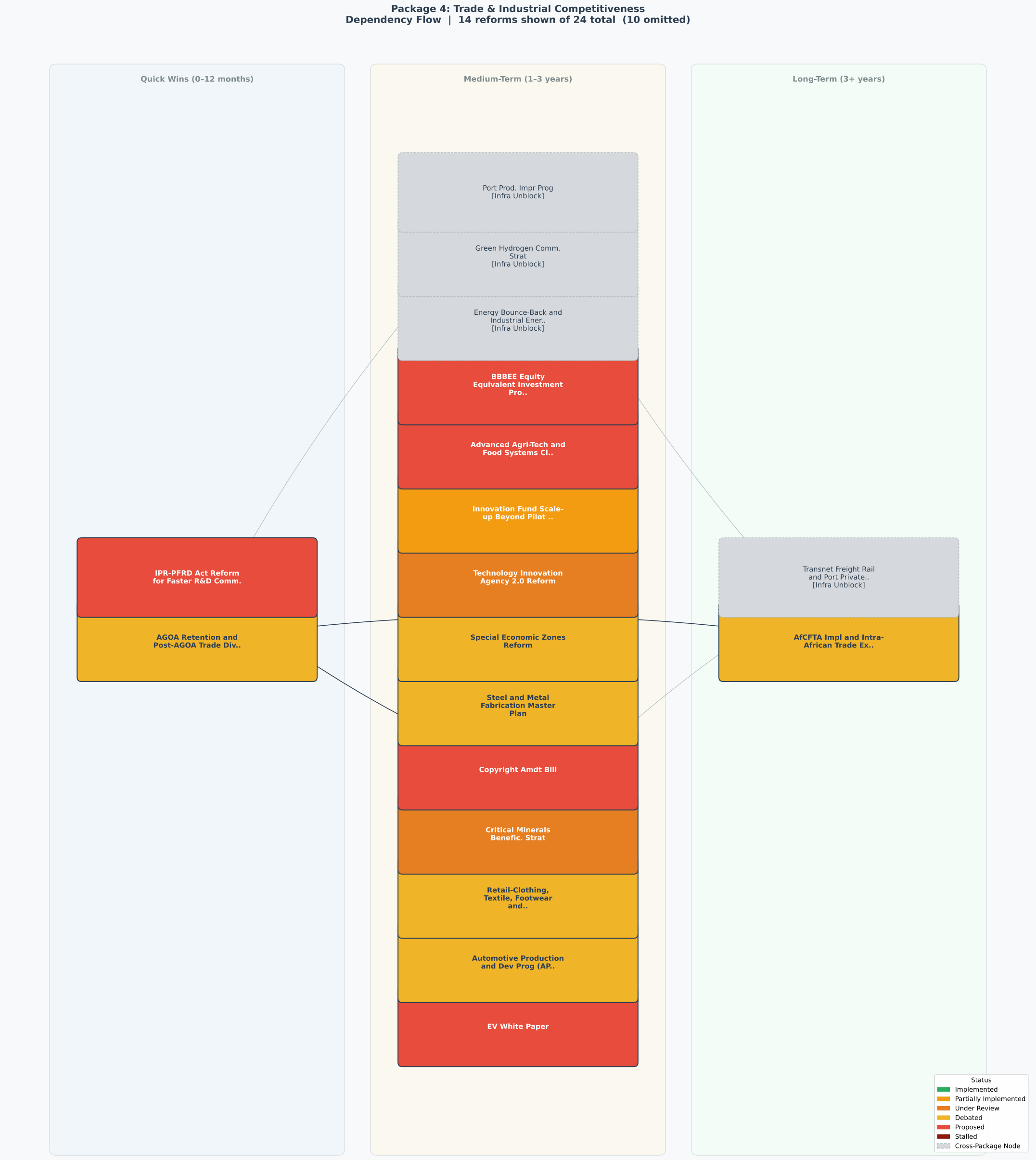
AfCFTA trade diversification reduces AGOA dependency risk
SEZs provide platform for R-CTFL manufacturing clusters
SEZs provide platform for critical minerals beneficiation
Critical minerals beneficiation feeds steel sector inputs
TIA 2.0 reform enables innovation fund scale-up
IPR Act reform enables copyright and digital access reform
Innovation fund scale-up supports advanced agri-tech cluster
Anti-dumping surveillance modernisation enables more effective poultry industry protection
Poultry anti-dumping protection may conflict with AfCFTA trade liberalisation obligations
Dependency Flow Diagram
See all packages →Visual map of how reforms in this package sequence and unlock each other.
Implementation Roadmap
Sequenced action plan from quick regulatory wins to structural reform, with key dependencies, success metrics, and risk factors.
Publish the DMRE Critical Minerals Strategy as a gazetted government policy, establishing SA's position on PGMs, manganese, vanadium, and lithium beneficiation targets. Required to unlock EU critical minerals partnership investment.
Secure Cabinet approval for the Electric Vehicles White Paper setting out SA's managed automotive transition strategy. Resolves the policy uncertainty that is delaying OEM investment decisions on EV assembly in SA.
Gazette South Africa's AfCFTA implementation priorities — tariff schedules, sanitary and phytosanitary measures, and services sector commitments — providing business with the regulatory roadmap for continental expansion.
Publish a sector-by-sector AGOA utilisation strategy targeting undercaptured categories (apparel, processed food, automotive parts). SA currently uses AGOA preferences for <40% of eligible exports.
Reduce the SEZ establishment and licence approval period from the current 18+ months to 6 months through process reform and a single window for SEZ investors. Immediate action available within existing DTIC mandate.
Implement 90% of SA's goods tariff reduction commitments under AfCFTA, phased over 2025–2028. Requires ITAC schedule amendments and customs system updates. Unlocks continental market access for manufacturers.
Launch a dedicated green hydrogen IPP procurement round under the REIPPP framework, targeting 1GW of electrolyzer capacity. Requires off-take agreement framework and port hydrogen bunkering infrastructure.
Revise the Automotive Production and Development Programme incentives to reward investment in EV component manufacturing (battery packs, electric drivetrains) alongside ICE production. Prevents SA from being stranded in the EV transition.
Secure investment for three new battery minerals beneficiation facilities: PGM refining expansion, lithium cathode materials, and vanadium flow battery production. Requires DFI co-investment and streamlined environmental authorisations.
Finalise and operationalise the SA-EU Strategic Minerals Partnership announced in 2023, securing European investment commitments for beneficiation in exchange for preferential minerals supply access.
Implement the findings of the ongoing digital markets inquiry into platform dominance, data portability, and interoperability. Enables SA fintech and digital economy firms to compete against global platforms.
Establish South Africa as a competitive green hydrogen and green ammonia exporter, leveraging its renewable energy resources and PGM-based catalyst production. Requires port infrastructure, pipeline investment, and off-take agreements with European utilities.
Attract R50bn in new investment in battery minerals beneficiation by 2030, moving SA up the value chain from raw ore to cathode materials and battery components. Requires long-term mining rights stability and competitive electricity prices.
Achieve R100bn in additional exports to continental Africa by 2030 through AfCFTA tariff liberalisation, pan-African payment systems, and customs corridor agreements.
Achieve 10% of South African vehicle production being EV by 2030, through APDP incentive alignment, OEM investment attraction, and local EV component supply chain development.
Key Dependencies
Green hydrogen competitiveness depends entirely on the price of renewable electricity. SA's green hydrogen exports are only viable if REIPPP delivers electricity below R0.50/kWh — requiring Package 1 success.
SEZs and APDP beneficiation depend on a supply of qualified manufacturing workers. TVET artisan pipeline transformation is the upstream prerequisite.
AfCFTA and AGOA export competitiveness improvements are negated if port logistics costs add 15–30% to export costs. Package 1 port reform is a precondition for competitive exports.
SEZ investment attraction requires credible governance, reliable customs, and IP protection. Without Package 5 state capacity reform, investor confidence in SEZ commitments remains weak.
Success Metrics
| Metric | Current | Target | By |
|---|---|---|---|
| Annual FDI inflows | R150bn (2023 SA Investment Conference) | R250bn per annum | 2027 |
| Non-mineral merchandise exports | ~R600bn annually | 10% annual growth | 2028 |
| Green hydrogen first commercial export contract | Pre-commercial (pilots only) | First commercial contract | 2027 |
| Vehicle export volumes (APDP) | ~400,000 units per year | Maintain volume through EV transition | 2028 |
| Intra-Africa exports | ~R250bn | R350bn (+40%) | 2028 |
Risk Factors
AGOA expires in September 2025. US Congressional renewal is uncertain and SA's geopolitical positioning (BRICS, Russia relations) creates political risk. Non-renewal would cost R50bn+ in automotive and textile exports.
EU CBAM full implementation from 2026 will impose carbon costs on SA steel, aluminium, and cement exports. SA's carbon pricing system is not yet accepted as equivalent — exports face a 20–30% cost increase.
BYD, Chery, and SAIC are entering the SA domestic market at prices that undercut APDP-supported local assembly. If OEMs lose domestic market share, the volume basis for APDP export incentives collapses.
Industrial-scale green hydrogen requires large quantities of desalinated water and land for solar/wind farms. Environmental authorisation backlogs and water licence delays could stall projects.
Minerals beneficiation (smelting, refining) requires cheap, reliable power. Eskom's tariff trajectory — driven by cost-recovery pricing — threatens the comparative advantage in energy-intensive industries.
Key Stakeholders
Major actors with a stake in this reform package, ranked by influence. Full stakeholder map →
Presidency / Operation Vulindlela
Influence
10/10
Cross-cutting structural reform coordination across energy, logistics, water, digital infrastructure, and visa reform. Operation Vulindlela,…
National Treasury
Influence
9/10
Fiscal consolidation with public debt stabilising below 75% of GDP; structural reforms that improve revenue without expanding contingent lia…
South African Reserve Bank
Influence
8/10
Price stability under the 3–6% inflation targeting framework; financial system stability under the Twin Peaks prudential model; integrity of…
Business Unity South Africa (BUSA)
Influence
8/10
Cross-sector structural reform across energy security, logistics efficiency, regulatory certainty, labour market flexibility, and digital in…
DTIC (Dept. of Trade, Industry & Competition)
Influence
7/10
Industrial policy objectives — local content requirements, beneficiation, BBBEE transformation, SEZ development, and protection of manufactu…
Business Leadership South Africa (BLSA)
Influence
7/10
CEO-level advocacy for structural reform across energy, logistics, digital infrastructure, and investment climate. Runs the CEO Initiative o…
Competition Commission
Influence
7/10
Reducing market concentration and promoting effective competition across freight, telecoms, financial services, food retail, and healthcare.…
National Union of Mineworkers (NUM)
Influence
7/10
Mining employment security and worker safety; just transition pace that protects coal-dependent community livelihoods; collective bargaining…
DMRE (Dept. of Mineral Resources & Energy)
Influence
6/10
Regulatory oversight of energy generation licensing and mineral rights under the ERA and MPRDA; managing the REIPPP procurement programme; c…
ICASA
Influence
6/10
Spectrum licensing and management; competition regulation in electronic communications; consumer protection; broadband connectivity targets…
Renewable Energy IPP Developers
Influence
6/10
REIPPP Bid Window pipeline certainty; wheeling tariffs at cost-reflective transmission charges; grid access and connection timelines; bankab…
US / AGOA Trade Relations
Influence
6/10
Preferential market access under the African Growth and Opportunity Act (AGOA) for SA textile, automotive, and agricultural exports; investm…
DCDT (Dept. of Communications & Digital Tech)
Influence
5/10
Broadband infrastructure roll-out under SA Connect Phase 2 targeting 100% connectivity by 2030; spectrum allocation coordination; digital ec…
European Union / JETP Partners
Influence
5/10
Just Energy Transition Partnership — €8.5bn committed for SA's coal transition; renewable energy scale-up and coal community support; Carbon…
Telkom
Influence
5/10
Fibre network monetisation across SA's largest fibre backbone; spectrum position relative to MTN and Vodacom; competitive response to mobile…
Equal Education
Influence
4/10
School infrastructure quality and safety; electrification of schools in underserved areas; broadband connectivity in education; equitable re…
How to cite
Wilse-Samson, L. (n.d.). Trade & Industrial Competitiveness. SA Policy Space. https://sa-policy-space.vercel.app/packages/4 Live page. Data version: 2026-10-13.a85db628; data as of: 2026-10-13.
Data as of 2026-10-13 · latest PMG meeting 2026-10-09