Infrastructure Unblock
Remove physical bottlenecks that constrain all economic activity
51
Ideas in this package
3.7/5
Average growth impact
Editorial assessment
3.2/5
Average feasibility
Editorial assessment
Decision Summary
The immediate move, the economic upside, and the coalition and delivery constraints that will determine whether this package actually lands.
Roadmap activity
10/18
Actions completed or in progress
Quick wins open
4
6 first-phase actions
High-severity risks
3
Eskom union resistance to unbundling
Stakeholders in play
22
7 champions, 13 swing actors
Next Move
IRP 2024 gazette and approval
In progress · DMRE
Economic Case
+2.5-3.5% GDP by 2030
R630bn private capital for a R220bn public anchor over 5 years.
Delivery Chokepoint
NERSA independence -> Competitive electricity market
Without an independent regulator, market rules lack credibility and private investors cannot price risk. NERSA independence is the legal foundation for all market reform.
Coalition Read
Anchor: Presidency / Operation Vulindlela
7 champions, 13 swing actors, 2 hard objections. Highest-leverage persuasion target: COSATU. Hardest resistance to manage: NUMSA.
South Africa's infrastructure deficit is both its most visible economic problem and its most tractable one. Unlike deficits in human capital — where today's investment takes a decade to appear in the workforce — infrastructure investment pays dividends relatively quickly: a mine that cannot export, a factory running diesel generators, a logistics chain adding weeks to delivery times all respond to physical improvements within years, not decades. The Infrastructure Unblock package targets the bottlenecks where constraint relief yields the highest cross-sectoral growth multiplier.
The energy anchor dominates everything else. Load-shedding destroyed an estimated R338 billion in output between 2020 and 2024, suppressing investment confidence across every sector. EskomEskom: South Africa's national electricity utility and dominant power producer, transmitter, and distributor. Eskom's debt crisis and maintenance failures have been a primary cause of load shedding and a binding constraint on economic growth.'s recovery and liberalisation of electricity generation under the Electricity Regulation Amendment Act are the most time-critical reforms in this package — they unlock the returns to virtually every other investment in the economy. Parallel reforms to Transnet's port and rail operations address the logistics corridor that exporters, miners, and manufacturers depend on.
The package is deliberately front-loaded with regulatory changes requiring no capital outlay. Removing licensing thresholds for self-generation, establishing NERSANERSA — National Energy Regulator of South Africa: The regulatory authority for the electricity, piped-gas, and petroleum pipelines industries in South Africa. NERSA approves Eskom's tariff applications and licenses new electricity generators.'s independence, and updating the Integrated Resource Plan change incentive structures and crowd in private capital at minimal fiscal cost. Capital-intensive network expansions follow once the regulatory platform is in place — a sequencing principle that distinguishes workable infrastructure reform from expensive fiscal sinkholes.
Diagnostic Context
Binding Constraints Addressed
In the Hausmann-Rodrik-Velasco diagnostic framework, this package addresses low social returns arising from infrastructure failure. Electricity, logistics, and water deficits raise the cost of all economic activity — not by raising the price of any single input but by imposing premium costs (diesel backup, alternative logistics, water storage) that erode margins and make SA producers uncompetitive at the margin of global value chain participation. A secondary constraint is the coordination failure inherent in network industries: electricity grids, rail networks, and ports are natural monopolies where private actors cannot solve the coordination problem unilaterally, requiring state action to restructure the market.
Hausmann-Rodrik-Velasco growth diagnostics framework
Sequencing Rationale
Regulatory liberalisation comes first because it can be achieved by amendment and immediately changes private sector incentive structures without fiscal outlays. NERSA independence, self-generation deregulation, and the IRP update are 12-month deliverables. Institutional restructuring — Eskom unbundling, Transnet governance reform — follows because it requires legislative change and management capacity-building. Capital-intensive infrastructure (transmission expansion, port deepening, water treatment investment) comes last, partly financed by the private capital that prior regulatory reform has already crowded in. Inverting this sequence — deploying capital before the regulatory environment changes — creates fiscal sinkholes, as South Africa's own history of Eskom capital programmes demonstrates.
International Precedents
Chile reformed its electricity sector in the 1980s, separating generation from transmission and distribution and creating an independent regulator. By the 2000s, Chile had Latin America's lowest electricity tariffs and most reliable supply, attracting substantial mining investment — the lesson being that regulatory restructuring precedes investment, not the reverse. India's Electricity Act (2003) opened generation to competition; capacity grew from 112 GW to over 400 GW by 2022. Colombia's logistics reform (CONPES 3547, 2008) and subsequent port modernisation reduced logistics costs for exporters by an estimated 15% over a decade. Kenya's geothermal corridor demonstrates that state development corporations can effectively de-risk private generation investment when governance is competent.
Expected Economic Impact
Full implementation is estimated to add 1.5–2.5 percentage points to South Africa's potential GDP growth rate, with the energy reforms accounting for roughly half. Eskom stabilisation and competitive generation reform are expected to reduce electricity costs for industrial users by 20–30% in real terms within 5 years. Transnet and port reforms could reduce logistics costs for exporters by 15–20%, improving competitiveness in manufacturing and agri-processing. The package is estimated to catalyse R300–400 billion in private infrastructure investment over 10 years, with fiscal multipliers meaning each rand of public enabling investment generates R2–4 in private capital deployment.
Theory of Change
South Africa's growth ceiling is set by infrastructure failure. Load-shedding cuts industrial output by an estimated 5–7% of potential GDPGDP — Gross Domestic Product: The total monetary value of all goods and services produced within a country's borders in a given period. The primary measure of an economy's size and overall output.; dysfunctional ports and rail add 15–30% to logistics costs for exporters; deteriorating roads raise transport poverty in rural areas. These bottlenecks interact: an SMME that survives power cuts still cannot compete internationally if Transnet cannot move its goods reliably. Infrastructure reform therefore carries the highest cross-sector growth multiplier of any package.
The package is sequenced around the energy anchor: Eskom restructuring and the Electricity Regulation Amendment Act create the competitive platform; grid expansion and renewables integration deliver the supply; and parallel Transnet and port reforms unblock the logistics corridor. Water and digital infrastructure close the gap. Most reforms here require institutional change and capital, placing the majority in the medium-term — but quick regulatory wins (NERSA independence, self-generation licensing, IRP update) can deliver measurable relief within a year.
Fiscal Impact Estimates
Scenario estimates — not official government projections. See full methodology.
Public investment
R220bn
over 5 years
+ R630bn private capital catalysed
GDP impact
+2.5–3.5%
by 2030
Jobs created
~280k
direct + indirect
Annual revenue uplift
R85bn/yr
break-even ~9 years
Uplift through reduced load-shedding costs (~R204bn/yr per Eskom estimates), logistics efficiency gains on Transnet corridor, and economic-activity multiplier. Does not capture avoided-cost savings to households and firms from ending load-shedding.
Ideas by Time Horizon
Sequencing from quick regulatory wins through institutional reform to structural change.
IMT Spectrum Auction Completion (ICASA)
ICASA concluded its high-demand spectrum auction on 17 March 2022, following the opt-in phase on 8 March and the main stage from 10 March. The auction covered 700 MHz, 800 MHz, 2600 MHz and 3500 MHz and generated R14,477,889,512.60 in financial commitments. One 2x10 MHz lot in the 800 MHz band remained unsold. This record marks completion of the auction, not completion of network rollout or demonstrated reductions in data prices. Licences include coverage and public-institution connectivity obligations; operator-specific conditions and subsequent compliance need to be checked against the issued licences and monitoring reports. The previously stated universal 30% rural coverage requirement within five years has not been substantiated and is withdrawn.
Rapid Deployment Policy for Telecommunications Infrastructure
South Africa's Rapid Deployment Policy (RDP) for electronic communications infrastructure, issued under the Electronic Communications Act, is designed to reduce the time and cost of obtaining wayleave rights, municipal construction approvals, and environmental authorisations for towers, fibre ducts, and small cells. Historically, mobile operators and ISPs faced 18-36 month approval timelines, with municipalities levying inconsistent and excessive fees that deterred rural rollout. The Electronic Communications Amendment Act and subsequent ICASA facilities leasing regulations (updated 2024) provide for deemed consent, standardised wayleave fees, and mandatory co-location on towers and access to dark fibre to prevent infrastructure duplication. Operation Vulindlela Phase II identified RDP enforcement at local government level as a priority.
Digital TV Migration and Analogue Switch-Off
South Africa's transition from analogue to digital terrestrial television (DTT) using the DVB-T2 standard is among the most persistently delayed policy deliverables in post-apartheid infrastructure history — originally planned for 2011, it has been deferred multiple times due to procurement disputes, an encoding policy impasse, and contested set-top box (STB) subsidies. The analogue switch-off (ASO) matters beyond broadcasting: completing it frees the "digital dividend" spectrum in the 694-862 MHz range, low-band frequencies essential for affordable rural mobile broadband and central to 5G coverage economics. SENTECH manages DTT signal distribution; the SABC and e.tv are the primary transitioning broadcasters. An estimated 3.5-5 million qualifying low-income households require state-subsidised STBs. A 2023 settlement resolved the encoding policy dispute. As of early 2026, the ASO has been completed in some regions but not nationally.
Railway Safety Regulator: Independent Enforcement Capacity
The Railway Safety Regulator (RSR), established under the National Railway Safety Regulator Act (2002), oversees all railway operators across approximately 23,000 km of track—including Transnet Freight Rail, PRASA, and private industrial railways—but is persistently underfunded relative to its mandate. The RSR has fewer than 200 inspectors for the full network. PRASA train collision incidents (Kempton Park 2018, Cape Town 2019) and Transnet locomotive failure patterns highlighted the RSR's limited investigative capacity. Reform involves increasing the RSR's budget, granting independent enforcement powers parallel to the NERSA model, and mandating independent accident investigation through an AIIB-style board separate from the RSR itself. Parliamentary Committee on Transport BRRRs noted the RSR cannot effectively enforce compliance against large state operators like Transnet, which has a self-interest in minimising regulatory intervention.
National Nuclear Regulator — Capacity for New Build Oversight
South Africa's nuclear build programme—Koeberg Unit 3 planning and IRP 2019 allocation of 2,500 MW of new nuclear—requires the National Nuclear Regulator (NNR) to scale technical oversight capacity for construction, not merely operations. Current NNR staffing is calibrated for Koeberg's existing two units. Cabinet approved the nuclear procurement programme in 2023. Parliamentary Committee on Mineral Resources BRRRs noted the NNR's budget has not kept pace with the expanded oversight mandate, risking safety gaps. International partnerships with the IAEA and bilateral agreements with France (EDF) and South Korea (KEPCO) are under active negotiation. The reform involves NNR Act amendment, a staffing plan, and budget increase sufficient to hire and retain nuclear engineers.
Fuel Price Regulation Reform — Partial Deregulation
South Africa's regulated fuel price mechanism, governed by the DMRE, uses a basic fuel price formula based on international benchmarks plus fixed levies and distribution margins. Reform proposals call for partial deregulation of inland retail margins while retaining regulation of the fuel levy and RAF components. The existing single-price model suppresses investment in alternative fuels (LPG, CNG) and new market entrants. The Energy White Paper (2019) and Competition Commission market inquiry (2023) both identified the regulated model as a barrier to efficiency. Parliamentary BRRRs noted the coastal-to-inland cross-subsidy inflates logistics costs for manufacturing and agri-processing. Partial deregulation aligned with the Liquid Fuels Charter is the preferred approach.
NERSA Institutional Independence and Regulatory Capacity
The National Energy Regulator of South Africa (NERSA) is constituted as an independent regulator under the National Energy Regulator Act (2004), with jurisdiction over electricity, piped gas, and petroleum pipelines. However, NERSA's effective independence has been repeatedly questioned: tariff decisions are contested by Eskom and municipalities through courts and political processes, NERSA's budget is approved through the National Assembly (creating political exposure), and its regulatory methodology for the electricity sector has not been updated to handle a competitive multi-generator market. The ERA Amendment Act (2024) dramatically expands NERSA's mandate—it must now regulate third-party grid access, license dozens of new generators, and oversee the emerging wholesale electricity market—without a commensurate increase in regulatory staff or funding. The reform proposes: full budget autonomy (funded through licensee fees, not Parliament), a dedicated market regulation division for competitive electricity markets, and independent judicial appointment of NERSA commissioners (removing ministerial discretion). The World Bank and International Energy Agency have both flagged regulatory independence as a key risk to SA's energy transition credibility.
National Rail Policy White Paper: Third-Party Access Framework
The National Rail Policy White Paper, adopted by Cabinet in March 2022, establishes South Africa's long-term framework for structural reform of the rail sector — transitioning from Transnet's vertically integrated monopoly model toward a network access regime in which the track infrastructure is separated from train operations and open access is enabled for competitive private operators. As of early 2026, the freight component has advanced: third-party access regulations were finalised in December 2024, and under Operation Vulindlela Phase II rail access agreements have been concluded with all 11 train operating companies allocated capacity on Transnet corridors; their services are reported as expected to start from April 2027. Full track-operations separation within Transnet has not yet been implemented and represents the medium-term reform target.
Freight Rail Third-Party Access and Transnet Separation
Third-party access to Transnet's freight rail network is essential for competitive private rail operations. The reform involves gazetted third-party access regulations specifying access charges, capacity allocation rules, and dispute resolution mechanisms for private operators seeking to run trains on Transnet's corridors. Third-party access regulations were finalised in December 2024, and under Operation Vulindlela Phase II rail access agreements have been concluded with all 11 train operating companies allocated capacity on the freight network — a structural shift from 2022, when no private operator had network access. Allocation is not operation: the operators' services are reported as expected to start from April 2027. Full institutional separation of TFR's track management from train operations remains incomplete and is the medium-term structural target.
Forestry Sector Revitalisation and Timber Value Chain
SAFCOL, the state forestry company managing 188,000 hectares of plantations, reported consecutive annual losses and faces R1.5 billion in unfunded fire protection and replanting liabilities. Plantation fires destroyed over 20,000 hectares nationally in 2024/25, exacerbated by climate change and invasive species. The committee reviewed SAFCOL's Q1-Q2 2025/26 performance alongside SANBI and IWPA in February 2026, noting governance deficiencies and the collapse of community forestry lease programmes. The core challenge is that restructuring has been deferred since 2018, leaving state plantations in a cycle of disinvestment, fire loss, and declining timber output.
Marine Fisheries Reform and Small-Scale Fisher Rights
The fishing rights allocation process has generated intense controversy in the Western Cape, where small-scale communities argue they were marginalised by the 2021-2022 allocation in favour of industrial operators. The committee examined marine fisheries transformation in March 2026 alongside the Aquaculture Bill. Illegal, unreported, and unregulated fishing costs South Africa an estimated R5-7 billion annually per DFFE estimates. The obstacle is the tension between transformation and sustainability: DFFE must balance court-ordered redress of historical dispossession with total allowable catch limits set by the Marine Living Resources Fund.
Carbon Tax Rate Escalation and Revenue Recycling
South Africa's carbon tax entered Phase 2 in January 2026 at R190 per tonne of CO2-equivalent, a significant step up from the Phase 1 effective rate of under R50 per tonne after allowances. The committee's consideration of the Climate Change Act (signed 2024) and oversight visits to Mpumalanga in late 2024 have framed the revenue recycling debate. Industry lobbying has secured continued tax-free allowances of 60-95% for trade-exposed sectors. The key tension is between environmental effectiveness and competitiveness concerns: without transparent recycling of carbon tax revenue into adaptation and transition programmes, political support for further rate escalation remains fragile.
Johannesburg Water and Municipal Water Utility Reform
Johannesburg Water, serving over 5 million residents, accumulated debts exceeding R4 billion by late 2025, prompting the Minister to authorise Rand Water to assume direct bulk supply functions in parts of Gauteng. The committee held hearings in September and November 2025, with National Treasury and the Auditor-General detailing the utility's financial collapse. The equitable share withholding mechanism was invoked against defaulting municipalities in September 2025. The fundamental challenge is political: municipal water utilities serve patronage functions that resist technocratic restructuring, and Section 139 interventions have a poor track record.
Water Use Licensing and Allocation Reform
The Department of Water and Sanitation has a backlog of over 900 pending water use licence applications, with average processing times exceeding two years, delaying agricultural and industrial investment. Parliament examined water use transformation in February 2026, with committee members pressing the Minister on the racial skew of existing allocations under the National Water Act. The 1998 Act's compulsory licensing provisions have never been fully implemented. The obstacle is dual: DWS lacks processing capacity, and any reallocation triggers litigation from existing lawful users, creating a paralysis between equity objectives and legal risk.
Water Board Governance and Financial Sustainability
Several of South Africa's nine water boards face acute governance and financial distress, with Amatola Water and Lepelle Northern Water placed under intervention and Rand Water assuming emergency supply functions for Johannesburg. The committee reviewed 2024/25 annual reports for Rand Water, uMngeni-uThukela, Magalies, Vaal Central, and Overberg boards in early 2026, documenting accumulated debt and infrastructure backlogs. National Treasury's briefing on Johannesburg Water's financial position in November 2025 highlighted systemic municipal non-payment threatening board viability. The NWRIA restructuring adds further institutional uncertainty during this critical period.
Water Services Amendment Bill Implementation
The 2023 Blue Drop assessment found that only 26% of water supply systems achieved safe drinking water status, a steep decline from earlier years. The Water Services Amendment Bill, tabled in Parliament in 2025 and briefed to the committee in November 2025, proposes to strengthen the regulatory mandate over water service authorities and enforce compliance with Blue Drop and Green Drop standards. The Parliamentary Water Caucus deliberated the Bill in February 2026. The chief obstacle is weak enforcement capacity at the Department of Water and Sanitation, which must regulate municipalities it simultaneously depends on for service delivery.
Municipal Water Loss Reduction (Non-Revenue Water)
South Africa loses roughly 40% of treated water before it reaches consumers, according to the Department of Water and Sanitation's Blue Drop reports, costing municipalities an estimated R9.9 billion annually in lost revenue. The Portfolio Committee on Water and Sanitation has repeatedly examined non-revenue water during its Ministerial Support Programme reviews covering 105 critical municipalities. Despite ring-fenced grants for leak repair and meter installation, most municipalities lack the technical staff to sustain pressure management programmes. The Water Services Amendment Bill proposes strengthened regulatory oversight, but local capacity gaps remain the core obstacle.
National Water Resources Infrastructure Agency (NWRIA) Establishment
The National Water Resources Infrastructure Agency (NWRIA) is proposed as a dedicated state entity to own, operate, and develop South Africa's bulk national water infrastructure — including 314 major dams, the Lesotho Highlands Water Project transfer tunnels, and inter-basin transfer schemes such as the Vaal-Orange system. Currently these functions sit within DWS's Water Trading Entity (WTE), which lacks a separate balance sheet, independent governance, and the commercial mandate needed to raise development finance for new infrastructure. A separately capitalised NWRIA could potentially mobilise R50-100 billion in development finance to address the R900 billion+ investment gap identified in the National Water and Sanitation Master Plan. As of early 2026, the Water and Sanitation Amendment Bill has been tabled in Parliament but not yet enacted.
Raw Water Pricing Strategy Reform
South Africa's raw water pricing — the charges levied by DWS for water abstracted from state water schemes (dams, reservoirs, and inter-basin transfer infrastructure) and supplied to municipalities, industries, and agriculture — is managed through the Water Trading Entity (WTE). The existing pricing structure has been criticised for systematic under-recovery of operating and capital costs, leading to infrastructure maintenance underfunding. The Raw Water Pricing Strategy reform aims to introduce cost-reflective tariffs that recover full operating and maintenance costs while providing transparent cross-subsidies for poor households and smallholder farmers.
Water-Use Licence Reform: Streamlining the Application System
South Africa's water-use licensing process — administered by the Department of Water and Sanitation (DWS) under the National Water Act (1998) — is a severe administrative bottleneck constraining agricultural expansion, mining, and industrial investment. Licence applications routinely take 3-7 years to process; the backlog at DWS exceeded 4,000 applications as of 2024. Operation Vulindlela identified water-use licence reform as a Phase II priority, targeting: full digitalisation of the National Water Resource System (NWRS) application platform; delegation of lower-risk licensing decisions to Catchment Management Agencies (CMAs); and introduction of deemed-approval provisions for applications meeting defined minimum criteria within 90 days.
Green Building Standards Mandate for Government Properties
The South African government owns or leases approximately 83,000 properties through the PMTE, representing one of the country's largest institutional electricity consumers, with energy costs estimated at R4-6 billion annually. Mandatory green building standards for new government construction and major refurbishments — aligned with the Green Star SA rating system administered by the Green Building Council of South Africa (GBCSA) — would reduce state energy costs, signal market leadership, and deliver co-benefits in water efficiency and occupant health. DPWI's Green Building Framework (2022) sets aspirational targets but lacks binding standards or enforcement mechanisms. A Ministerial Determination under the Government Immovable Asset Management Act (GIAMA) could make Green Star compliance mandatory for all new government buildings above a defined cost threshold.
SANRAL Road Funding Model Reform Post E-Tolls
South Africa's e-toll system on Gauteng freeways was officially discontinued on 12 April 2024, after more than a decade of near-total public non-compliance. Gantries were physically disconnected; the Gauteng Freeway Improvement Project (GFIP) debt of approximately R20 billion is being settled 70% by National Treasury and 30% by the Gauteng Provincial Government. SANRAL's traditional toll plazas continue to operate nationwide, with tariffs increased by 4.84% effective 1 March 2025. The e-toll episode exposed the fundamental challenge of road funding in South Africa: the fuel levy, historically the primary source of road maintenance revenue, is declining in real terms as vehicles become more fuel-efficient, and faces accelerating long-term erosion as EVs (which pay no fuel levy) gain market share. The Department of Transport is developing a Road Funding Policy that must address: the fiscal gap left by the fuel levy decline, the replacement revenue model for EVs and electric trucks, the equitable contribution of heavy freight vehicles that cause disproportionate road damage, and the feasibility of distance-based charging (a modern tolling concept) without repeating the political failure of e-tolls. The R1 trillion infrastructure programme requires SANRAL to maintain and expand the national road network, but its revenue base is structurally challenged.
Port Productivity Improvement Programme
South African port performance is a severe competitiveness liability: Durban harbour's average ship turnaround time of 3–4 days compares to under 12 hours at leading global ports. Container terminal productivity at Durban and Cape Town is among the lowest in the world by crane moves per hour. The reform programme involves concessioning terminal operations to experienced private operators under long-term agreements, introducing performance-based management contracts, and investing in equipment and digitisation (terminal operating systems, truck booking, port community systems). Transnet Port Terminals (TPT) retains infrastructure ownership under proposed models. Improved port efficiency could reduce logistics costs for exporters by 15–30% and improve SA's competitiveness in automotive, agricultural, and mineral exports. As of early 2026, RFP processes for terminal concessions at Durban have been initiated but face union resistance and regulatory delays under the EROT framework.
Transport Economic Regulator: Operationalising the EROT Act
The Economic Regulation of Transport Act (EROT Act, 2024) establishes an independent economic regulator for South Africa's transport sector — the Transport Economic Regulator (TER) — with jurisdiction over ports, freight rail, and potentially airports. Operationalisation requires appointing the TER board, staffing the entity, developing sector-specific regulatory frameworks, and determining tariff methodologies. Currently, Transnet self-regulates its own port and rail tariffs, creating conflicts of interest that deter third-party rail operators and private port investors. An independent TER modelled on NERSA would provide tariff certainty and dispute resolution mechanisms critical for private sector participation in logistics infrastructure. As of early 2026, the TER remains unestablished; progress has been slower than anticipated. This reform is a prerequisite for meaningful private sector engagement in the freight rail and port concession programmes.
Upstream Petroleum Resources Development Bill
The Upstream Petroleum Resources Development Act, assented to by President Ramaphosa in November 2024, ends the decades-long legal ambiguity that governed petroleum exploration under the Mineral and Petroleum Resources Development Act (MPRDA). The Act separates the petroleum regime from mining, establishing a dedicated framework administered by the South African Agency for Promotion of Petroleum Exploration and Exploitation (SAAPEE). Key provisions include a 20% free-carry state participation right for PETROSA (the state oil company, formerly PetroSA) and mandatory black persons' equity participation in exploration and production rights, modelled on the mining sector's black economic empowerment requirements. The Act covers reconnaissance permits, exploration rights, production rights, and retention permits, providing greater regulatory certainty for international exploration companies. The timing is significant: TotalEnergies, Shell, and other majors have been exploring in the Orange Basin off the Southern African coast, with the Brulpadda and Luiperd fields (operated by TotalEnergies) representing potential multi-billion barrel reserves whose development has been delayed by legislative uncertainty. Gas discoveries in the Karoo and offshore could provide a domestic supply solution to the looming industrial gas shortage.
Gas Amendment Bill — LNG Import Infrastructure and City Gas
The Gas Amendment Bill (2024) updates South Africa's Gas Act to facilitate LNG importation, establish a licensing framework for gas import terminals, and enable city gas distribution networks. South Africa currently imports LNG on a spot basis through the Gravity floating storage regasification unit (FSRU) at Richards Bay, but lacks a permanent LNG import infrastructure framework. The Coega LNG terminal in the Eastern Cape and a Richards Bay permanent facility are in various stages of development. Gas plays a transition role as a dispatchable complement to intermittent renewables, and as feedstock for industrial processes currently dependent on Sasol's gas network. The Bill also provides for virtual gas pipelines (road and rail transport of compressed or liquefied gas). As of early 2026, the Bill has passed Parliament and awaits Presidential assent; secondary licensing regulations are under NERSA development.
Electricity Regulation Amendment Act — Competitive Electricity Market
The Electricity Regulation Amendment Act (ERAA), enacted in 2024, establishes the legal framework for a competitive wholesale electricity market in South Africa, ending Eskom's statutory monopoly over generation and supply. It creates the National Transmission Company SA (NTCSA) as an independent transmission system operator, provides for third-party network access, and enables municipalities and large users to procure power directly from independent producers. This is structurally among the most significant energy reforms in post-apartheid SA. Full market operationalisation requires secondary regulations, NERSA licensing rules, and NTCSA capitalisation — all pending as of early 2026. A functional competitive market could lower industrial electricity costs by 15–25%, directly improving manufacturing competitiveness and reducing load-shedding risk through diversified supply.
Solar Water Heater Programme — Mass Residential Rollout
Solar water heaters (SWH) reduce household electricity consumption by 30–40% by substituting electric geysers — one of the largest residential electricity loads. The DMRE's Solar Water Heater Programme (SWHP) has been running in various forms since 2008, targeting 1 million installations but achieving far fewer due to supply chain, installation quality, and financing constraints. The updated programme model uses an ESCO (Energy Services Company) delivery mechanism with a monthly service fee replacing upfront capital cost. Municipalities and utilities procure installations via competitive tender; Eskom rebates provide fiscal support. The programme targets low-income households (subsidised) and middle-income households (financed). SABS accreditation standards for imported Chinese SWH units address quality failures that plagued earlier rounds. Potential to reduce residential peak demand by 400–600 MW at scale.
Integrated Energy Plan Update — Gas and Energy Diversification
The Integrated Energy Plan (IEP) provides the overarching strategy for South Africa's entire energy sector — encompassing electricity, liquid fuels, gas, and emerging carriers like hydrogen — complementing the electricity-focused IRP. The 2024 update addresses liquefied natural gas (LNG) importation for peaking power and industrial use, the role of natural gas as a transition fuel displacing coal in baseload generation, city gas distribution networks, and petroleum sector transformation in the context of declining liquid fuels demand. South Africa has no domestic gas production at scale; the Richards Bay and Coega LNG import terminal projects are key infrastructure anchors. The IEP also frames South Africa's hydrogen economy ambitions. As of early 2026, the updated IEP has been published in draft; stakeholder engagement on gas transition pathways remains contested between environmental advocates and energy security interests.
NERSA Municipal Tariff Rationalization and Cost-Reflective Pricing
South Africa's electricity tariff structure is fragmented across Eskom bulk supply and approximately 160 municipal distributors, with municipal tariffs varying widely and often lacking cost-reflective design. NERSA's approval process under the MFMA has historically been weak in enforcing cost-reflectivity, enabling cross-subsidisation of rates income from electricity margins. The reform involves NERSA developing standardised tariff methodologies for municipalities, enforcing ring-fenced electricity accounts, and introducing time-of-use pricing aligned with Eskom's Megaflex tariff structure. Cost-reflective tariffs are essential for rooftop solar economics, demand response, and private distribution investment. Several municipalities — including Ekurhuleni and eThekwini — face electricity distribution entity (EDE) viability questions. As of early 2026, NERSA's municipal tariff review process has been initiated but standardisation is nascent and politically contested in councils dependent on electricity revenue surpluses.
Koeberg Nuclear Power Plant Long-Term Operation Extension
Koeberg Nuclear Power Station near Cape Town contributes approximately 1,800 MW to South Africa's grid — roughly 4–5% of national capacity — and is the only nuclear plant on the African continent. Eskom applied to NERSA for a 20-year life extension beyond the original 2024 decommissioning date. Unit 1's life extension was approved following steam generator replacement (a major technical milestone completed in 2023–24). Unit 2 life extension approval is pending regulatory review. Koeberg's continued operation is significant for Western Cape grid stability, providing reliable baseload generation that wind and solar cannot replicate without storage. The life extension avoids decommissioning costs of R20+ billion and preserves 1,800 MW of zero-carbon baseload capacity. As of early 2026, Unit 1 has returned to service under extended licence; Unit 2 steam generator replacement is scheduled, with full dual-unit extended operation expected by 2025–26.
Integrated Resource Plan (IRP) 2024 Update — Revised Electricity Mix
The IRP 2024 Update revises South Africa's long-term electricity generation mix, superseding the IRP 2019. It integrates sharply lower renewable energy costs, revised demand projections reflecting load-shedding's suppressive effect on growth, and accelerated coal retirement timelines aligned with Just Energy Transition commitments. The plan sets procurement targets for wind, solar PV, storage, and gas peakers through 2030 and beyond. South Africa's energy security and decarbonisation trajectory depend critically on this roadmap — investors, municipalities, and the NTCSA require IRP certainty to plan grid investments. As of early 2026, the draft IRP remains under public comment, delayed partly by political contestation over coal phase-down timelines in Mpumalanga. Finalisation would unlock private generation investment and provide NERSA with a regulatory framework for new capacity licensing.
GEPF Infrastructure Investment Mandate
The Government Employees Pension Fund (GEPF), with assets exceeding R2.4 trillion, is one of Africa's largest institutional investors. Its investment mandate has historically been conservative, with infrastructure comprising a small share of the portfolio. The reform involves expanding the GEPF's infrastructure investment mandate — through the Public Investment Corporation (PIC) as its asset manager — to direct 5–10% of assets toward domestic infrastructure including energy, transport, and water. This could unlock R120–240 billion in patient capital for projects with long-term, inflation-linked returns suited to pension liabilities. Governance concerns about PIC's past conduct (Steinhoff, VBS) require robust investment governance reforms as a precondition. The GEPF Infrastructure Fund vehicle and blended finance structures with DBSA are under development. As of early 2026, the mandate revision is under actuarial and regulatory review, with GEPF trustees cautious about concentration risk.
Energy Bounce-Back and Industrial Energy Self-Generation
The Energy Bounce-Back Loan Guarantee Scheme and related self-generation incentives enable businesses to install rooftop solar, battery storage, and gas backup capacity with government-backed financing and accelerated depreciation allowances. Introduced in the 2023 Budget as a R9 billion tax incentive programme and expanded under Operation Vulindlela Phase I, the policy shifts generation responsibility partly to the private sector while Eskom's grid is stabilised. Firms that install renewable capacity reduce their dependence on load-shedding schedules, cutting downtime costs estimated at R20 billion per month across the economy. The scheme is administered through the commercial banking sector under SARB oversight and links directly to the Electricity Regulation Amendment Act (ERA, signed August 2024), which removed the licensing threshold for embedded generation. Industrial energy users—especially in manufacturing, mining, and agriculture—are the primary beneficiaries, with the DTI tracking uptake through the industrial energy cadastre.
Green Hydrogen Commercialisation Strategy
South Africa's Hydrogen Society Roadmap (2021) and the Green Hydrogen Commercialisation Strategy (2023) aim to leverage the country's exceptional solar and wind resources, its PGM reserves (platinum as electrolyser catalyst), and its existing industrial gas infrastructure to position SA as a green hydrogen exporter and domestic industrial decarbonisation leader. The strategy identifies three near-term project clusters: green hydrogen for direct reduction ironmaking in the Northern Cape (linked to ArcelorMittal SA's decarbonisation plans), green ammonia for fertiliser production (replacing imported grey ammonia), and green hydrogen export to the EU via the SA-Germany Hydrogen Partnership (signed 2023). The Presidential Hydrogen Commission, established under Operation Vulindlela, coordinates across DMRE, DTIC, DSIT, and DBSA. Fiscal context: R2.4 billion in catalytic funding from the JETP partnerships is earmarked for hydrogen demonstration projects. The main constraint is electrolyser cost (currently USD 800–1,200/kW) and green electricity price, both declining rapidly.
Green Hydrogen R&D and Demonstration Programme
South Africa's Hydrogen Society Roadmap (2021) identified green hydrogen — produced via electrolysis using renewable electricity — as a strategic export opportunity and domestic decarbonisation tool, leveraging the country's exceptional solar and wind resources and PGM-based electrolyser catalyst reserves. The DSIT-led R&D and demonstration programme funds pilot electrolysis projects, green ammonia feasibility studies, and fuel cell bus deployments in partnership with the Industrial Development Corporation and CSIR. The Boegoebaai green hydrogen export hub in the Northern Cape is the flagship project, targeting export to European markets under the EU's RFNBO regulations. As of early 2026, R&D funding has been allocated and the Boegoebaai feasibility study is complete; commercial investment decisions depend on electrolyser cost trajectories, offtake agreements with EU importers, and Transnet port infrastructure development at Boegoebaai.
Transnet Freight Rail and Port Private Sector Participation
Transnet's freight rail volumes fell from a peak of 226.3 million tonnes in 2017/18 to 149.5 million tonnes in 2022/23, driven by infrastructure deterioration, cable theft, and operational dysfunction; they have since recovered to 167.9 million tonnes in 2025/26, still below the 170 million tonnes Transnet had targeted for 2024/25. The reform programme involves awarding third-party access rights on the iron ore and coal export corridors, concessioning terminal operations at major ports to private operators, and establishing an independent economic regulator for ports and rail (EROT). Third-party access regulations for freight rail were finalised in December 2024, and under Operation Vulindlela Phase II rail access agreements have been concluded with all 11 train operating companies allocated capacity on the freight network — a structural shift from 2022, when no private operator had network access. Allocation is not operation: the operators' services are reported as expected to start from April 2027.
Green Hydrogen and Critical Minerals Regulatory Framework
South Africa's green hydrogen ambitions centre on the Northern Cape-Saldanha corridor, a designated special economic zone with world-class solar and wind resources and port infrastructure. The Presidential Climate Commission and committee hearings on the JET-IP have examined how green hydrogen fits the broader transition strategy. South Africa holds over 70% of global platinum group metal reserves, critical for electrolyser manufacturing. The obstacle is regulatory readiness: no consolidated permitting framework exists for hydrogen production, and water-scarce regions face difficult trade-offs between electrolyser demand and competing uses.
Climate Change Adaptation Infrastructure
The April 2022 KwaZulu-Natal floods caused over R17 billion in damage, and recurring drought conditions in the Eastern and Northern Cape underscore South Africa's acute climate vulnerability. The committee examined the Climate Change Bill through public hearings and deliberations in 2022-2023, culminating in its adoption in September 2023 and presidential signature in 2024. SAWS capacity to provide early warning services was scrutinised in February 2026 alongside SANParks performance data. The obstacle is fiscal: National Treasury has not ring-fenced adaptation funding, and the National Adaptation Strategy lacks binding expenditure commitments from provincial and municipal governments.
Just Energy Transition Implementation Plan (JET-IP)
South Africa's JET-IP, backed by an $8.5 billion pledge from the EU, US, UK, France, and Germany at COP26, has disbursed only a fraction of committed funds by early 2026, with Eskom's improved energy availability factor of roughly 72% reducing political urgency around coal plant closures. The committee examined the Presidential Climate Commission's mandate in August 2024 and the JET Investment Plan after COP27. Mpumalanga coal communities remain anxious about transition timelines with limited visible investment in alternative livelihoods. The core obstacle is coordination failure across multiple departments and international partners without a single accountable implementation authority.
Sanitation Infrastructure and Bucket Eradication
Over 30,000 households still relied on bucket sanitation as of the 2024/25 DWS quarterly report, while the 2023 Green Drop assessment found 334 of 995 wastewater treatment works in critical condition, discharging partially treated effluent into rivers. The committee examined sanitation backlogs alongside the Water Services Amendment Bill in February 2026. The AGSA's December 2025 water sector report flagged persistent underspending on sanitation infrastructure grants. Progress is stalled by the intersection of municipal incapacity, poor grant design, and the high capital cost of waterborne sanitation in informal settlements.
Catchment Management Agency Establishment
The National Water Act envisioned nine Catchment Management Agencies to decentralise water governance, but by 2025 only six had been established, with three still awaiting ministerial proclamation. The committee reviewed CMA annual reports in October 2025 and performance plans in June 2025, noting inadequate funding and staffing. The NWRIA restructuring has complicated the institutional landscape by shifting bulk infrastructure functions away from DWS. Without dedicated revenue streams or meaningful delegation of powers, existing CMAs operate largely as advisory bodies rather than resource managers.
Bulk Water Infrastructure Investment Programme
South Africa faces a R90 billion backlog in bulk water infrastructure, with the Lesotho Highlands Water Project Phase 2 behind schedule and the Vaal system under severe strain from pollution and over-extraction. Parliament's Water and Sanitation Committee has scrutinised the disestablishment of the Trans-Caledon Tunnel Authority and its absorption into the new National Water Resources Infrastructure Agency, finalised in mid-2025. Implementation is hampered by institutional restructuring delays and cost overruns on major projects. The NWRIA Amendment Bill provides the legislative vehicle, but operational capacity remains the binding constraint.
Infrastructure Delivery Management System: Professional Project Management Mandate
The Infrastructure Delivery Management System (IDMS), developed by National Treasury in partnership with DPWI, provides a standardised framework for managing government construction projects from inception to close-out. Despite being policy-mandated since 2015, IDMS adoption across national and provincial departments remains below 40%, contributing to the chronic project delays, cost overruns, and maintenance failures documented in parliamentary oversight. This reform requires: mandatory IDMS use for all projects above R30 million, a dedicated pool of registered professional project managers (PMs) deployed through DPWI's Property Management Trading Entity (PMTE), digital project dashboards visible to parliamentary oversight committees, and consequence management for officials who bypass IDMS controls. The BRRR synthesis identified infrastructure project under-expenditure—returning R5–8 billion in capital budgets annually due to planning failures—as a fiscally neutral reform opportunity: better execution of existing budgets rather than more funding. CIDB (Construction Industry Development Board) registration requirements for implementing agents are the enforcement mechanism.
Integrated Public Transport Networks Scale-up
South Africa's Integrated Public Transport Networks (IPTNs), funded through the Public Transport Network Grant (PTNG), represent the country's most significant urban mobility investment since apartheid-era planning created spatially fragmented cities. Networks in Johannesburg (Rea Vaya BRT), Cape Town (MyCiTi), George, and Rustenburg are operational; a further 12 cities have approved IPTN plans at various stages of implementation. The policy challenge is integration: BRT trunk lines operate alongside subsidised bus contracts (under the GABS/Autopax frameworks), minibus taxis (the dominant mode serving 65% of users), and Metrorail (PRASA). A unified traveller (smart card) payment system, operational real-time information, and coordinated scheduling remain aspirational rather than operational in most cities. The PTNG allocation for 2025/26 is R11.6 billion, but per-km costs of BRT construction in SA (R70–120 million/km) are among the highest globally. The Minibus Taxi Formalisation and PRASA recovery are necessary co-investments.
PRASA Passenger Rail Recovery Programme
PRASA's passenger rail network — once carrying over 650 million trips annually — had collapsed to under 10% of that volume by 2023 due to infrastructure vandalism, locomotive failures, and governance breakdowns. The Recovery Plan, overseen by PRASA's reconstituted board, prioritises corridor-by-corridor rehabilitation of signalling, track, and rolling stock, beginning with the Central Line (Cape Town) and Soweto corridors. New locomotive deliveries from the Gibela contract (Alstom) are being phased in. Restoring commuter rail is a spatial equity imperative: working-class commuters in townships bear disproportionate transport costs. The National Rail Policy (2022) provides the long-term framework. As of early 2026, the Central Line partial restoration has shown measurable progress, but full network recovery requires sustained capex of R15–20 billion per year and improved operational management well beyond current capacity.
National Transmission Company Capitalisation and Grid Expansion
The National Transmission Company SA (NTCSA) is being established as a standalone transmission system operator, legally ring-fenced from Eskom, to operate and expand South Africa's 33,000 km high-voltage grid. Capitalisation is the critical constraint: NTCSA requires an estimated R440 billion over ten years to implement the Transmission Development Plan, address the renewable energy connection queue backlog, and maintain ageing infrastructure. Funding options include direct state equity injections, development finance institution loans (DBSA, AfDB), and regulated asset base financing under NERSA-approved tariffs. Independent capitalisation also enables NTCSA to raise debt on its own balance sheet, separate from Eskom's distressed finances. As of early 2026, NTCSA's legal separation from Eskom remains in progress; full capitalisation and independent governance are prerequisites for the competitive electricity market to function.
Eskom Restructuring — Generation, Transmission, and Distribution Unbundling
Eskom's unbundling into three legally separate entities — generation (EGC), transmission (NTCSA), and distribution — was Cabinet policy from 2019 but has proceeded slowly. The Electricity Regulation Amendment Act (2024) provides the legal foundation for NTCSA's independence. Generation separation aims to enable competitive procurement through the electricity market, while distribution restructuring addresses the fragmented municipal distributor landscape. Eskom's R400+ billion debt overhang, legacy coal fleet reliability, and workforce transition concerns have slowed implementation. As of early 2026, NTCSA is operationally ring-fenced; full legal unbundling of generation assets remains pending. Successful restructuring is foundational to South Africa's electricity market reform and is a condition of both the Just Energy Transition Partnership (JETP) and ongoing debt restructuring support from development finance institutions.
Renewable Energy Grid Integration and Transmission Expansion
South Africa's transmission grid — operated by NTCSA under Eskom's legacy infrastructure — is severely constrained, with over 5 GW of renewable energy projects unable to connect due to grid capacity limitations in the Northern and Western Cape. The Transmission Development Plan (TDP) identifies an estimated R440 billion in required grid investment over the next decade. This reform covers accelerated TDP implementation, fast-tracked grid connection approvals, battery storage integration standards, and regulatory clarity for embedded generation curtailment. NERSA's network tariff framework and the Electricity Distribution Industry's fragmented structure compound the challenge at the distribution level. Without grid expansion, the IRP's renewable procurement targets are unachievable. As of early 2026, NTCSA is partially ring-fenced within Eskom, awaiting full legal separation and independent capitalisation.
Nuclear New Build Programme — 2,500 MW New Nuclear Sites
South Africa's Integrated Resource Plan (IRP 2023/24) includes 2,500 MW of new nuclear capacity as part of the baseload mix, a policy direction endorsed by Cabinet in 2024 following two decades of contested proposals (the Zuma-era R1 trillion nuclear deal collapsed in 2017 after court rulings and public outcry). The current programme, led by DMRE in consultation with the National Nuclear Energy Executive Coordination Committee (NNEECC), envisages a competitive procurement process for small modular reactors (SMRs) or conventional light-water reactors at sites including Thyspunt (Eastern Cape) and Bantamsklip. The MTBPS 2025 does not allocate direct capital but notes the programme is to be financed through the Eskom balance sheet or a dedicated project vehicle with an independent power producer (IPP) structure. International technology suppliers (Westinghouse, EDF, Rosatom, CGNPC, NuScale, Holtec) have all engaged with the DMRE process. The NNR capacity constraints for new-build oversight are the regulatory bottleneck. A government financial guarantee of R100–200 billion would be required for any conventional new-build under current debt structures.
SANParks and Protected Area Expansion
South Africa has designated roughly 15% of its land and about 5% of its ocean as protected, well short of the 30x30 target under the Kunming-Montreal Global Biodiversity Framework. SANParks reported significant funding gaps in its Q1-Q2 2025/26 performance review, with Table Mountain National Park and West Coast parks facing deferred maintenance. The committee reviewed SANParks and SANBI annual reports in October 2025, noting that tourism revenue alone cannot sustain conservation mandates. The binding constraint is an unsustainable funding model relying on gate fees and Treasury transfers while protected area responsibilities expand under international commitments.
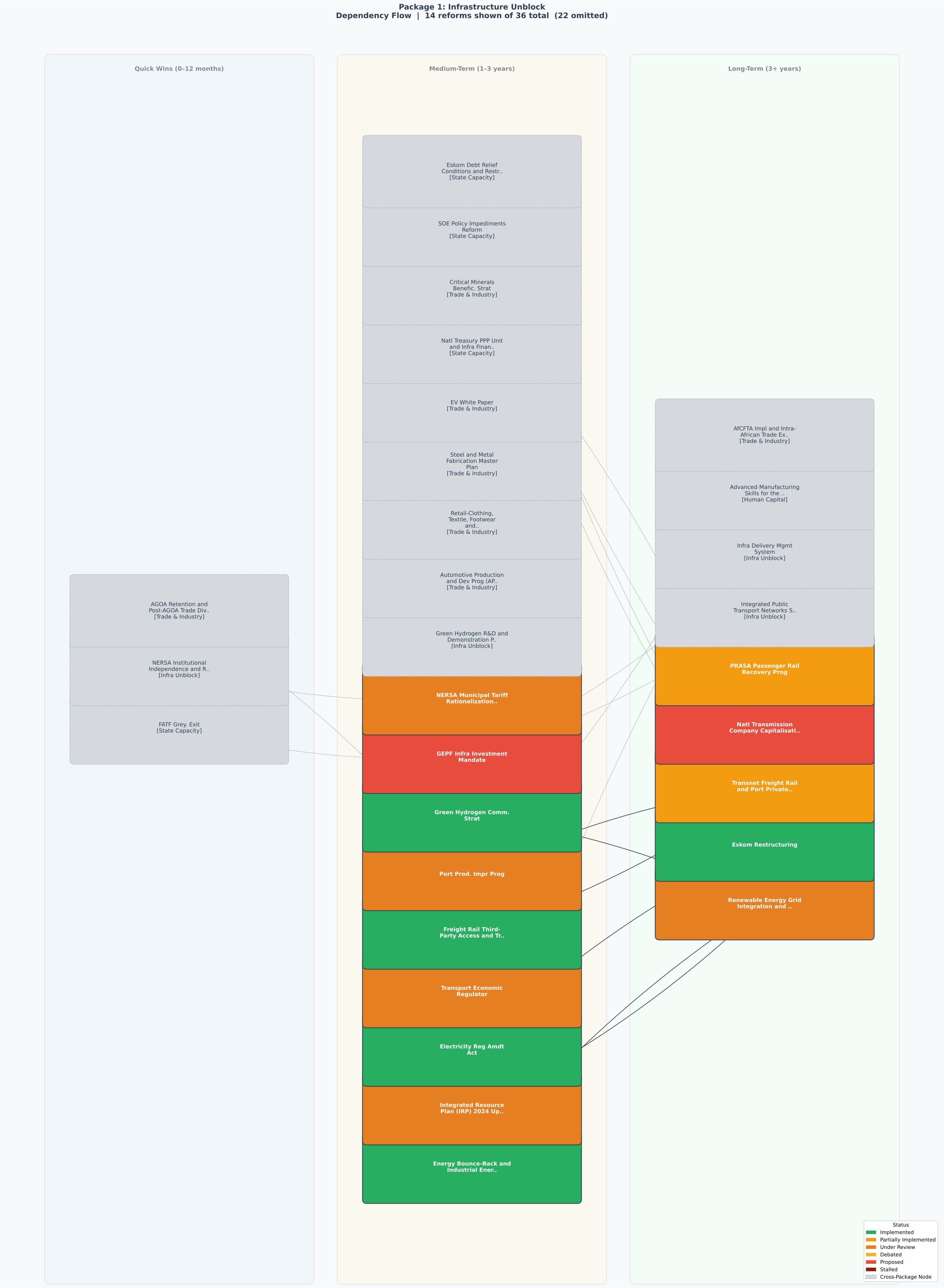
Reform Dependencies
Which reforms in this package enable or unlock others.
Green hydrogen commercialisation drives R&D programme
GEPF investment mandate finances integrated public transport
GEPF mandate funds infrastructure delivery management
IRP 2024 update mandates and directs grid integration
NERSA independence enables rational cost-reflective tariff reform
Competitive market enables industrial energy self-generation
Gas infrastructure advances integrated energy diversification plan
Expanded grid enables commercial green hydrogen production
Renewable supply enables energy bounce-back programme
Eskom unbundling enables competitive electricity market
Transnet reform enables port productivity improvement
NTC capitalisation funds national grid expansion
PRASA passenger rail recovery enables integrated public transport
Transport Economic Regulator provides framework for freight rail access
Freight rail third-party access reform enables Transnet PSP
IRP 2024 provides market mandate for competitive electricity market
IRP 2024 informs cost-reflective tariff structure design
IRP 2024 determines role of nuclear in the energy mix
IRP 2024 nuclear share decision triggers new build programme
NERSA independence is prerequisite for competitive electricity market credibility
Eskom unbundling creates the National Transmission Company as separate entity
Independent NTC enables functional competitive generation market
Nuclear regulator capacity enables Koeberg long-term extension oversight
Nuclear regulator capacity is prerequisite for new build programme safety oversight
Upstream petroleum development data informs Integrated Energy Plan gas strategy
Integrated Energy Plan drives gas infrastructure investment and import decisions
LNG backup energy supply enables reliable production for green hydrogen facilities
Solar water heater demand reduction creates headroom for industrial energy self-generation
Transport Economic Regulator provides oversight framework for Transnet PSP
EROT provides price regulation framework for port services
Railway safety regulator enforces PRASA safety standards for rolling stock
Railway safety regulator oversees third-party access safety compliance
Freight rail track separation enables dedicated port productivity corridors
Bulk water investment requires infrastructure procurement reform
Municipal utility reform depends on bulk water supply
JET-IP sequenced with Eskom unbundling
Carbon tax funds JET transition programmes
Green hydrogen requires green energy commercialisation
Climate adaptation requires resilient water infrastructure
Dependency Flow Diagram
See all packages →Visual map of how reforms in this package sequence and unlock each other.
Implementation Roadmap
Sequenced action plan from quick regulatory wins to structural reform, with key dependencies, success metrics, and risk factors.
Complete regulations establishing NERSA's operational independence and the governance framework for the competitive electricity market. ERA Amendment Act signed August 2024; implementing regulations required within 6 months.
Finalise and gazette the Integrated Resource Plan 2024, establishing the electricity capacity mix to 2030. Replaces the stalled IRP 2019 update and provides investor certainty for REIPPP procurement rounds.
Close Round 7 bid window and announce preferred bidders for 2,500MW of new renewable capacity. Operation Vulindlela priority deliverable for H1 2025.
Publish TNPA guidelines for private terminal operator concessions at Durban Container Terminal. First step in Transnet Port Terminals reform under Operation Vulindlela. Critical for reducing port dwell time from current 8 days.
Deploy SARS/ITAC integrated Single Window portal at all major ports of entry, eliminating parallel documentation processes. Operation Vulindlela customs reform milestone.
Complete assignment of high-demand spectrum licences (2.6GHz and 3.5GHz) to mobile network operators following the 2023 auction. Enables 5G rollout and broadband densification.
Complete the legal and operational unbundling of Eskom's transmission function into an independent National Transmission Company. Central to Operation Vulindlela's energy reform programme — enables open-access grid and third-party wheeling.
Implement NERSA-regulated Day-Ahead Market allowing multiple generators to compete for dispatch. Requires NTC operational independence and metering infrastructure. Key to attracting private investment in generation.
Complete competitive tender and award concession for DCT Pier 1 or Pier 2 to a private terminal operator. Target: reduce dwell time from 8 days to under 4 days within 18 months of concession start.
Publish and implement a Network Statement allowing third-party operators access to the Transnet freight rail network on commercial terms. Prerequisite for private rail investment on the iron ore and manganese corridors.
Establish and staff the NWRIA as a dedicated infrastructure delivery vehicle for bulk water schemes. Separates water resource infrastructure from DWS regulatory and operational functions.
Approve and begin procurement for the transmission grid expansion plan required to integrate planned REIPPP capacity. Current grid constraints are the binding limit on renewable energy integration.
Implement universal service broadband rollout using USAF funding and DCDT oversight. Target: 80% household internet access by 2027. Includes school and clinic connectivity as priority.
Enable competition at the retail level, allowing large industrial consumers and eventually households to choose their electricity supplier. Final stage of the Electricity Regulation Amendment Act implementation pathway.
Achieve world-class port productivity through private terminal concessions, digitalisation, and infrastructure investment. Full transformation requires 3–5 years of concession operation and capital expenditure.
Diversify South Africa's generation mix to 50% non-Eskom (private IPPs, municipalities, C&I) through REIPPP, self-generation, and embedded generation programmes. Eliminates structural load-shedding risk.
Reduce non-revenue water (current national average ~45%) by rehabilitating ageing municipal pipe networks. Requires MISA technical support, conditional grants, and DWS enforcement of Blue Drop standards.
Achieve seamless road-rail-port logistics for the busiest freight corridor in sub-Saharan Africa, reducing logistics costs by 20–25%. Requires integrated corridor governance and private rail operator entry.
Key Dependencies
Without an independent regulator, market rules lack credibility and private investors cannot price risk. NERSA independence is the legal foundation for all market reform.
Grid expansion requires capital spending Eskom cannot fund without balance sheet repair. Debt restructuring and R254bn government support package must be completed first.
Open-access wheeling and competitive dispatch require a neutral transmission company separated from Eskom generation interests.
Private terminal operators bring capital, technology, and productivity incentives that state-owned TNPA cannot replicate. Port reform is the precondition for export competitiveness.
Success Metrics
| Metric | Current | Target | By |
|---|---|---|---|
| Load-shedding days per year | 0 (achieved Q1 2024) | 0 days permanently | Sustained 2024–2026 |
| Durban port average dwell time | 8 days | 3 days | 2027 |
| New generation capacity added (MW) | ~1,500MW new since 2022 | 5,000MW by 2026 | 2026 |
| Household internet access | 60% | 80% | 2027 |
| Transnet freight rail volumes | 154Mt (FY2023) | 250Mt | 2028 |
Risk Factors
NUM and solidarity have historically opposed Eskom restructuring. NTC-SA formation could face industrial action or legal challenge, delaying grid independence.
Transmission grid capacity is the binding constraint on REIPPP generation — awarded projects cannot connect. If the 14,000km grid expansion programme is delayed, new generation becomes stranded.
IPP project finance is predominantly USD-denominated while revenue is ZAR. Rand depreciation raises tariffs and reduces investor returns, potentially stalling bid windows.
Transnet's R130bn debt and operational mismanagement constrain its capacity to invest in port and rail infrastructure even under reform. Concession processes require functional governance.
NERSA's history of politically influenced tariff decisions and capacity constraints could undermine market rule-setting even after formal independence.
Key Stakeholders
Major actors with a stake in this reform package, ranked by influence. Full stakeholder map →
Presidency / Operation Vulindlela
Influence
10/10
Cross-cutting structural reform coordination across energy, logistics, water, digital infrastructure, and visa reform. Operation Vulindlela,…
National Treasury
Influence
9/10
Fiscal consolidation with public debt stabilising below 75% of GDP; structural reforms that improve revenue without expanding contingent lia…
COSATU
Influence
9/10
Worker protections under the Labour Relations Act and Basic Conditions of Employment Act; collective bargaining rights; equitable wage growt…
Business Unity South Africa (BUSA)
Influence
8/10
Cross-sector structural reform across energy security, logistics efficiency, regulatory certainty, labour market flexibility, and digital in…
Eskom
Influence
8/10
Managing R400bn+ debt restructuring with government support; maintaining grid stability during the unbundling transition; preserving technic…
NERSA
Influence
7/10
Statutory mandate as National Energy Regulator: licensing, tariff regulation for electricity, gas, and petroleum pipelines; consumer price p…
Business Leadership South Africa (BLSA)
Influence
7/10
CEO-level advocacy for structural reform across energy, logistics, digital infrastructure, and investment climate. Runs the CEO Initiative o…
Minerals Council South Africa
Influence
7/10
Investment certainty and mineral rights security under the MPRDA; energy cost and reliability for deep mining operations (SA mines are among…
National Union of Mineworkers (NUM)
Influence
7/10
Mining employment security and worker safety; just transition pace that protects coal-dependent community livelihoods; collective bargaining…
NUMSA
Influence
7/10
Metalworker and Eskom employee livelihoods; opposition to the IPP model and Eskom unbundling; preserving state ownership of the electricity…
DMRE (Dept. of Mineral Resources & Energy)
Influence
6/10
Regulatory oversight of energy generation licensing and mineral rights under the ERA and MPRDA; managing the REIPPP procurement programme; c…
Renewable Energy IPP Developers
Influence
6/10
REIPPP Bid Window pipeline certainty; wheeling tariffs at cost-reflective transmission charges; grid access and connection timelines; bankab…
SAFTU
Influence
6/10
Anti-austerity fiscal policy; nationalisation of strategic sectors; worker and community ownership of public enterprises; opposing structura…
World Bank Group
Influence
6/10
Structural reform technical assistance and Development Policy Loan financing conditional on reform milestones; energy transition support thr…
Dept. of Public Enterprises (DPE)
Influence
5/10
SOE restructuring and shareholder oversight under the PFMA; balancing Eskom and Transnet restructuring with employment protection; implement…
PRASA
Influence
5/10
Commuter rail rehabilitation and rolling stock procurement; urban mobility for low-income commuters; PRASA Modernisation Programme recovery;…
OUTA
Influence
5/10
Fiscal accountability and value for money in public spending; SOE governance and transparency; infrastructure pricing fairness; opposing was…
IMF
Influence
5/10
Fiscal sustainability with public debt stabilising below 80% of GDP; current account stability; SOE contingent liability management; labour…
European Union / JETP Partners
Influence
5/10
Just Energy Transition Partnership — €8.5bn committed for SA's coal transition; renewable energy scale-up and coal community support; Carbon…
Equal Education
Influence
4/10
School infrastructure quality and safety; electrification of schools in underserved areas; broadband connectivity in education; equitable re…
African Development Bank
Influence
4/10
Infrastructure financing for energy, transport, and water with a regional integration lens; REIPPP co-financing; logistics corridor investme…
Portfolio Committee on Energy (Parliament)
Influence
4/10
Legislative oversight of NERSA, DMRE, and Eskom under Parliament's constitutional mandate; scrutiny of REIPPP procurement and tariff approva…
How to cite
Wilse-Samson, L. (n.d.). Infrastructure Unblock. SA Policy Space. https://sa-policy-space.vercel.app/packages/1 Live page. Data version: 2026-10-12.218dea82; data as of: 2026-10-12.
Data as of 2026-10-12 · latest PMG meeting 2026-10-09